Home › Kanakadhāra Stotram › Verse 9
The verse
॥ श्लोक ९ ॥
इष्टा विशिष्टमतयोऽपि यया दयार्द्र-
दृष्ट्या त्रिविष्टपपदं सुलभं लभन्ते।
दृष्टिः प्रहृष्टकमलोदरदीप्तिरिष्टां
पुष्टिं कृषीष्ट मम पुष्करविष्टरायाः॥
॥ श्री महालक्ष्म्यै नमः ॥
Iṣṭā viśiṣṭa-matayo 'pi yayā dayārdra-
dṛṣṭyā triviṣṭapa-padaṁ sulabhaṁ labhante;
Dṛṣṭiḥ prahṛṣṭa-kamalodara-dīptir iṣṭāṁ
puṣṭiṁ kṛṣīṣṭa mama puṣkara-viṣṭarāyāḥ.
Meaning in short
Even people who are cherished and of distinguished understanding gain the station of heaven easily by her glance, moist with compassion. May that glance of the lotus-seated Goddess, bright as the interior of a fully open lotus, bring about for me the nourishment I desire.
A glance moist with compassion and bright as an open lotus: even the wise reach heaven by it. May it nourish me.
Key highlights
- Dayārdra Compassion: a glance moist with compassion
- Viśiṣṭa Wisdom: even the wise reach heaven by her glance
- Kamalodara Lotus: bright as the heart of an open lotus
- Puṣṭi Thriving: the prayer for nourishment
Explore the four images
Tap a card to open its meaning and a question to carry with you.
DayārdraCompassion
Dayā-ārdra-dṛṣṭi, the glance moist with compassion. Ārdra means moist, like soil after rain or eyes that have filled. The idea of Verse 8’s cloud returns here in a smaller, quieter form.
Pause and reflect: Where can I look at someone with compassion rather than judgement?
ViśiṣṭaWisdom
The first half says that even people of distinguished understanding, viśiṣṭa-matayaḥ, reach heaven easily by her glance. Learning is not dismissed, but grace makes the way easy.
Pause and reflect: Do I rely on skill alone, or also ask for grace?
KamalodaraLotus
Prahṛṣṭa-kamala-udara-dīptiḥ: the glow of the inside of a fully opened lotus. The flower has opened completely, with nothing held back. The glance is as open and radiant as that.
Pause and reflect: What would it look like to open up fully to something good?
PuṣṭiThriving
Puṣṭi is nourishment and thriving: strength of body, clarity of mind, steadiness in the family. It is a wider word than wealth. Verse 8 asked from need; this verse asks from hope.
Pause and reflect: What would help me thrive, in more than money?
Sketch note
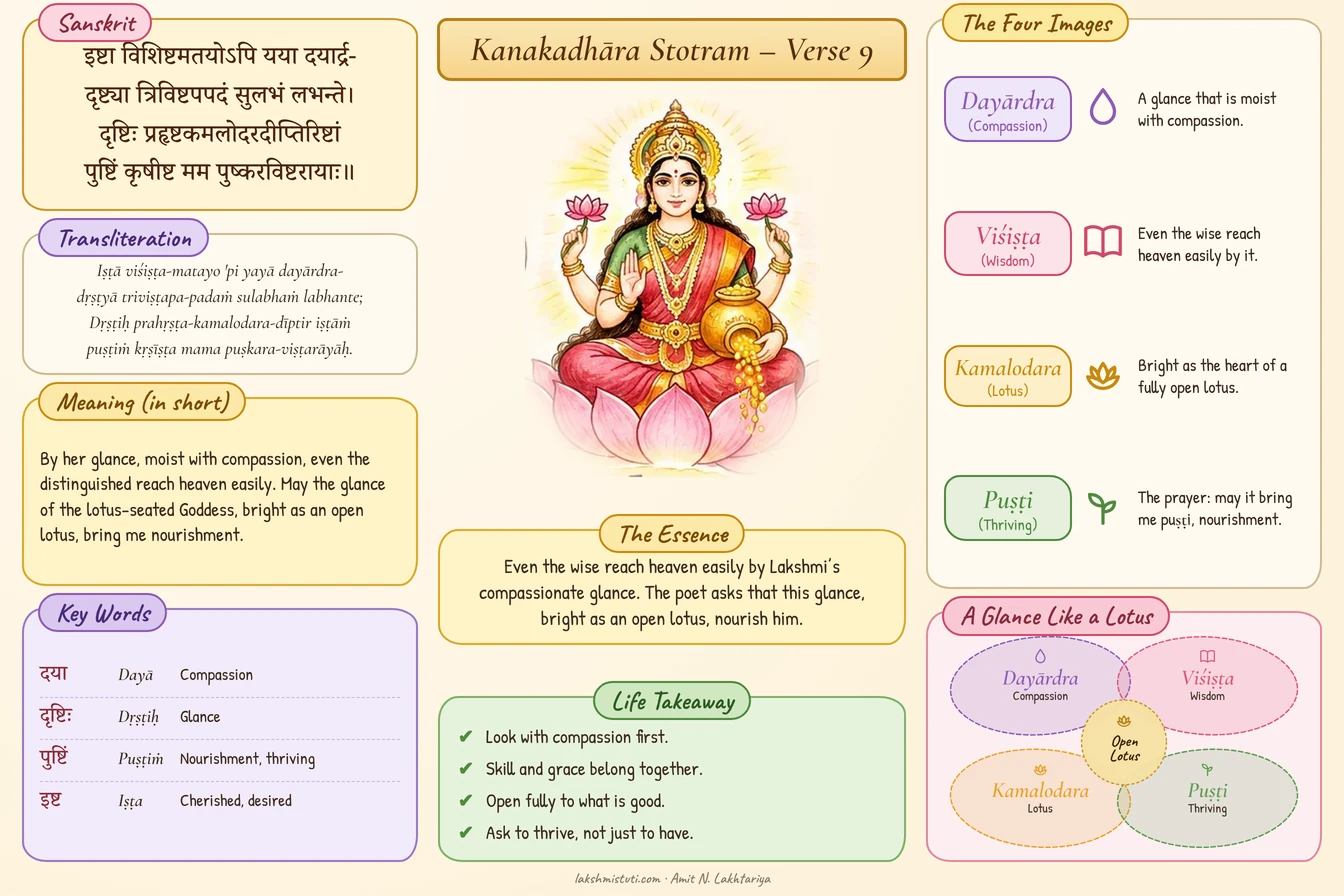
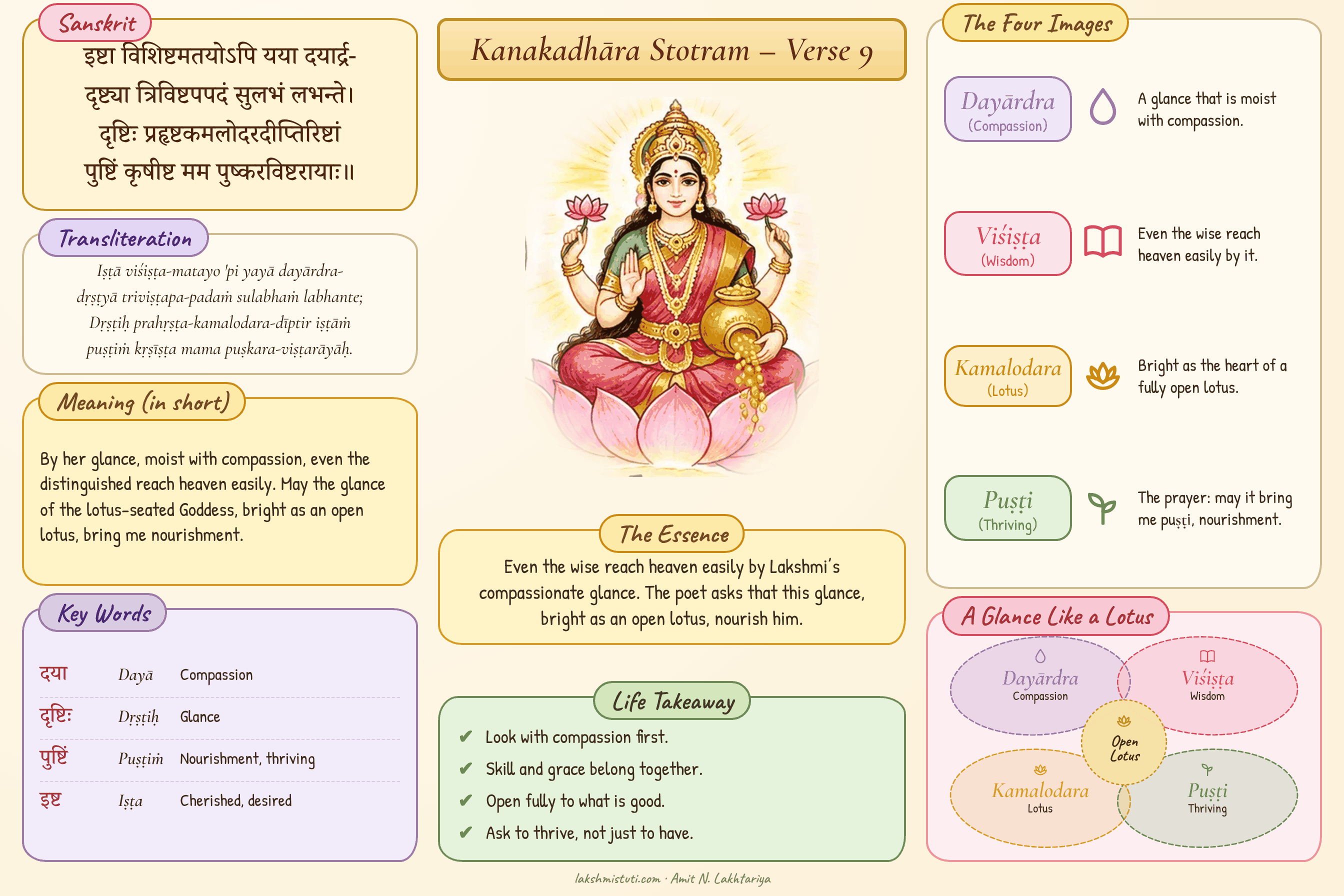
A one-page summary of the verse: Sanskrit, meaning, key ideas, key words and a takeaway. On a phone, open it full screen.
Word-by-word meaning
The literal meaning of each word.
| Sanskrit | Meaning |
|---|---|
| इष्टाःIṣṭāḥ | The cherished ones; the devoted |
| विशिष्टमतयःViśiṣṭa-matayaḥ | Those of distinguished understanding |
| अपिApi | Even; also |
| ययाYayā | By which |
| दयार्द्रदृष्ट्याDayārdra-dṛṣṭyā | By the glance moist with compassion |
| त्रिविष्टपपदम्Triviṣṭapa-padam | The station of heaven |
| सुलभम्Sulabham | Easily |
| लभन्तेLabhante | They obtain |
| दृष्टिःDṛṣṭiḥ | The glance |
| प्रहृष्टकमलोदरदीप्तिःPrahṛṣṭa-kamala-udara-dīptiḥ | With the radiance of the interior of a fully open lotus |
| इष्टाम्Iṣṭām | The desired |
| पुष्टिम्Puṣṭim | Nourishment, thriving |
| कृषीष्टKṛṣīṣṭa | May it bring about |
| ममMama | For me; my |
| पुष्करविष्टरायाःPuṣkara-viṣṭarāyāḥ | Of her whose seat is a lotus |
Notes on each word
Iṣṭa means desired, dear, cherished; it is also used for what is honoured by worship. Here it describes the people who are meant: those dear to her, or devoted to her. Readers differ on the exact shade. In the verse it appears as iṣṭā, because the final visarga falls away before the next word.
Viśiṣṭa is distinguished, excellent, set apart; mati is mind, understanding, intelligence. So these are people of fine understanding. Note the beginning of the word: it is viśiṣṭa, not aviśiṣṭa. Run together with the next word it becomes matayo ’pi.
A small word that adds “even, too”. Here it is joined to the previous word as -yo ’pi, where the apostrophe marks a vowel that has merged.
A feminine “by which”, agreeing with dṛṣṭyā (glance): by which glance.
Dayā is compassion; ārdra is moist, tender, softened; dṛṣṭi is a look or glance. The picture is of a look so full of compassion that it is wet with it. The ending means “by”: it is by this glance that the next thing happens.
Triviṣṭapa is heaven, the celestial world. Pada is a place, a station, a standing. The traditional meaning is the heavenly state or world.
Su- is good or well; labha is getting. So sulabha is easy to obtain, easily had. Here it is used as an adverb: they get it with ease.
From labh, to obtain. The plural subject is the devoted and the wise named at the start of the verse.
The subject of the second half. From dṛś, to see. This is the same glance that the first half has described.
Prahṛṣṭa is thrilled, delighted; for a flower, it suggests fully open, as if bristling with joy. Kamala is lotus. Udara is the inside, the middle, the body of something; for a lotus, its centre. Dīpti is brightness, shining. The glance has the glow of the heart of an open lotus. The words join as kamalodara.
The same word iṣṭa as at the start of the verse, now in the singular, describing puṣṭi: the nourishment that is wished for.
Puṣṭi is nourishment, fullness, growth, flourishing; it is the word for becoming well-fed and well-grown, in body, family and life. See Śrī Sūktam Verse 13, where the same word appears.
A form of kṛ, to do or make, used for a blessing or wish: “may it make, may it bring about”. It is the verb of the second half.
“Of me, mine”. It tells us who the prayer is for.
Puṣkara is a lotus; viṣṭara is a seat. So she is the one who sits on a lotus: Lakshmi. The ending means “of”: the glance belongs to her.
Deeper spiritual insights
Interpretation and reflection: ideas that help us read the verse, not part of the text itself.
Before we begin
We now move to Verse 9 of the Kanakadhāra Stotram. This verse returns to the central prayer: may the compassionate glance of Goddess Lakshmi bring not merely wealth, but nourishment, growth and flourishing into my life.
Its theme is the glance that makes the impossible attainable.
“O Mother Lakshmi! Your compassion is so immense that even the wise and the devoted gain the station of heaven with ease through your glance. May your beautiful, compassionate eyes, radiant like the heart of a blooming lotus, bless me with growth, nourishment, prosperity and well-being.”
1Two important compounds
| Compound | Meaning |
|---|---|
| Dayārdra-dṛṣṭi (दयार्द्र-दृष्टि) | Dayā means compassion, and ārdra means moist or tender. Together, it describes a glance softened and filled with compassion. |
| Prahṛṣṭa-kamala-udara-dīptiḥ (प्रहृष्ट-कमल-उदर-दीप्तिः) | The radiance of the inner heart of a joyful, fully blossomed lotus. Śaṅkarācārya is describing the beautiful brilliance of Lakshmi’s eyes. |
2The literal meaning
Even those of distinguished understanding, the devoted and the wise, easily attain the position of heaven through her compassionate glance. May the radiant glance of the Goddess seated upon the lotus, shining like the heart of a fully blossomed lotus, bring me the nourishment and prosperity I desire.
A note on the reading
The line is iṣṭā viśiṣṭa-matayo ’pi: iṣṭā, the cherished or devoted, and viśiṣṭa-matayaḥ, those of distinguished understanding. Some summaries split the words differently, as iṣṭa and aviśiṣṭa-matayaḥ, “those whose understanding or merit is not particularly distinguished”, and so take the verse to be about ordinary people being lifted. Standard editions have viśiṣṭa, and so does this page, so the literal meaning above follows it.
Both readings can inspire a reflection. As a reflection, not a statement of the verse: if even people of fine understanding find the way easy only through her glance, then grace is not something we must first become perfect to deserve.
3The poetry hidden in the verse
Imagine a lotus pond at sunrise.
The night has passed. The first rays of sunlight touch the water. A lotus slowly opens its petals, revealing its delicate, luminous inner heart. There is a quiet beauty in that moment.
Now imagine Goddess Lakshmi seated upon that lotus. Her eyes carry the same gentle radiance as the heart of the blossoming flower.
And Śaṅkarācārya says something extraordinary: her glance can lift someone to the highest heavenly position.
Notice the contrast:
- The lotus is delicate, yet it is radiant.
- Her glance is gentle, yet its influence is immense.
- Her compassion is quiet, yet it can transform someone’s destiny.
Śaṅkarācārya does not describe Lakshmi’s power through weapons, thunder or command. He describes it through her eyes. That is the beauty of this verse: the greatest power is expressed through the gentlest gesture.
4Deeper spiritual insights: reflections inspired by the verse, rather than additional literal meanings
A. Grace is not earned by achievement alone
The verse places even people of distinguished understanding under her compassionate glance: ability and learning do not stand outside her grace, and grace is not something we earn by achievement alone.
We often believe that we must first become perfect to deserve blessings. This verse invites us to reconsider that assumption.
B. Prosperity is more than money
The word puṣṭi (पुष्टि) is especially important. It means nourishment, strengthening, growth and flourishing.
So the prayer is not merely for wealth. It can encompass:
- Strength in the body.
- Clarity in the mind.
- Stability in the family.
- Growth in one’s work.
- Contentment in the heart.
- Strengthening of one’s spiritual life.
Money may be one expression of prosperity, but it is not the whole meaning of puṣṭi.
C. Heaven begins with a change in consciousness
The verse speaks of Triviṣṭapa, the heavenly realm. Traditionally, this means heaven or the celestial world.
As a spiritual reflection, we can also see it as a reminder that grace can elevate the quality of our lives and consciousness.
It is not a guarantee that every worldly desire will be fulfilled. It is a prayer for a life that becomes more wholesome and elevated.
5Reflection for today
There is a subtle lesson here.
We spend much of our lives trying to become exceptional: more successful, more knowledgeable, more powerful and more accomplished. But this verse reminds us that being deserving of compassion is not the same as being exceptional in achievement.
Work hard. Develop your abilities. Fulfil your responsibilities. But never allow achievement to become the condition for kindness, either towards yourself or towards others.
Three Sanskrit treasures to remember
- Dayārdra (दयार्द्र) – compassion-filled, softened by kindness: a beautiful word for a heart that remains tender
- Puṣṭiḥ (पुष्टिः) – nourishment, strengthening, flourishing: prosperity in its broader and deeper sense
- Sulabham (सुलभम्) – easily attainable or accessible: something that becomes accessible without extraordinary difficulty
6The essence of the verse
The eighth verse presented Śaṅkarācārya as a helpless little bird waiting for the rain of compassion. The ninth verse takes that prayer further.
It tells us that the compassionate glance of the Divine can lift a person to heights that effort alone does not reach. And Śaṅkarācārya asks not merely for gold, but for puṣṭi, a life that is nourished, strengthened and flourishing.
A thought to carry forward: may prosperity enter my home, but may compassion enter my heart. May my wealth grow, but may my wisdom grow with it.
A question to carry into Verse 10
A glimpse of Verse 10: it takes a beautiful turn. Instead of describing Lakshmi’s eyes, it celebrates her many divine identities and forms: as Goddess of Speech, as Śākambharī, as the beloved of Shiva, and as the power behind creation, preservation and dissolution.
We move from contemplating her compassionate glance to contemplating her universal nature.
Practical meditation
- Minute 1SettleSit comfortably. Close your eyes. Take a few gentle breaths. Imagine a beautiful lotus resting on still water.
- Minute 2VisualiseImagine Goddess Lakshmi seated upon that lotus. Visualise a gentle, luminous radiance around her eyes.
- Minute 3ContemplateRepeat silently dayārdra dṛṣṭi, a glance filled with compassion. Think of the people, responsibilities and situations in your life that need compassion.
- Minute 4ReflectAsk yourself, “Am I creating nourishment and growth in the lives of people around me? Am I pursuing wealth while also nurturing wisdom, relationships and peace?”
- Minute 5PrayClose with this simple prayer. हे माँ लक्ष्मी, मेरे जीवन में केवल धन नहीं, बल्कि सद्बुद्धि, स्वास्थ्य, शान्ति और समृद्धि भी प्रदान करें। “O Mother Lakshmi, may my life flourish in every meaningful way.”
May prosperity enter my home, but may compassion enter my heart; may my wealth grow, but may my wisdom grow with it.
This meditation is a devotional practice for attention and reflection; it does not promise a supernatural result or guarantee material wealth.