Home › Kanakadhāra Stotram › Verse 10
The verse
॥ श्लोक १० ॥
गीर्देवतेति गरुडध्वजसुन्दरीति
शाकम्भरीति शशिशेखरवल्लभेति।
सृष्टिस्थितिप्रलयकेलिषु संस्थितायै
तस्यै नमस्त्रिभुवनैकगुरोस्तरुण्यै॥
॥ श्री महालक्ष्म्यै नमः ॥
Gīrdevateti garuḍadhvaja-sundarīti
Śākambharīti śaśiśekhara-vallabheti;
Sṛṣṭi-sthiti-pralaya-keliṣu saṁsthitāyai
Tasyai namas tribhuvanaika-guros taruṇyai.
Meaning in short
Salutations to her who is called the goddess of speech, the beautiful beloved of him whose banner bears Garuḍa, Śākambharī, and the beloved of the moon-crested one; who abides in the play of creation, preservation and dissolution; to that youthful wife of the one teacher of the three worlds.
Four names, one Goddess, present in the play of creation, preservation and dissolution. The hymn turns from asking to bowing.
Key highlights
- Gīrdevatā Speech: the goddess of speech, taken as Sarasvatī
- Sundarī Lakshmi: the beloved of Vishnu, Garuḍa’s banner
- Śākambharī Nourisher: she who feeds the world
- Vallabhā Pārvatī: beloved of the moon-crested Shiva
Explore the four names
Tap a card to open its meaning and a question to carry with you.
GīrdevatāSpeech
Gīrdevatā is the goddess of speech, usually taken as Sarasvatī. Each name ends with iti, “thus”, like a quotation mark: she who is called this. Traditional readers take these as names of the one Goddess.
Pause and reflect: How do I use the gift of speech today?
SundarīLakshmi
Garuḍadhvaja-sundarī is Vishnu’s beloved, Lakshmi. This site follows the traditional reading that the hymn is addressed to Lakshmi throughout, who also bears these other names.
Pause and reflect: What do I value most in the name Lakshmi: beauty, grace or care?
ŚākambharīNourisher
Śākambharī is the form remembered in the Devī Māhātmya for sustaining the world with greens in a time of drought. After asking for puṣṭi in Verse 9, Śaṅkarācārya names the Goddess who feeds the world.
Pause and reflect: Who feeds me, and whom do I feed?
VallabhāPārvatī
Śaśiśekhara-vallabhā is the beloved of Shiva, the one who wears the moon, usually taken as Pārvatī. The Goddess is bowed to as the ever-young wife of the one teacher of the three worlds.
Pause and reflect: What does it mean to see many names as one presence?
Sketch note
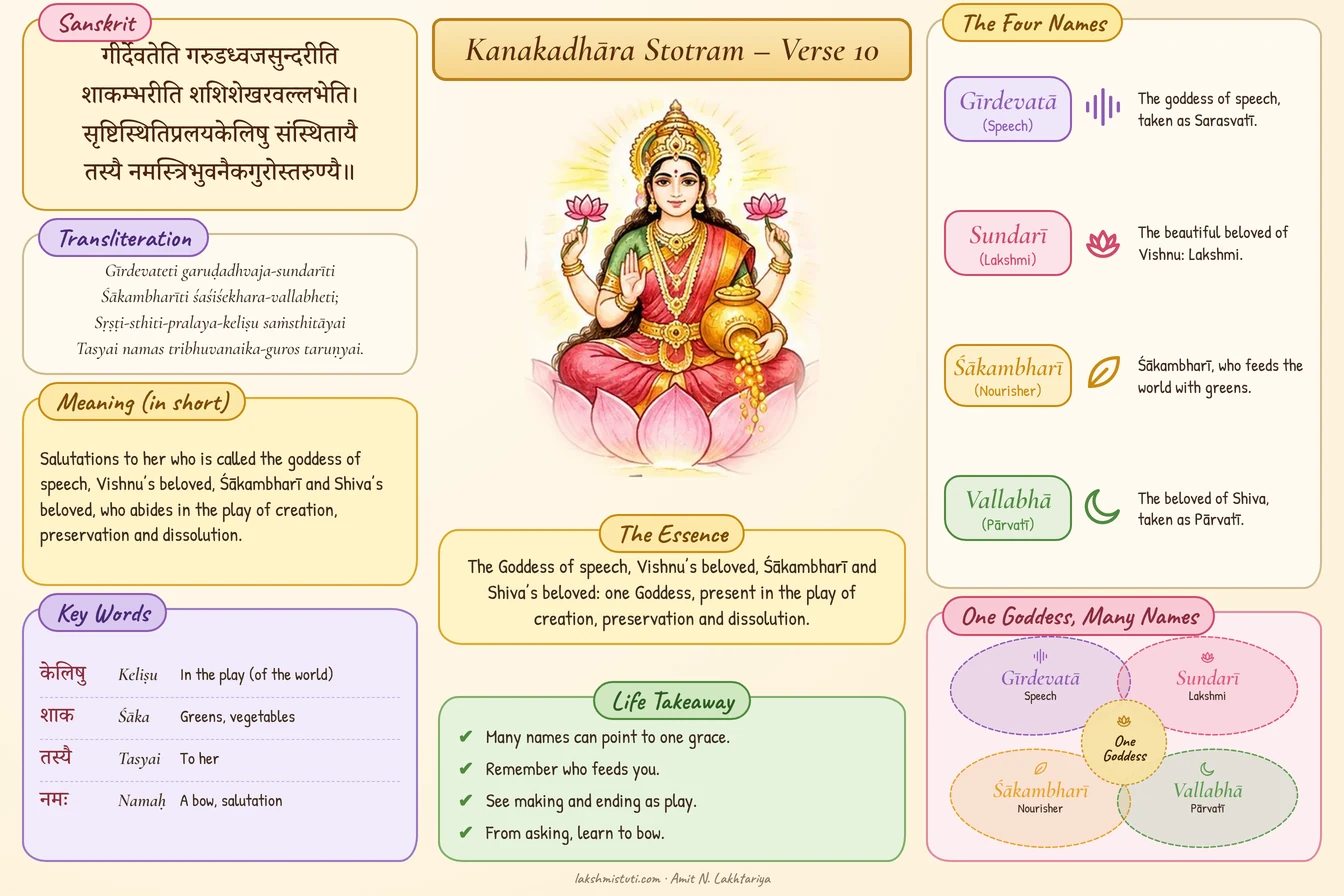
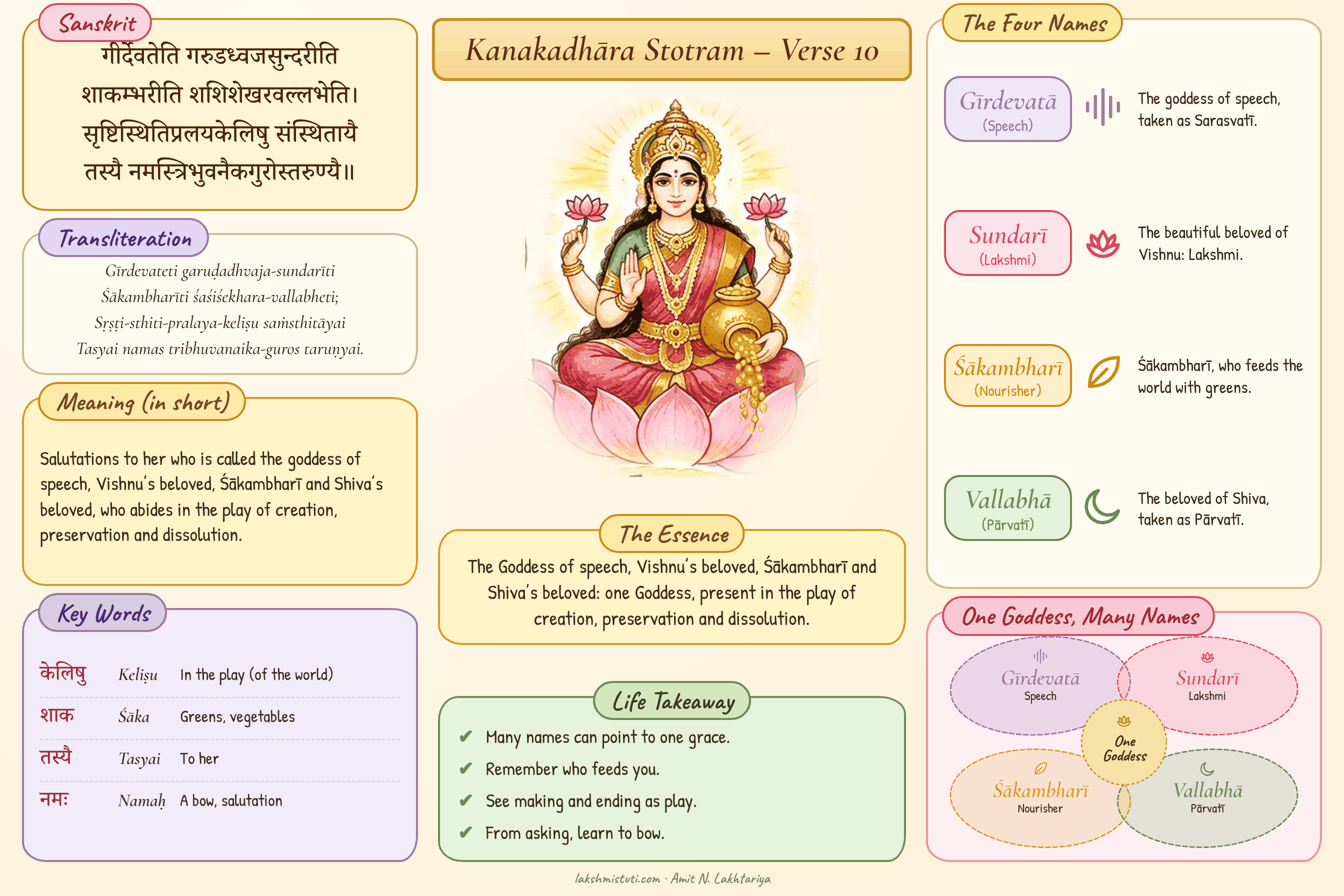
A one-page summary of the verse: Sanskrit, meaning, key ideas, key words and a takeaway. On a phone, open it full screen.
Word-by-word meaning
The literal meaning of each word.
| Sanskrit | Meaning |
|---|---|
| गीर्देवता इतिGīr-devatā iti | “The goddess of speech”, thus called |
| गरुडध्वजसुन्दरी इतिGaruḍadhvaja-sundarī iti | “The beautiful one of Garuḍa’s banner”, thus called |
| शाकम्भरी इतिŚākambharī iti | “She who bears vegetables”, thus called |
| शशिशेखरवल्लभा इतिŚaśiśekhara-vallabhā iti | “The beloved of the moon-crested one”, thus called |
| सृष्टिस्थितिप्रलयकेलिषुSṛṣṭi-sthiti-pralaya-keliṣu | In the play of creation, preservation and dissolution |
| संस्थितायैSaṁsthitāyai | To her who abides |
| तस्यैTasyai | To her |
| नमःNamaḥ | A bow, salutation |
| त्रिभुवनैकगुरोःTribhuvana-eka-guroḥ | Of the one teacher of the three worlds |
| तरुण्यैTaruṇyai | To the young woman, the young wife |
Notes on each word
Gīr is speech, voice, the spoken word; devatā is a deity. Tradition understands her as Sarasvatī. Iti means “thus”; it closes a name, as quotation marks do in English. Because ā and i meet, the two words are written together as gīrdevateti.
Garuḍa is the eagle, the mount of Vishnu; dhvaja is a banner, so garuḍadhvaja is the one whose banner bears Garuḍa: Vishnu. Sundarī is a beautiful woman. So she is Vishnu’s beautiful beloved: Lakshmi herself. The words join as sundarīti.
Śāka is vegetable, leafy food; bharī is a bearer or supporter (from bhṛ, to carry, to sustain). So śākambharī is the one who sustains life with greens and plants. It is also the name of a form of the Goddess who is remembered for feeding the world (see below). The words join as śākambharīti.
Śaśin is the moon (“the one with the hare mark”); śekhara is a crest or crown; śaśiśekhara is the one who wears the moon as a crest: Shiva. Vallabhā is a beloved, a wife. The words join as vallabheti, where ā and i become e.
Sṛṣṭi is creation, letting go forth; sthiti is standing, staying, preservation; pralaya is dissolution, the melting away of the world at the end of a cycle. Keli is play, sport. The ending means “in”. The three great acts are called play: done freely and without strain.
From sam (together, fully) and sthā (to stand): firmly established, present. The ending means “to”: this is the one being saluted.
“To that one”. It gathers all the names and descriptions above into one person.
Before the next word it is written namas. The same word that ends many Sanskrit prayers: “bowing”.
Tri is three; bhuvana is a world; eka is one, sole; guru is a teacher, one who is weighty with knowledge. The three worlds are heaven, earth and the lower realm. Traditionally the one teacher or lord of the three worlds is Nārāyaṇa. A and e join as ai, giving -bhuvanaika-. The ending means “of”, and the final ḥ becomes s before t: guros taruṇyai.
Taruṇī is a young woman, in the full bloom of youth. The ending means “to”. She is the youthful consort of the guru of the three worlds.
Deeper spiritual insights
Interpretation and reflection: ideas that help us read the verse, not part of the text itself.
Before we begin
In the earlier verses, we saw Lakshmi’s compassionate eyes, her loving glances and her power to bestow prosperity.
Now Śaṅkarācārya reveals something much larger. In this verse he calls the Divine Mother by four different names, and then places her in the whole cycle of creation, preservation and dissolution.
“Salutations to her who is known as the Goddess of Speech, the beautiful beloved of Vishnu, Śākambharī, and the beloved of Shiva. She is present in the divine activities of creation, preservation and dissolution. Salutations to that youthful Goddess, the consort of the one supreme teacher of the three worlds.”
1In simple English
O Divine Mother! You are worshipped by many names and in many forms.
You are the power of speech and wisdom. You are the beloved of Vishnu. You nourish the world as Śākambharī. You are also the beloved of Shiva.
You are present throughout the cosmic cycle, when the universe is created, sustained and dissolved.
I bow to you, the eternal Divine Feminine.
2A few names deserve special attention
First – Gīrdevatā: the Goddess of speech
Gīḥ refers to speech, including sacred expression and the power of language.
Second – Garuḍadhvaja-sundarī: the beloved of Vishnu
The beautiful beloved of Vishnu, the Lord whose banner bears Garuḍa.
Third – Śākambharī: the nourishing Mother
A nourishing form of the Divine Mother associated with vegetables, herbs and vegetation.
Fourth – Śaśiśekhara-vallabhā: the beloved of Shiva
The beloved of Shiva, who wears the crescent moon on his head.
3The poetry hidden in the verse
Imagine a devotee standing before a great temple.
At first, the devotee sees different forms:
- A Goddess holding a vīṇā, representing speech, music and knowledge.
- A Goddess beside Vishnu, representing beauty, prosperity and preservation.
- A Mother surrounded by fruits, vegetables and greenery, feeding the world.
- A Goddess beside Shiva, representing the power that accompanies transformation and dissolution.
Different names. Different appearances. Different divine relationships.
But Śaṅkarācārya is inviting us to look beyond the forms. He is saying: the divine power that nourishes, creates, sustains and transforms the universe is one.
This is the beauty of the verse. It moves from the personal, the beloved of Vishnu, to the universal, the power present throughout cosmic existence.
4Deeper spiritual insights
A. The Divine Feminine is not confined to one form
The verse connects the Goddess with several important divine identities. The names evoke different dimensions of the sacred feminine:
- Speech and knowledge.
- Beauty and prosperity.
- Food and nourishment.
- Divine partnership and cosmic power.
A traditional Hindu theological reading can understand these as different manifestations of one divine reality.
B. Śākambharī – the Mother who feeds the world
This is particularly beautiful. The word Śākambharī is traditionally associated with the Goddess who sustains life through vegetation.
Think about the significance: we may worship wealth in gold and jewels, but our most fundamental prosperity begins with food. A plate of wholesome food, fertile soil, clean water and a healthy harvest are also expressions of abundance.
There is a profound message here: the Goddess of wealth is also the Goddess of nourishment.
C. Creation, preservation and dissolution are all sacred
The verse uses three important words:
- Sṛṣṭi: creation
- Sthiti: preservation
- Pralaya: dissolution
We often welcome creation and preservation, but fear dissolution. Yet dissolution is also part of the cosmic order. Old forms must sometimes end for new possibilities to emerge.
As a philosophical reflection, this can also apply to our lives: beginning, sustaining and letting go are all necessary parts of growth.
D. The word Taruṇī – the youthful Goddess
Śaṅkarācārya calls her Taruṇī, the youthful one. This is a poetic expression of freshness, vitality and ever-renewing divine energy. It does not mean that the eternal Goddess is limited by physical age.
The universe may pass through endless cycles, but its creative energy is ever fresh.
5Reflection for today
We often divide life into separate compartments:
- Knowledge belongs to education.
- Wealth belongs to business.
- Food belongs to agriculture.
- Spirituality belongs to religion.
But this verse offers a more integrated vision. All these dimensions are interconnected. A successful life requires knowledge, resources, nourishment, relationships and the ability to transform.
The lesson is simple: do not worship prosperity while forgetting the forces that sustain it. Be grateful for knowledge, respect the source of food, use wealth responsibly and accept that change is part of life.
Three Sanskrit treasures to remember
- Śākambharī – the nourishing Mother; the Goddess associated with vegetation and food. A reminder that nourishment is one of life’s greatest forms of wealth
- Pralaya – dissolution, the ending of a cosmic cycle. An ending is not necessarily destruction without purpose; it can make way for renewal
- Sthiti – continuity, preservation and sustaining order. The ability to maintain and nurture what has been created
6Essence of the verse
She is not merely the Goddess who gives wealth. She is the power behind knowledge, nourishment, beauty, preservation and transformation.
One Mother. Many manifestations. One universal energy.
A question to carry into Verse 11
A glimpse of Verse 11: the next verse begins with a beautiful sequence of salutations: śrutyai namo ’stu… ratyai namo ’stu… śaktyai namo ’stu… puṣṭyai namo ’stu…
Śaṅkarācārya salutes the Goddess as sacred wisdom, divine love, cosmic power and nourishment. It is almost like a garland of four divine attributes.
Practical meditation
- Theme: one Divine Mother, many forms. Minute 1, speech: think of the Goddess as the power of speech. Resolve to use your words thoughtfully, truthfully and kindly.
- Minute 2ProsperityVisualize Lakshmi and reflect on the resources and opportunities already present in your life.
- Minute 3NourishmentImagine a green field, ripened crops, fruits and vegetables. Offer gratitude for the food that sustains you.
- Minute 4TransformationThink of something in your life that needs to end, perhaps an old habit, unnecessary worry or limiting belief. Allow yourself to release it.
- Minute 5UnityRepeat slowly, Ekaiva Śaktiḥ Bahurūpā: one divine power, appearing in many forms. This is a meditation phrase for reflection, not a quotation from the verse.
The hands that bless us with prosperity are also the hands that nourish the earth and sustain creation.
This meditation is a devotional practice for attention and reflection; it does not promise a supernatural result or guarantee material wealth.