Home › Kanakadhāra Stotram › Verse 17
The verse
॥ श्लोक १७ ॥
यत्कटाक्षसमुपासनाविधिः सेवकस्य सकलार्थसम्पदः।
सन्तनोति वचनाङ्गमानसैः त्वां मुरारिहृदयेश्वरीं भजे॥
॥ श्री महालक्ष्म्यै नमः ॥
Yat-kaṭākṣa-samupāsanā-vidhiḥ sevakasya sakalārtha-sampadaḥ,
Santanoti vacanāṅga-mānasaiḥ tvāṁ murāri-hṛdayeśvarīṁ bhaje.
Meaning in short
The practice of worshipping whose sidelong glance spreads every kind of aim and prosperity for her servant: you, the queen of Murāri’s heart, I worship, with speech, body and mind.
The worship of her glance spreads every aim and prosperity, and Śaṅkarācārya vows to worship her wholly.
Key highlights
- Kaṭākṣa Glance: her sidelong look, which is worshipped
- Sampad Prosperity: every kind of aim and riches
- Vacana Speech: with speech, body and mind together
- Hṛdayeśvarī Queen: of the heart of Murāri
Explore the four ideas
Tap a card to open its meaning and a question to carry with you.
KaṭākṣaGlance
Kaṭākṣa is the sidelong glance, the same picture as apāṅga in Verse 1. Here it is not only admired but worshipped. A reflection: what you worship is what you give attention to, and attention is where this verse starts.
Pause and reflect: What do I give my attention to?
SampadProsperity
Sampad is prosperity and sakalārtha means every kind of aim, so the word is wider than money. The text names no particular reward, and this page promises none. A reflection: ask what the aims really are.
Pause and reflect: Which of my aims would I still want if no one saw them?
VacanaSpeech
Vacana, aṅga and mānasa are speech, body and mind, the three ways in which a person acts. To worship with all three is to let words, deeds and thoughts point the same way. A reflection: a prayer in words alone leaves two out.
Pause and reflect: Do my words, deeds and thoughts agree today?
HṛdayeśvarīQueen
Murāri-hṛdayeśvarī names her as the queen of Vishnu’s heart. A reflection: the title suggests why the worship is worth giving, since she holds the heart of the one who sustains the worlds.
Pause and reflect: Whose heart do I hold, and whose holds mine?
Sketch note
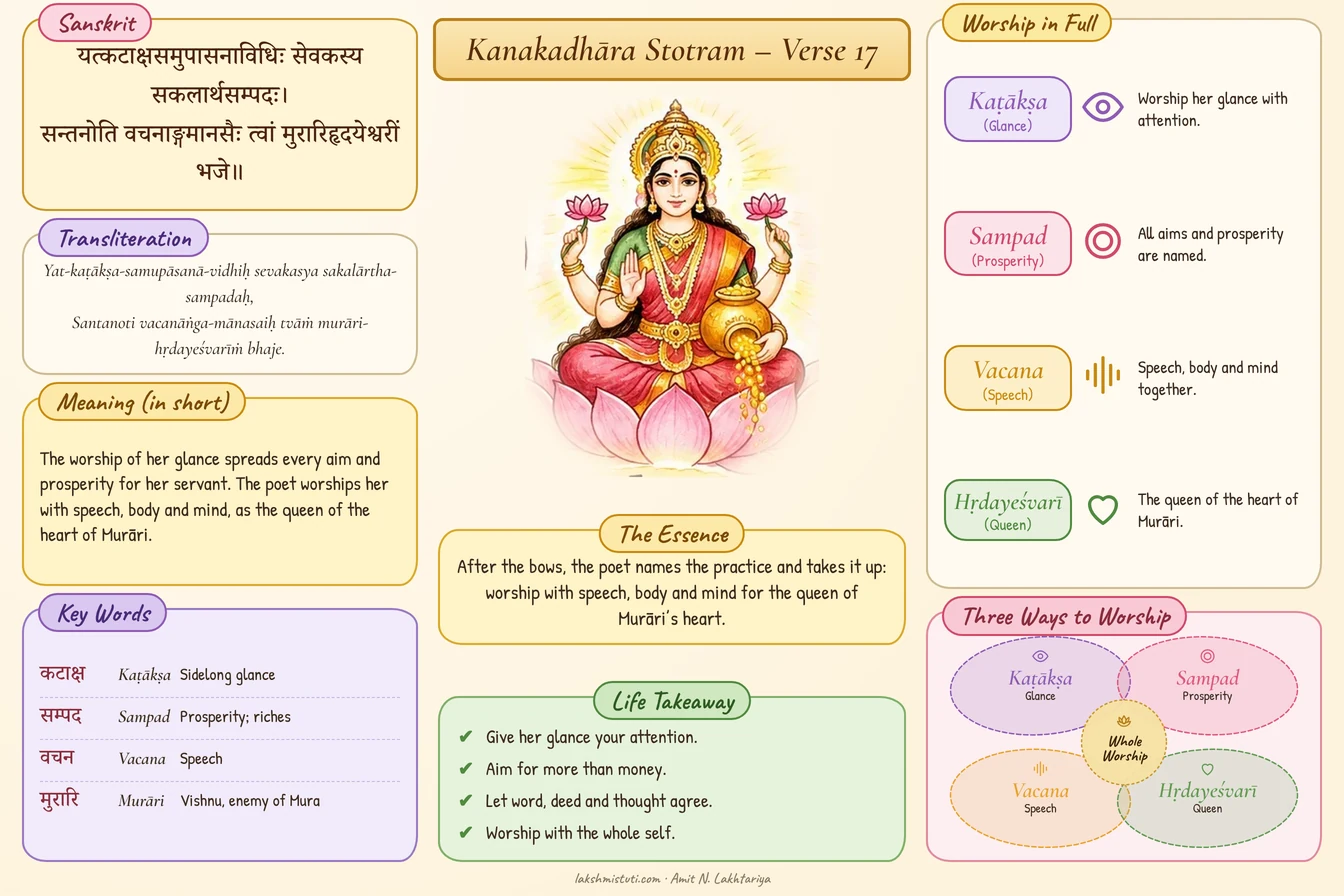
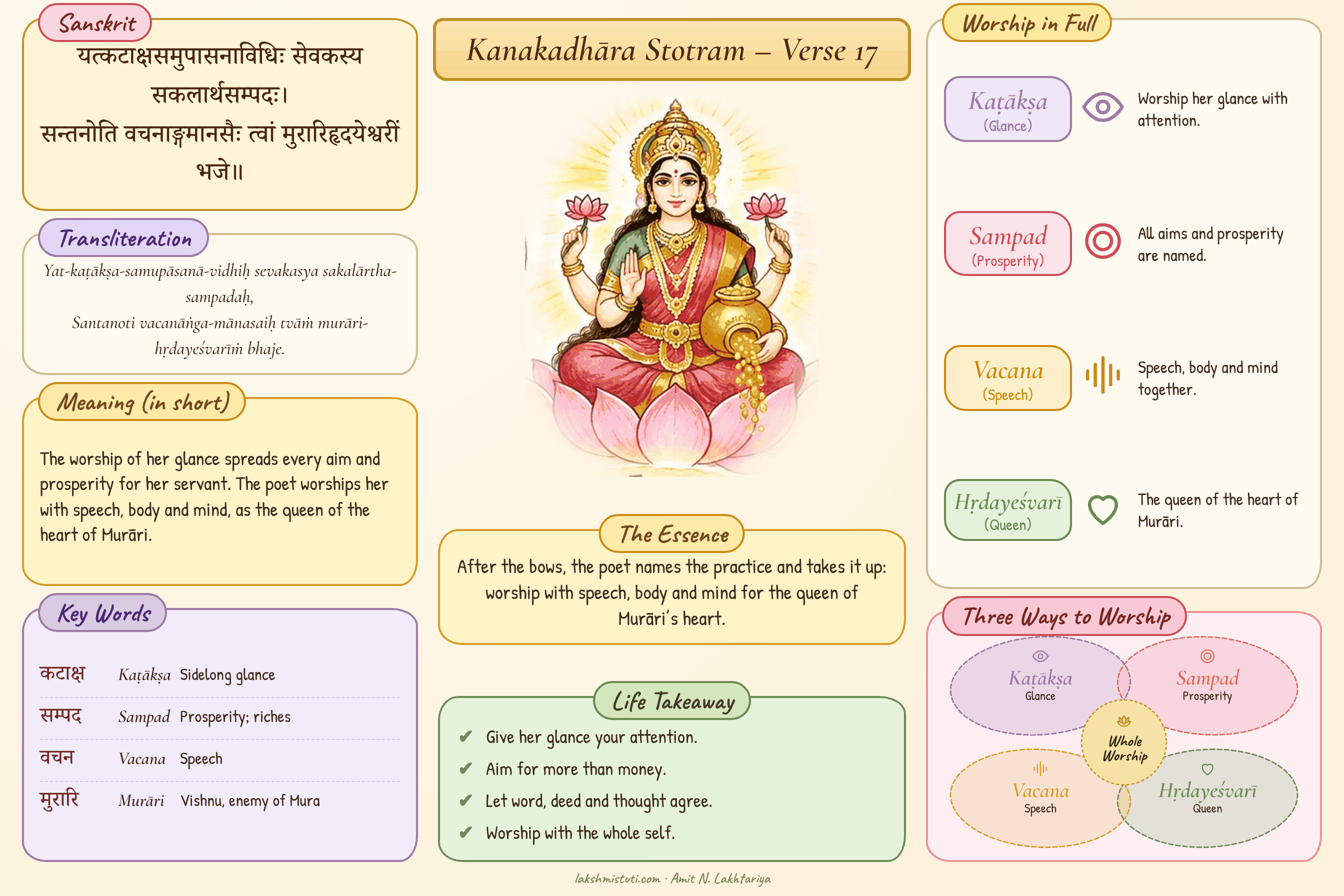
A one-page summary of the verse: Sanskrit, meaning, key ideas, key words and a takeaway. On a phone, open it full screen.
Word-by-word meaning
The literal meaning of each word.
| Sanskrit | Meaning |
|---|---|
| यत्कटाक्षसमुपासनाविधिःYat-kaṭākṣa-samupāsanā-vidhiḥ | The practice of worshipping whose sidelong glance |
| सेवकस्यSevakasya | Of the servant, of the devotee |
| सकलार्थसम्पदःSakalārtha-sampadaḥ | All kinds of aims and riches |
| सन्तनोतिSantanoti | Spreads out, brings abundantly |
| वचनाङ्गमानसैःVacana-aṅga-mānasaiḥ | By speech, body and mind |
| त्वाम्Tvām | You |
| मुरारिहृदयेश्वरीम्Murāri-hṛdayeśvarīm | The queen of Murāri’s heart |
| भजेBhaje | I worship, I adore |
Notes on each word
Yat is “whose”, and it points ahead to tvām, “you”, in the second line. Kaṭākṣa is a sidelong glance, from kaṭa, “the corner”, and akṣa, “the eye”. Samupāsanā is devoted worship, a sitting close in attention. Vidhi is a rule or method. So the whole compound is “the method of worshipping whose glance”.
Sevaka is one who serves, a devotee. The ending -sya is “of”: the servant’s.
Sakala is “all, whole”. Artha is an aim, an object, also wealth. Sampad is prosperity, success. The ending -aḥ marks the plural “things”, here the object of the verb: every sort of aim and prosperity.
From sam, “together, fully”, and the root tan, “to stretch, to spread”. The sense is that the practice extends and brings forth riches in full measure.
Vacana is speech, aṅga is the body or limbs, mānasa is the mind. The ending -aiḥ means “by, with”, in the plural. These are the three instruments of action in the tradition: what we say, what we do and what we think.
The “you” of the Goddess, as the object of the verb bhaje. It is the word the opening yat, “whose”, was waiting for.
Murāri is “the enemy of Mura”, a name of Vishnu, who defeated the demon Mura. Hṛdaya is the heart; īśvarī is a mistress, a queen. So she is the queen of Vishnu’s heart. The a and ī join into e: hṛdayeśvarī.
From the root bhaj, “to share in, to serve, to revere”. It is in the first person: “I worship”. It is the one verb of devotion in the verse, and Śaṅkarācārya says it plainly.
Deeper spiritual insights
Interpretation and reflection: ideas that help us read the verse, not part of the text itself.
Before we begin
Verse 16 was a direct prayer to the Divine Mother: may her worship bring prosperity, well-being and the removal of adversity.
Verse 17 takes us deeper into one of the most beautiful ideas in the Stotram: Lakshmi’s gracious glance, kaṭākṣa. In Sanskrit devotional literature, a divine glance is not merely a look. It represents grace, acceptance, blessing and the awakening of fortune.
Here, Śaṅkarācārya describes the power of contemplating that gracious glance and then concludes with a deeply personal declaration: I worship You, the sovereign of Murāri’s heart.
“Mother, there is a way of honouring your glance. It brings the devotee every kind of good thing. With my speech, my body and my mind, I worship you, the queen of Murāri’s heart.”
1A grammatical detail
Bhaje is first person singular: “I worship.” This is a shift from the previous verse’s prayer, kalayantu (“may they bestow”), to a personal declaration of devotion.
2Line-by-line meaning
First line – Yat-kaṭākṣa-samupāsanā-vidhiḥ
The discipline of worshipping and contemplating her gracious glance. The word kaṭākṣa literally refers to a glance cast sideways, but in devotional poetry it carries a much deeper meaning: the benevolent glance of the Divine Mother.
In the traditional imagery of Lakshmi, her glance is associated with grace and divine favour, the awakening of fortune, protection from adversity, the removal of obstacles, and the blessing that transforms an ordinary life.
Notice that Śaṅkarācārya does not merely ask for Lakshmi’s glance. He speaks of samupāsanā: devoted contemplation and worship of that glance. There is a difference between casually seeking a blessing and cultivating a life of devotion.
Contemplation: The divine glance is a symbol of grace; the devotee’s responsibility is to remain receptive through sincere worship and righteous conduct.
Second line – Sevakasya sakalārtha-sampadaḥ
All forms of prosperity and fulfilment belonging to the devotee. Artha is much broader than money. Depending on context, it can mean wealth and material resources, purpose or objective, a desired outcome, or something meaningful and valuable. Sakalārtha-sampadaḥ therefore suggests prosperity and fulfilment in all relevant dimensions of life.
This is an important distinction: Lakshmi’s blessings are not confined to gold and currency. They can be understood as abundance in the many areas that make life meaningful.
Third line – Santanoti vacanāṅga-mānasaiḥ
It expands or bestows prosperity through speech, body and mind. This line has a particularly beautiful threefold expression: vacana, speech, what we say; aṅga, body, what we do; mānasa, mind, what we think. In traditional Sanskrit thought, these are the three dimensions of karma.
Our speech should be truthful and beneficial. Our actions should be responsible and ethical. Our thoughts should be disciplined and compassionate. A person may speak beautifully but act dishonestly. Another may perform good actions but harbour harmful intentions. The verse invites us to bring all three dimensions into harmony.
Vacanāṅga-mānasaiḥ is instrumental plural, “through speech, body and mind”. It describes the means or manner of worship.
Contemplation: Let my thoughts, words and actions become aligned with the values I profess.
Fourth line – Tvāṁ murāri-hṛdayeśvarīṁ bhaje
I worship you, O sovereign Goddess of Murāri’s heart. This is the emotional conclusion of the verse. Who is Murāri? Mura refers to the demon Mura, and ari means enemy or destroyer. Murāri is therefore an epithet of Lord Vishnu, who is also worshipped as Krishna.
And Lakshmi is addressed as hṛdayeśvarī, the sovereign Lady of his heart. In the earlier verses, Śaṅkarācārya called her the beloved of Nārāyaṇa, Vishnu and Dāmodara. Now he calls her the very sovereign of Murāri’s heart. It expresses the inseparability of Lakshmi and Nārāyaṇa in Vaishnava devotional understanding.
The verse ends not with a request for wealth, but with bhaje: I worship You. That is a meaningful shift. The devotee’s final declaration is devotion itself.
3The central concept: Kaṭākṣa, the gracious glance of Lakshmi
We should spend some time on this word because it is central to the entire Kanakadhāra Stotram. Kaṭākṣa is commonly used in Sanskrit devotional poetry to describe a gracious sideways glance of a deity.
Why a glance? Because a glance is an expression of attention. When someone important looks upon us with kindness, we feel acknowledged. When a mother looks at her child with affection, the child feels protected even without hearing a single word. Śaṅkarācārya uses this human experience to express divine grace. In the context of Lakshmi, her glance signifies auspiciousness, acceptance, the awakening of prosperity and compassion towards the devotee.
This also connects with the title of the Stotram itself, Kanakadhārā, the stream of gold. The famous traditional narrative associates the hymn with Śaṅkarācārya’s prayer for a poor woman’s welfare and the shower of golden āmalaka fruits. The narrative is traditionally understood as an expression of Lakshmi’s compassionate grace. The important idea is not simply that a person receives gold. It is that compassion can transform circumstances.
4Why does Śaṅkarācārya mention speech, body and mind?
Vacana – speech
This is perhaps the most practical teaching of Verse 17. The verse brings devotion into the whole of human life. Let your words be truthful, gentle and beneficial. Prayer and mantra are also expressions of speech.
Aṅga – body
Let your physical actions reflect discipline, service and responsibility. Worship is not complete if conduct contradicts devotion.
Mānasa – mind
Let your thoughts become clear, focused and free from unnecessary jealousy, greed and resentment. The devotee does not worship with the mouth alone. The entire personality participates.
5A philosophical interpretation: prosperity begins with alignment
I would like to connect this verse with a simple principle: thought → speech → action → consequence. Consider two individuals. One may earn substantial wealth but have dishonest intentions, harsh speech and unethical business practices. Another may build prosperity through clear thinking, truthful communication, fair dealings and consistent effort. Both may have material success, but the second person’s prosperity is better aligned with dharma.
This is not a claim that ethical people will always become wealthy or that every hardship reflects wrongdoing. Rather, it is a reflection on the quality and sustainability of prosperity. The verse encourages us to seek divine grace while bringing our own thoughts, words and actions into harmony.
6A subtle point: the endings of Verse 16 and Verse 17
| Verse 16 | Verse 17 |
|---|---|
| Kalayantu, “may they bestow upon me” | Bhaje, “I worship” |
| A prayer for blessings | A declaration of devotion |
| The Mother is called mātar, “O Mother” | The Goddess is named hṛdayeśvarī, queen of Murāri’s heart |
| The devotee seeks her grace | The devotee offers himself through worship |
In Verse 16, the devotee asks for grace. In Verse 17, the devotee declares his devotion to the source of grace. This gives the two verses a natural continuity.
7The journey from Verse 16 to Verse 17
Verse 16: may your worship bring prosperity and remove adversity. Verse 17: may the contemplation of your gracious glance enrich every dimension of my life; I worship you, the sovereign of Murāri’s heart.
There is also a change in Śaṅkarācārya’s voice. In Verse 16, he speaks as a child seeking the Mother’s blessings. In Verse 17, he speaks as a devotee who has found the object of his worship. And the final words are not “give me wealth” or “remove my difficulties”. They are simply tvāṁ murāri-hṛdayeśvarīṁ bhaje: I worship you, O sovereign of Murāri’s heart. That is a lovely place to pause.
How to pronounce the key words
Yat-kaṭākṣa-samupāsanā-vidhiḥ: yat-ka-taak-sha-sa-mu-paa-sa-naa-vi-dhih. Sevakasya: se-va-ka-sya. Sakalārtha-sampadaḥ: sa-ka-laar-tha-sam-pa-dah. Santanoti: san-ta-no-ti. Vacanāṅga-mānasaiḥ: va-ca-naan-ga-maa-na-saih. Murāri-hṛdayeśvarīm: mu-raa-ri-hri-da-ye-shva-reem. Bhaje: bha-je.
A question to carry into Verse 18
Looking ahead to Verse 18: it begins sarasija-nilaye saroja-haste, “O you who dwell in the lotus and hold a lotus in your hand.” It returns to the visual and devotional beauty of Mahalakshmi, while introducing another sequence of divine attributes.
Practical meditation
- Use this verse as a daily reflection on three levels of personal discipline. Yat-kaṭākṣa-samupāsanā-vidhiḥ: “O Mother, may I remain receptive to Your grace through sincere devotion.”
- Sevakasya sakalārtha-sampadaḥ: “May my life be enriched with meaningful prosperity, wisdom and fulfilment.”
- Santanoti vacanāṅga-mānasaiḥ: “May my speech, actions and thoughts become pure and harmonious.”
- Tvāṁ murāri-hṛdayeśvarīṁ bhaje: “O Divine Mother, I worship You, the beloved sovereign of Murāri’s heart.”
The grace of the Divine Mother enriches life; true devotion is expressed when our thoughts, words and actions become aligned with her divine qualities.
This meditation is a devotional practice for attention and reflection; it does not promise a supernatural result or guarantee material wealth.