Home › Kanakadhāra Stotram › Verse 2
The verse
॥ श्लोक २ ॥
मुग्धा मुहुर्विदधती वदने मुरारेः
प्रेमत्रपाप्रणिहितानि गतागतानि।
माला दृशोर्मधुकरीव महोत्पले या
सा मे श्रियं दिशतु सागरसम्भवायाः॥
॥ श्री महालक्ष्म्यै नमः ॥
Mugdhā muhur vidadhatī vadane Murāreḥ,
Prema-trapā-praṇihitāni gatāgatāni;
Mālā dṛśor madhukarīva mahotpale yā,
Sā me śriyaṁ diśatu sāgara-sambhavāyāḥ.
Meaning in short
The lovely, bashful Goddess, born from the ocean, again and again directs towards the face of Murāri glances that come and go, full of love and modesty. Her glances move like a garland, like a female bee around a great lotus. May that Goddess Lakshmi grant me Śrī: prosperity, beauty, good fortune and auspiciousness.
Glances full of love and modesty, again and again, like a bee around a lotus, and a prayer for Śrī.
Key highlights
- Mugdhā Charm: the lovely, gently bashful Goddess
- Gatāgatāni Return: glances that come and go, again and again
- Madhukarī Lotus: a bee circling a great lotus
- Śrī Grace: the prayer for beauty and prosperity
Explore the four images
Tap a card to open its meaning and a question to carry with you.
MugdhāCharm
Mugdhā means lovely, innocent and gently bashful. Prema-trapā joins love with modesty. The Goddess is not distant: her look is affectionate and still keeps a graceful reserve.
Pause and reflect: Can I be warm with people and still be modest?
GatāgatāniReturn
Gatāgatāni means going and coming. Her glances turn toward Vishnu’s face and return, and turn again. Śaṅkarācārya shows love as something repeated, not a single moment.
Pause and reflect: What small act of care could I repeat every day?
MadhukarīLotus
The glances are a garland, like a female bee around a great lotus. The lotus stands for beauty and freshness, and the bee’s repeated movement gives the eye a picture of the repeated glance.
Pause and reflect: What in my life deserves my attention again and again?
ŚrīGrace
The verse ends with a direct prayer: sā me śriyaṁ diśatu, may she grant me Śrī. Śrī can mean prosperity, splendour, beauty, good fortune and auspiciousness, not only money.
Pause and reflect: Which part of Śrī am I most in need of just now?
Sketch note
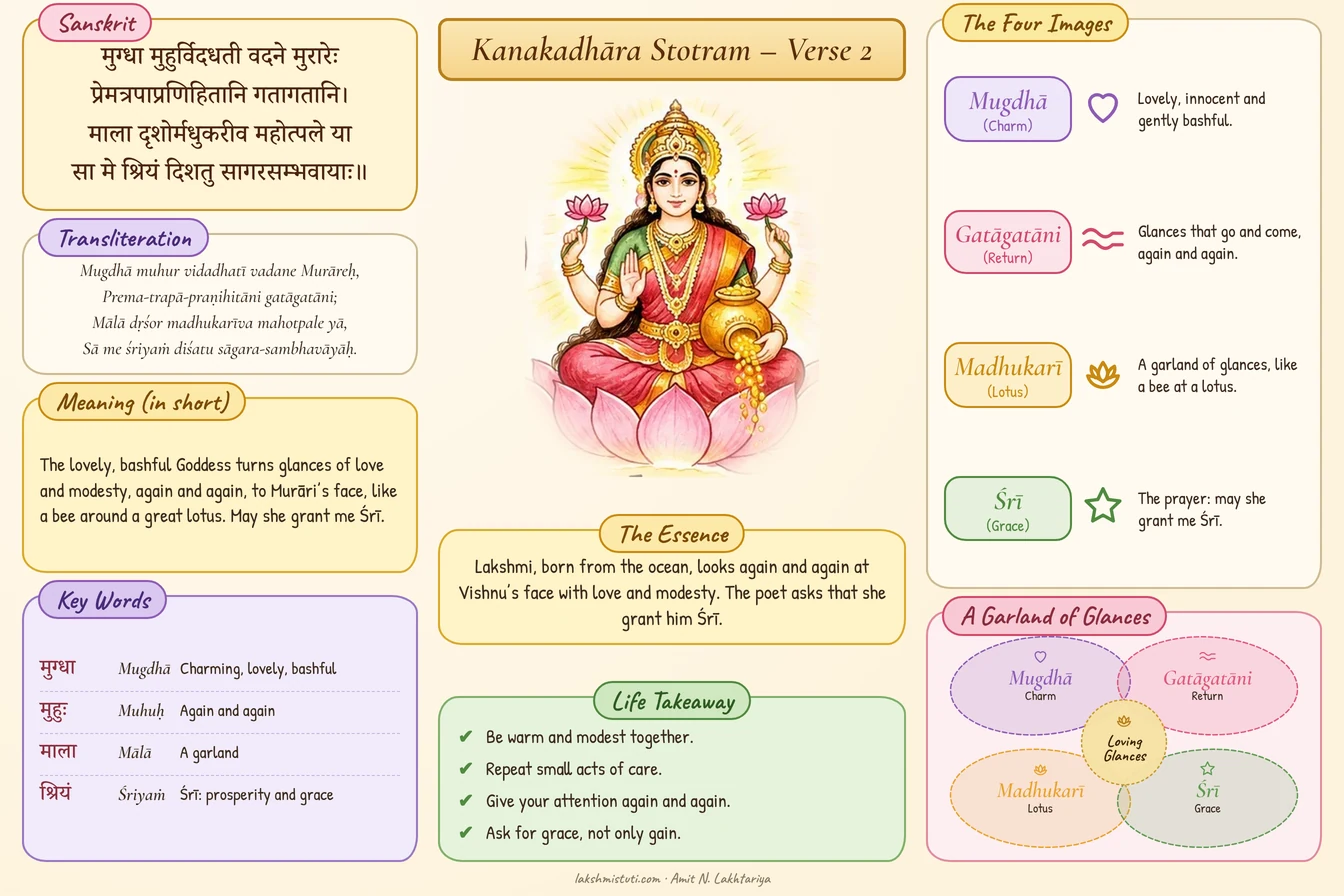
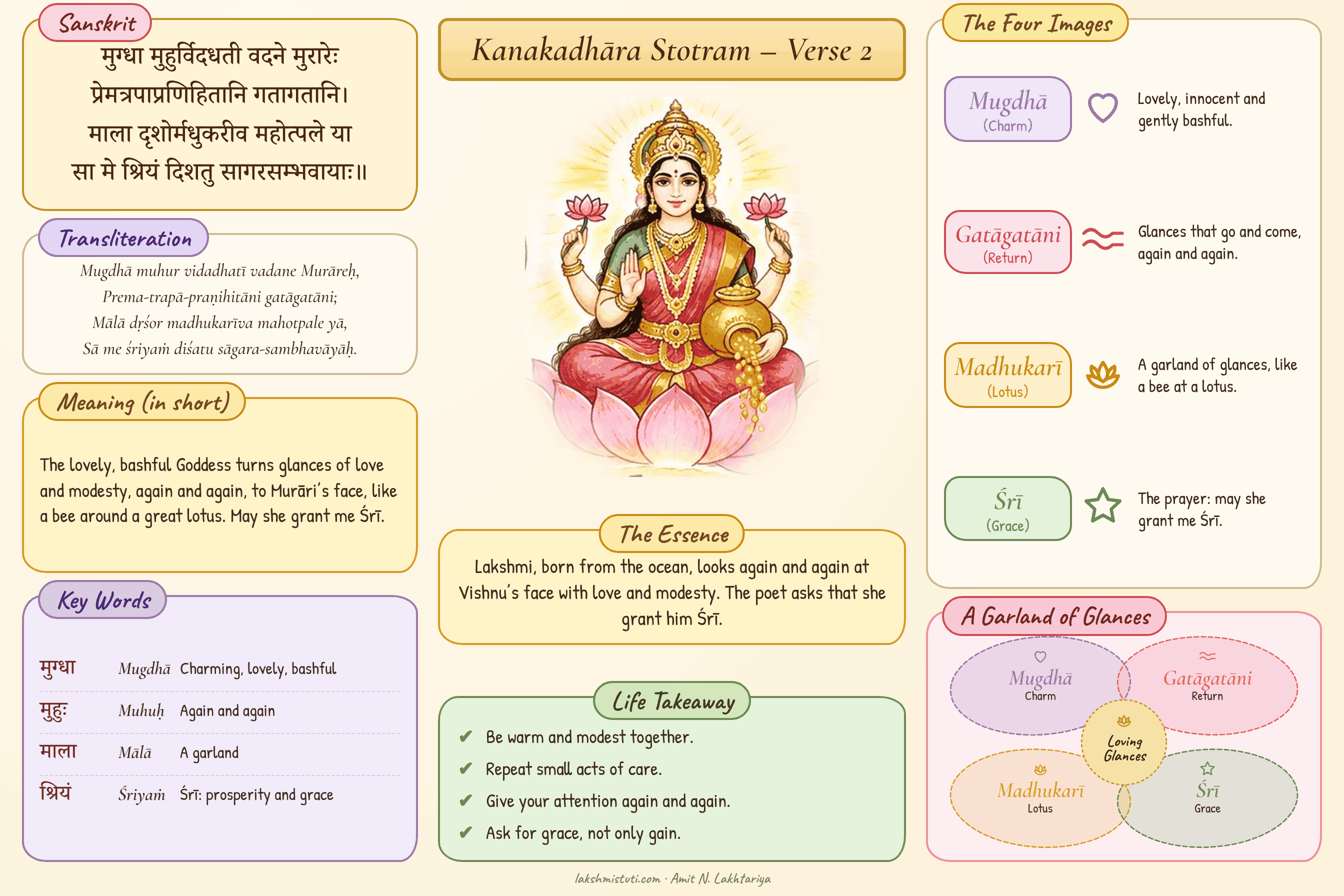
A one-page summary of the verse: Sanskrit, meaning, key ideas, key words and a takeaway. On a phone, open it full screen.
Word-by-word meaning
The literal meaning of each word.
| Sanskrit | Meaning |
|---|---|
| मुग्धाMugdhā | Charming, lovely, innocent, bashful |
| मुहुः विदधतीMuhuḥ vidadhatī | Again and again casting, directing |
| वदने मुरारेःVadane Murāreḥ | Upon the face of Murāri (Vishnu) |
| प्रेमत्रपाप्रणिहितानिPrema-trapā-praṇihitāni | Glances directed with love and bashfulness |
| गतागतानिGatāgatāni | Going and coming |
| माला दृशोःMālā dṛśoḥ | A garland of the eyes, of the glances |
| मधुकरी इवMadhukarī iva | Like a female bee |
| महोत्पलेMahotpale | On a great lotus |
| या साYā sā | She who… may she |
| मे श्रियं दिशतुMe śriyaṁ diśatu | May she grant me Śrī |
| सागरसम्भवायाःSāgara-sambhavāyāḥ | Of her who was born from the ocean |
Notes on each word
A description of the Goddess herself.
Muhuḥ is “again and again”; vidadhatī is making, performing or displaying.
Murāri means the foe of Mura, a name of Vishnu, who slew the demon Mura.
Prema is love; trapā is bashfulness or modesty; praṇihita is directed, placed, fixed upon.
Glances that go and return, repeated movements. The word gives movement to the poem.
Mālā is a garland; dṛśoḥ is “of the two eyes”. The poetic centre of the verse: her repeated glances become a garland.
Madhukarī is “she who makes honey”, a female bee.
Mahā is great and utpala is a lotus, often a blue lotus.
Yā (“who”) and sā (“she”) hold the sentence together: the Goddess who is described, and the same Goddess who is asked.
Śrī is prosperity, good fortune, beauty and auspiciousness; diśatu is “may she grant”.
Lakshmi, who emerged at the churning of the ocean.
Deeper spiritual insights
Interpretation and reflection: ideas that help us read the verse, not part of the text itself.
Before we begin
In Verse 1, we witnessed a beautiful scene: the graceful sidelong glance of Mahalakshmi brings divine joy to Lord Vishnu. We explored how Śaṅkarācārya transformed that glance into poetry.
In Verse 2, the imagery becomes even more delicate. We encounter lotus flowers, bees intoxicated by nectar, and the eyes of the Divine Mother.
As before, we will not rush through the Sanskrit. We will decode the words, visualise the scene, understand the spiritual symbolism, and conclude with meditation and reflection.
“May she (the charming Goddess born from the ocean, who repeatedly directs glances towards the face of Murāri, those glances imbued with love and bashfulness, forming a garland like a female bee at a great lotus) grant me Śrī, prosperity and auspiciousness.”
1A more poetic rendering
The lovely Goddess, with glances filled with love and tender modesty, looks again and again towards the face of Lord Vishnu.
Her glances move back and forth like a garland of bees hovering around a magnificent lotus.
May that Goddess Lakshmi, born from the ocean, bestow upon me Śrī: prosperity, beauty, good fortune, and auspiciousness.
2The meaning in simple English
“O Mother Lakshmi, your eyes are full of love and gentle bashfulness as you look again and again towards Lord Vishnu’s face. Your glances move like bees drawn to a magnificent lotus. O Daughter of the Ocean, may you bless me with Śrī: with prosperity, grace, and auspiciousness.”
3Notice a change from Verse 1
In Verse 1, we contemplated the power of a single sidelong glance. In Verse 2, we witness a repeated exchange of glances, full of love and modesty.
The first verse presents the beauty of divine grace. The second brings us closer to the emotional intimacy of the Divine Couple.
4The poetry hidden in Verse 2
There is something astonishing here. Śaṅkarācārya could have written: “Lakshmi looks lovingly at Vishnu.” Instead, he gives us an entire scene of glances that come and go, each carrying a delicate emotion.
Imagine Lord Vishnu, calm and magnificent, with the serene beauty of a blue lotus. Lakshmi looks towards His face. Her eyes linger for a moment. Then, perhaps out of modesty, they turn away. And then they return. Again and again.
There is love in the glance, but also trapā, a beautiful reserve, a gentle bashfulness. Śaṅkarācārya does not need to describe a conversation between the Divine Couple. Their eyes speak for them.
And then comes the extraordinary comparison: these repeated glances form a garland of bees around a magnificent lotus. Śaṅkarācārya sees what ordinary eyes miss.
5The emotional genius of the verse
| Image | What it carries |
|---|---|
| The lotus | The image of beauty, freshness, and attraction. |
| The bee | Drawn repeatedly towards the flower, moving around it. |
| The glance | Returning again and again, carrying love and bashfulness. |
The bee’s repeated movement gives us a visual language for the movement of Lakshmi’s eyes.
The lotus attracts the bee. The face of Vishnu draws Lakshmi’s loving attention.
The comparison is not merely decorative. It makes the feeling visible.
6A subtle distinction
In the first verse, the bee image evokes Lakshmi’s graceful movement around Vishnu’s dark, tamāla-like form.
In the second, the great lotus becomes the focus of the comparison. The glances are described as a garland, like a bee associated with that lotus.
The imagery develops from one verse to the next, but its emotional centre remains the same: the beauty of the Divine Couple and the grace that Śaṅkarācārya seeks from Lakshmi.
7The deeper symbolism
Insight 1 – Prema-trapā: love and modesty can coexist
The phrase prema-trapā is one of the most tender expressions in the verse. Prema is love, and trapā is bashfulness or modesty.
The Goddess is not portrayed as distant or impersonal. Her glances express affection, yet retain a graceful reserve.
We should remember that this is a poetic depiction of divine love, not a rule that everyone must express affection through shyness.
Contemplation: Love does not always need grand declarations. Sometimes tenderness is expressed through restraint, attention, and quiet presence.
Insight 2 – Mālā dṛśoḥ: the garland of glances
A garland is made by bringing individual flowers together. Here, Śaṅkarācārya imagines individual glances as a garland. Each glance is a moment of affection; together, they become a continuous expression of love.
There is a lovely idea here: repeated acts of attention can form something beautiful.
In everyday life, a relationship is rarely sustained by one grand gesture. It is sustained by many small ones: listening, remembering, caring, forgiving, and showing up.
Insight 3 – Mahotpala: why the lotus?
The lotus occupies a special place in Indian spiritual and literary traditions. It suggests beauty, purity, freshness, and the possibility of flourishing even in muddy water. The lotus is also deeply associated with Lakshmi herself.
In this verse, however, the lotus is part of a specific poetic comparison: the bee is drawn to the great lotus, just as Lakshmi’s glances repeatedly turn towards Vishnu’s face.
We should appreciate both layers, the immediate image and the wider cultural symbolism, without confusing the two.
Insight 4 – Sā me śriyaṁ diśatu: why ask for Śrī?
The verse ends with a direct prayer: sā me śriyaṁ diśatu, “May she grant me Śrī.” This is a beautiful progression from describing the Goddess to addressing her grace.
The word Śrī can signify prosperity, splendour, beauty, good fortune, and auspiciousness. Here, the prayer is broad enough to invite contemplation of prosperity in its many forms.
For us, that can include material well-being as well as the discernment to use resources wisely, the character to act ethically, and the contentment to recognise what is already good.
That wider application is a reflection inspired by the verse; it should not be mistaken for a literal list of meanings contained in the Sanskrit.
8The story within the story: Lakshmi as Sāgarasambhavā
The final compound deserves special attention: sāgarasambhavāyāḥ. It refers to her who was born from the ocean.
In Hindu tradition, Lakshmi is associated with the Samudra Manthana, the churning of the cosmic ocean. During this great event, Lakshmi emerged from the ocean of milk and was welcomed by the gods. The account appears in different forms across the Purāṇic tradition.
Why does Śaṅkarācārya invoke this identity? He is reminding us of the Goddess’s traditional cosmic origin. She is not merely a beautiful figure in an intimate scene with Vishnu; she is the revered Goddess born from the cosmic ocean, associated with auspiciousness and prosperity.
There is a poetic contrast here: the vastness of the ocean and the delicacy of a glance. From a cosmic event, Śaṅkarācārya brings us to a deeply personal prayer: may she grant me Śrī. The universe is vast, yet devotion makes the prayer intimate.
9Reflection for today
Here is a question to carry with you: where does your attention return, again and again?
The bee returns to the lotus. Lakshmi’s glance returns to Vishnu. Our own attention also returns to certain things: sometimes to worry, sometimes to ambition, sometimes to gratitude, sometimes to the people we love. Repeated attention gradually shapes our inner world.
Consider three questions:
- What occupies my thoughts most often: fear of losing what I have, desire for what I lack, or gratitude for what I possess?
- Do the people important to me receive my attention in small, consistent ways?
- If I seek prosperity, am I also cultivating the qualities that will allow me to use it wisely?
You need not answer every question today. Choose the one that speaks to you most deeply.
10Three Sanskrit treasures to remember
| Word | Meaning | Deeper association |
|---|---|---|
| Prema (प्रेम) | Love and affection | The warmth at the heart of the Goddess’s glances. |
| Trapā (त्रपा) | Bashfulness and modesty | The delicate reserve that gives the verse its tenderness. |
| Śrī (श्री) | Prosperity and auspiciousness | The blessing Śaṅkarācārya seeks from the Goddess born of the ocean. |
11The essence of Verse 2
Let us bring the verse together in one final picture.
Lakshmi looks towards Vishnu. Her eyes move away and return, carrying both love and modesty. Śaṅkarācārya sees these repeated glances as a garland of bees around a magnificent lotus. Then he makes his prayer: may the Goddess born from the ocean grant me Śrī.
Verse 1 taught us to contemplate the power of the divine glance. Verse 2 invites us to contemplate the tenderness of that glance: the affection, the repeated attention, and the beauty of a relationship expressed without words.
A quick pronunciation guide
Mugdhā: mugdhaa. Muhuḥ: muhur, meaning repeatedly. Murāreḥ: muraareh. Prema-trapā: prema-tra-paa. Gatāgatāni: ga-taa-ga-taa-ni. Madhukarī: ma-dhu-ka-ree. Mahotpale: ma-hot-pa-le. Sāgarasambhavāyāḥ: saa-ga-ra-sam-bha-vaa-yaah.
One small Sanskrit lesson: when words are joined in a verse, their sounds often change slightly. This is called sandhi. We will gradually learn to recognise these joins without making Sanskrit grammar a barrier to enjoying the poetry.
A question to carry into Verse 3
A small suggestion for our continuing journey: before moving to Verse 3, read Verse 1 and Verse 2 aloud once together. Notice how the first verse establishes the divine glance, while the second develops it into a living garland of glances. That continuity is part of the artistry we are learning to recognise.
Practical meditation
- Minute 1Become stillSit comfortably, breathe gently and let the day’s concerns settle. You do not need to empty your mind; simply allow yourself to be present.
- Minutes 2–3Recite the verseRead the Sanskrit slowly, resting on prematrapāpraṇihitāni gatāgatāni. Recall the meaning: glances directed with love and bashfulness, moving back and forth.
- Minute 4Visualise the sceneImagine a magnificent lotus, with a bee gently moving around it. Then picture Lakshmi’s loving glance turning towards Vishnu and returning again. Let the image remind you of tenderness, attention and harmony.
- Minute 5Offer your prayerSay silently, “O Mother Lakshmi, may my attention be loving, my conduct be graceful, and my understanding of prosperity be wise. May I recognise and nurture the goodness already present in my life.”
What we return to, again and again, becomes an important part of our lives: may we return to wisdom when confused, gratitude when restless, integrity when tempted, and compassion when dealing with others.
This meditation is a devotional practice for attention and reflection; it does not promise a supernatural result or guarantee material wealth.