Home › Kanakadhāra Stotram › Verse 20
The verse
॥ श्लोक २० ॥
कमले कमलाक्षवल्लभे त्वं
करुणापूरतरङ्गितैरपाङ्गैः।
अवलोकय मामकिञ्चनानां
प्रथमं पात्रमकृत्रिमं दयायाः॥
॥ श्री महालक्ष्म्यै नमः ॥
Kamale kamalākṣa-vallabhe tvaṁ
karuṇā-pūra-taraṅgitair apāṅgaiḥ,
Avalokaya mām akiñcanānāṁ
prathamaṁ pātram akṛtrimaṁ dayāyāḥ.
Meaning in short
O Kamalā, beloved of the lotus-eyed one, look on me with your glances rippling with a flood of compassion: me, the first among those who have nothing, a genuine vessel for your mercy.
Śaṅkarācārya asks to be looked on, and offers honest need as his only claim.
Key highlights
- Kamale Lotus: she is called by the name of the lotus
- Karuṇā-pūra Flood: compassion rippling in her glance
- Akiñcana Empty: those who have nothing
- Pātra Vessel: one who can receive her mercy
Explore the four ideas
Tap a card to open its meaning and a question to carry with you.
KamaleLotus
Kamalā is a name of Lakshmi, “she of the lotus”, and Śaṅkarācārya calls her beloved of the lotus-eyed one. A reflection: the verse begins by naming who she is before it asks for anything.
Pause and reflect: How do I begin when I ask for help?
Karuṇā-pūraFlood
Karuṇā-pūra-taraṅgita is rippling with a flood of compassion. The glance is the water. A reflection: the hymn travels from describing a glance in Verse 1 to asking for one here.
Pause and reflect: Who has looked on me with real kindness?
AkiñcanaEmpty
Akiñcana is one who has nothing. Verse 8 used the word for a helpless young bird. Śaṅkarācārya applies it to himself and goes further: prathamam, the first. A reflection: the claim on mercy is made by honesty about need.
Pause and reflect: What do I actually lack, said plainly?
PātraVessel
Pātra is a vessel and also a worthy recipient, and akṛtrima means genuine. A reflection: a full cup cannot be filled; what the verse suggests is making room.
Pause and reflect: What do I hold so tightly that nothing else fits?
Sketch note
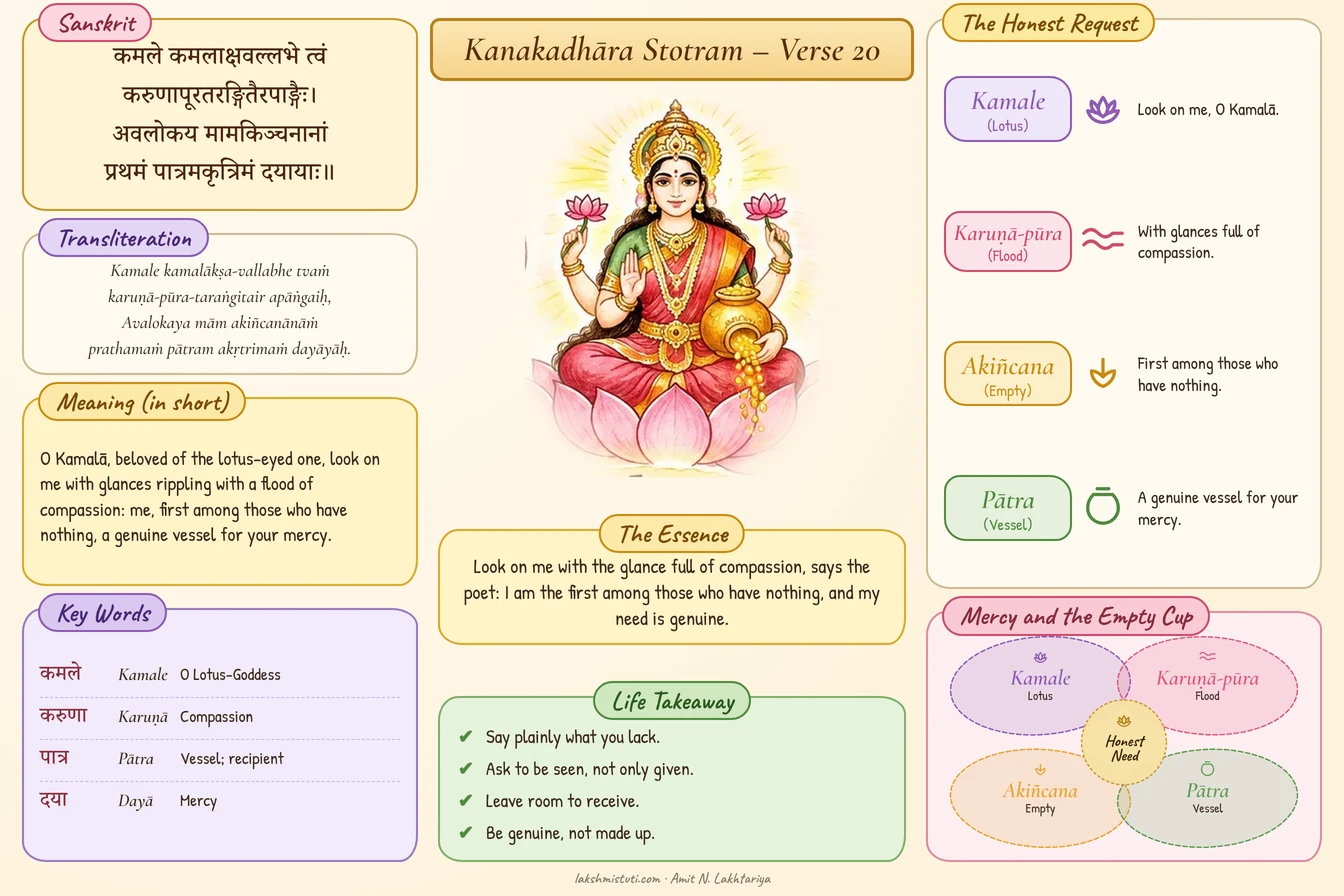
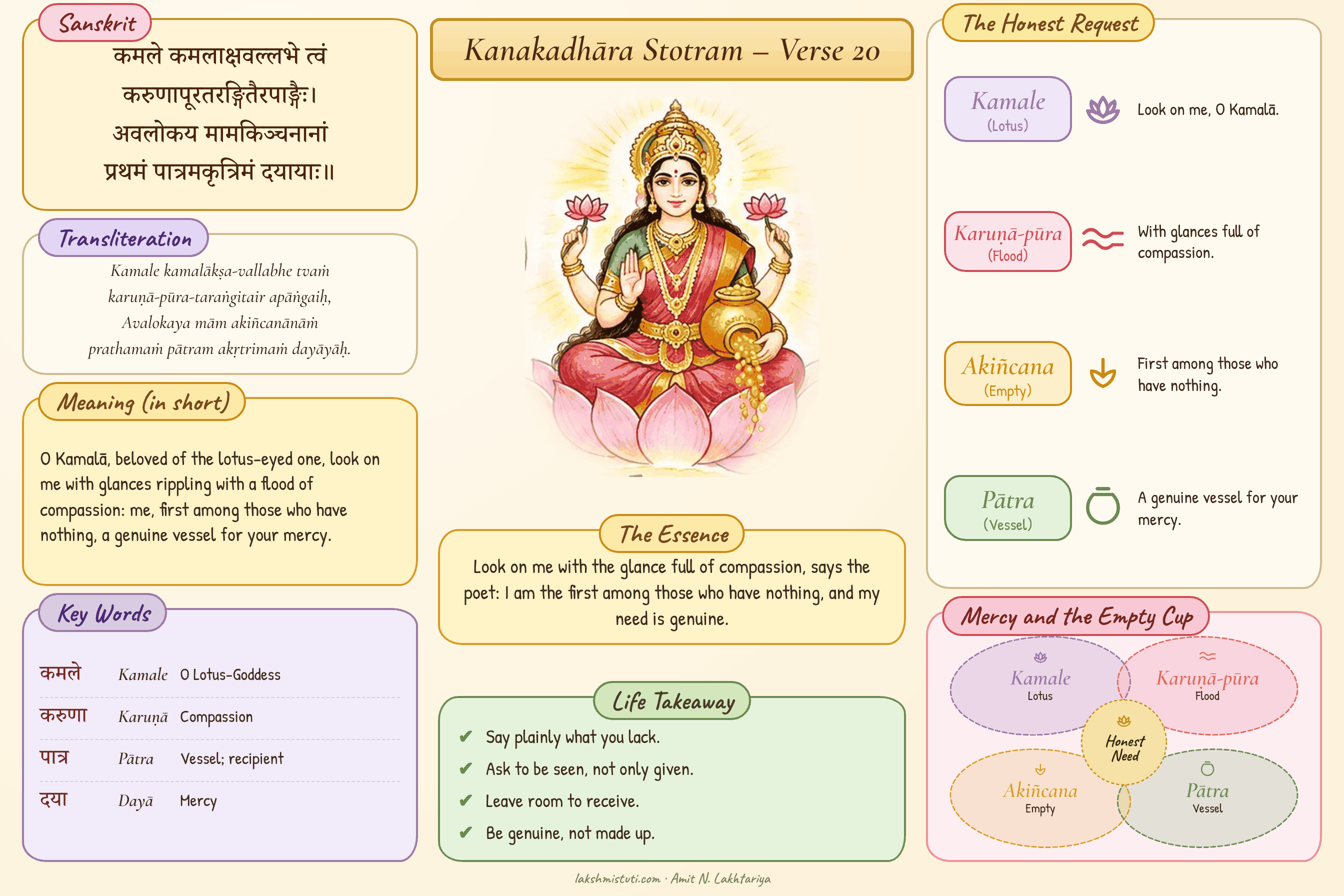
A one-page summary of the verse: Sanskrit, meaning, key ideas, key words and a takeaway. On a phone, open it full screen.
Word-by-word meaning
The literal meaning of each word.
| Sanskrit | Meaning |
|---|---|
| कमलेKamale | O Kamalā, O lotus-dweller |
| कमलाक्षवल्लभेKamalākṣa-vallabhe | O beloved of the lotus-eyed one |
| त्वम्Tvam | You |
| करुणापूरतरङ्गितैःKaruṇā-pūra-taraṅgitaiḥ | Rippling with a flood of compassion |
| अपाङ्गैःApāṅgaiḥ | With your glances |
| अवलोकयAvalokaya | Look upon me, regard |
| माम्Mām | Me |
| अकिञ्चनानाम्Akiñcanānām | Of those who have nothing |
| प्रथमम्Prathamam | The first, the foremost |
| पात्रम्Pātram | A vessel, a fit recipient |
| अकृत्रिमम्Akṛtrimam | Genuine, not made up |
| दयायाःDayāyāḥ | Of compassion, of mercy |
Notes on each word
Kamalā is a name of Lakshmi, “she of the lotus”. The ending -e is the calling form: “O Kamalā”.
Kamala is a lotus and akṣa is the eye, so kamalākṣa is “lotus-eyed”, a familiar name of Vishnu. Vallabhā is a beloved. The calling form is vallabhe.
The word “you”, as the one who will act: “you, look on me”.
Karuṇā is compassion. Pūra is a flood, a filling. Taraṅgita is “made into waves, rippling”, from taraṅga, a wave. The ending -aiḥ is “with” in the plural, and agrees with apāṅgaiḥ: glances that ripple with a flood of compassion.
Apāṅga is the outer corner of the eye, and so a sidelong glance. It is the word with which the hymn began in Verse 1. The ending -aiḥ is “with”, in the plural.
From ava, “down”, and the root lok, “to see”. The command is to look down kindly, as one looks on someone who needs help. The same root gives the name Avalokiteśvara, “the one who looks down”.
The “whom” form of “I”. The look is to fall on Śaṅkarācārya himself.
Kiñcana is “anything”; a-kiñcana is “not even anything”, one who has nothing of his own. The ending -ānām is “of”, in the plural: among those who have nothing. The m of mām runs into the a: mām akiñcanānām.
Prathama means first. Here it describes Śaṅkarācārya as the first among the destitute, the leading case.
Pātra is a vessel, a cup, and also a worthy recipient of a gift. In the verse it is the one who can receive her compassion.
Kṛtrima is artificial, made. A-kṛtrima is the opposite: natural, true. His need is real and he does not pretend.
Dayā is compassion. The ending -āyāḥ is “of”: a vessel of compassion, one fit to receive it.
Deeper spiritual insights
Interpretation and reflection: ideas that help us read the verse, not part of the text itself.
Before we begin
After the majestic vision of Mahalakshmi’s celestial abhiṣeka in Verse 19, Śaṅkarācārya now turns towards a deeply personal prayer.
The language becomes simple, intimate and moving. There is no grand description of celestial elephants or golden vessels. Instead, the devotee asks the Goddess for just one thing: “Please look upon me with your compassionate sidelong glance.”
This verse is especially beautiful because it makes karuṇā, compassion, the central theme of divine grace.
“O Kamalā, beloved of the lotus-eyed Lord! With your sidelong glances, surging with waves of compassion, please look upon me. Among those who possess nothing, may I be the foremost and genuine recipient of your mercy.”
1A more poetic rendering
O Lotus Goddess, beloved of the Lotus-eyed Lord, let your eyes, overflowing with waves of compassion, turn towards me. Among those who have nothing to claim as their own, may I be a humble and worthy vessel of your unfeigned mercy.
A small but important grammatical observation: avalokaya is an imperative verb, “please look upon me”. Śaṅkarācārya is not merely describing the Goddess; he is directly addressing her with a heartfelt request.
2The four beautiful expressions
Image 1 – Kamale: the Goddess of the Lotus
The word Kamalā is derived from the lotus association and is a celebrated name of Lakshmi. The lotus has several layers of symbolism: it grows in water, yet its beauty remains unstained; it opens towards the light; it represents purity, auspiciousness and spiritual awakening.
There is a subtle connection with Verse 18, where Lakshmi is described as sarasija-nilaye, the one whose abode is the lotus. Here, however, Śaṅkarācārya is not merely describing where she resides. He is calling her by an intimate name.
Image 2 – Kamalākṣa-vallabhe: beloved of the lotus-eyed Lord
Kamala is lotus, akṣa is eye, so kamalākṣa is the lotus-eyed Lord, Vishnu; vallabhā is the beloved, the cherished consort. Śaṅkarācārya addresses Lakshmi as the beloved of Vishnu.
This is more than a reference to divine companionship. In Vaishnava understanding, Lakshmi and Nārāyaṇa represent inseparable divine principles: sustaining power and auspicious grace. Śaṅkarācārya invokes this relationship before asking for compassion. There is an interesting devotional thought here: the devotee approaches the Mother through the very relationship that defines her divine identity.
Image 3 – Karuṇā-pūra-taraṅgitair-apāṅgaiḥ: eyes overflowing with compassion
This is perhaps the most poetic expression of the verse. Karuṇā is compassion, pūra is fullness or flood, taraṅgita means moving in waves, and apāṅga is a sidelong glance. The image is extraordinary: her sidelong glances are imagined as waves arising from an ocean of compassion.
Why does Śaṅkarācārya use apāṅga, a sidelong glance, instead of simply saying eyes? In Sanskrit devotional poetry, the Goddess’s kaṭākṣa or apāṅga is a recurring symbol of grace. A single glance can express acceptance, protection, affection and blessing. Śaṅkarācārya does not ask for a grand miracle. He asks for her compassionate glance.
Contemplation: The eyes are the source of the image; the glance is the movement of grace towards the devotee.
Image 4 – Akiñcana: the one who has nothing
Mām akiñcanānāṁ prathamaṁ pātram is the emotional heart of the verse. Akiñcana literally means one who possesses nothing. But the word has an interesting spiritual dimension. It can describe someone without material possessions, someone without resources or worldly support, or someone who has surrendered the sense of ownership and dependence on material things.
We should not automatically assume that Śaṅkarācārya is referring only to financial poverty. The word allows a broader spiritual reading. Śaṅkarācārya says, in effect: “Among those who have nothing, let me be the foremost natural recipient of your compassion.” Notice that he does not claim to deserve her grace through his achievements. He approaches through humility and need.
3The significance of akṛtrima dayā
Akṛtrima means natural, genuine, unfeigned or not artificially produced; dayā means compassion or mercy. Śaṅkarācārya seeks genuine compassion, not a favour obtained through bargaining, display or pretence.
This brings us to an important philosophical distinction. Transactional devotion: “I worship you, therefore you must give me something.” Surrendering devotion: “I approach you because I need your grace, and I place my limitations before you.” The verse leans towards the second attitude.
It does not condemn material prayers. Indeed, the Stotram openly asks for prosperity elsewhere. But here, the emphasis is on the purity of the relationship between devotee and Divine Mother.
4The deeper philosophical meaning: three lenses
Human relationships often involve qualifications: what have you done, what can you offer, what do you deserve? The devotee approaches the Divine Mother from a different place. He asks for compassion that is akṛtrima, unfeigned. Grace is not a commercial transaction.
A person may possess wealth and still feel helpless before life’s uncertainties. Another may have little material wealth but possess inner contentment. As a contemplative interpretation, akiñcana can invite us to examine our attachments and the illusion that we control everything. Humility is not weakness; it is the recognition that human control has limits.
Śaṅkarācārya does not ask the Goddess to change her nature. He asks her to turn her compassion towards him. The image of the glance is a beautiful metaphor for divine grace becoming personally experienced.
5Connection with the previous verses
| Verse | Central image or prayer |
|---|---|
| 18 | Lakshmi as the lotus-dwelling Goddess and giver of prosperity to the three worlds |
| 19 | Lakshmi receiving celestial abhiṣeka; Mother of the universe |
| 20 | The devotee personally asks for her compassionate glance |
There is a gradual movement: divine beauty, then cosmic majesty, then personal compassion. This is an important progression in the devotional experience. First, Śaṅkarācārya beholds the greatness of the Goddess. Then he approaches her as a child approaches its Mother.
6Sanskrit vocabulary to remember
| Word | Meaning |
|---|---|
| Kamalā (कमला) | Lakshmi; the Lotus Goddess |
| Kamalākṣa (कमलाक्ष) | Lotus-eyed; an epithet of Vishnu |
| Vallabhā (वल्लभा) | Beloved, cherished consort |
| Karuṇā (करुणा) | Compassion |
| Taraṅga (तरङ्ग) | Wave |
| Apāṅga (अपाङ्ग) | Sidelong glance |
| Akiñcana (अकिञ्चन) | One who possesses nothing |
| Pātra (पात्र) | Vessel, recipient |
| Akṛtrima (अकृत्रिम) | Genuine, natural, unfeigned |
| Dayā (दया) | Mercy, compassion |
7The central thought
When the devotee asks not for wealth, but for grace. In this verse, Śaṅkarācārya approaches Lakshmi not as the sovereign of the universe, but as the compassionate Mother. He does not ask for golden vessels, royal status or celestial honours. He asks for her glance.
And in that single request lies the essence of the verse: true grace is not something we can demand as an entitlement. It is something we humbly become receptive to.
A question to carry into Verse 21
Next is Verse 21, devi prasīda jagadīśvari lokamātaḥ… It is the devotee’s final personal appeal to the Divine Mother, in which Śaṅkarācārya places his fears before the Goddess and asks for her compassionate glance every day.
Practical meditation
- Sit quietly and contemplate these four expressions. Kamale: “May my life remain pure, like the lotus.”
- Kamalākṣa-vallabhe: “May my actions remain aligned with righteousness and divine order.”
- Karuṇā-pūra-taraṅgitair-apāṅgaiḥ: “May compassion guide the way I see and treat others.”
- Akiñcana: “May I develop humility and recognise that not everything is within my control.” Then silently pray: “O Mother, I do not come before You with a claim. I come with humility. May Your compassion guide my thoughts, my actions and my life.”
When the devotee asks not for wealth, but for grace: true grace is not something we can demand as an entitlement. It is something we humbly become receptive to.
This meditation is a devotional practice for attention and reflection; it does not promise a supernatural result or guarantee material wealth.