Home › Kanakadhāra Stotram › Verse 6
The verse
॥ श्लोक ६ ॥
कालाम्बुदालिललितोरसि कैटभारेः
धाराधरे स्फुरति या तडिदङ्गनेव।
मातुः समस्तजगतां महनीयमूर्तिः
भद्राणि मे दिशतु भार्गवनन्दनायाः॥
॥ श्री महालक्ष्म्यै नमः ॥
Kālāmbudāli-lalitorasi Kaiṭabhāreḥ,
Dhārādhare sphurati yā taḍid-aṅganeva;
Mātuḥ samasta-jagatāṁ mahanīya-mūrtiḥ,
Bhadrāṇi me diśatu Bhārgava-nandanāyāḥ.
Meaning in short
May the revered form of the Mother of all the worlds, the daughter of Bhṛgu, grant me good things: the form that flashes like a lady of lightning on the rain-bearing cloud that is the chest of Vishnu, the enemy of Kaiṭabha, lovely as a bank of dark clouds.
Lakshmi on Vishnu’s dark chest is a flash of lightning on a rain cloud: the whole figure lit at once.
Key highlights
- Kālāmbuda Cloud: Vishnu’s chest, dark as a rain cloud
- Taḍit Lightning: Lakshmi flashing on the dark cloud
- Bhadra Blessing: the Mother of all worlds, asked for good
Explore the three images
Tap a card to open its meaning and a question to carry with you.
KālāmbudaCloud
Vishnu’s chest is pictured as a bank of dark monsoon clouds. The darkness here is not evil: it is the majestic darkness of a cloud that carries rain.
Pause and reflect: Where might something I call dark in my life actually be carrying rain?
TaḍitLightning
Lakshmi’s form flashes on that cloud like lightning, and the lightning shows the cloud’s own beauty. For a moment the whole sky is lit from inside.
Pause and reflect: What brings out the best in the people or work around me?
BhadraBlessing
The third line widens the view to mātuḥ samasta-jagatām, the Mother of all the worlds. The prayer, bhadrāṇi me diśatu, asks for many good things, not one gift.
Pause and reflect: What kinds of good, beyond wealth, am I asking for?
Sketch note
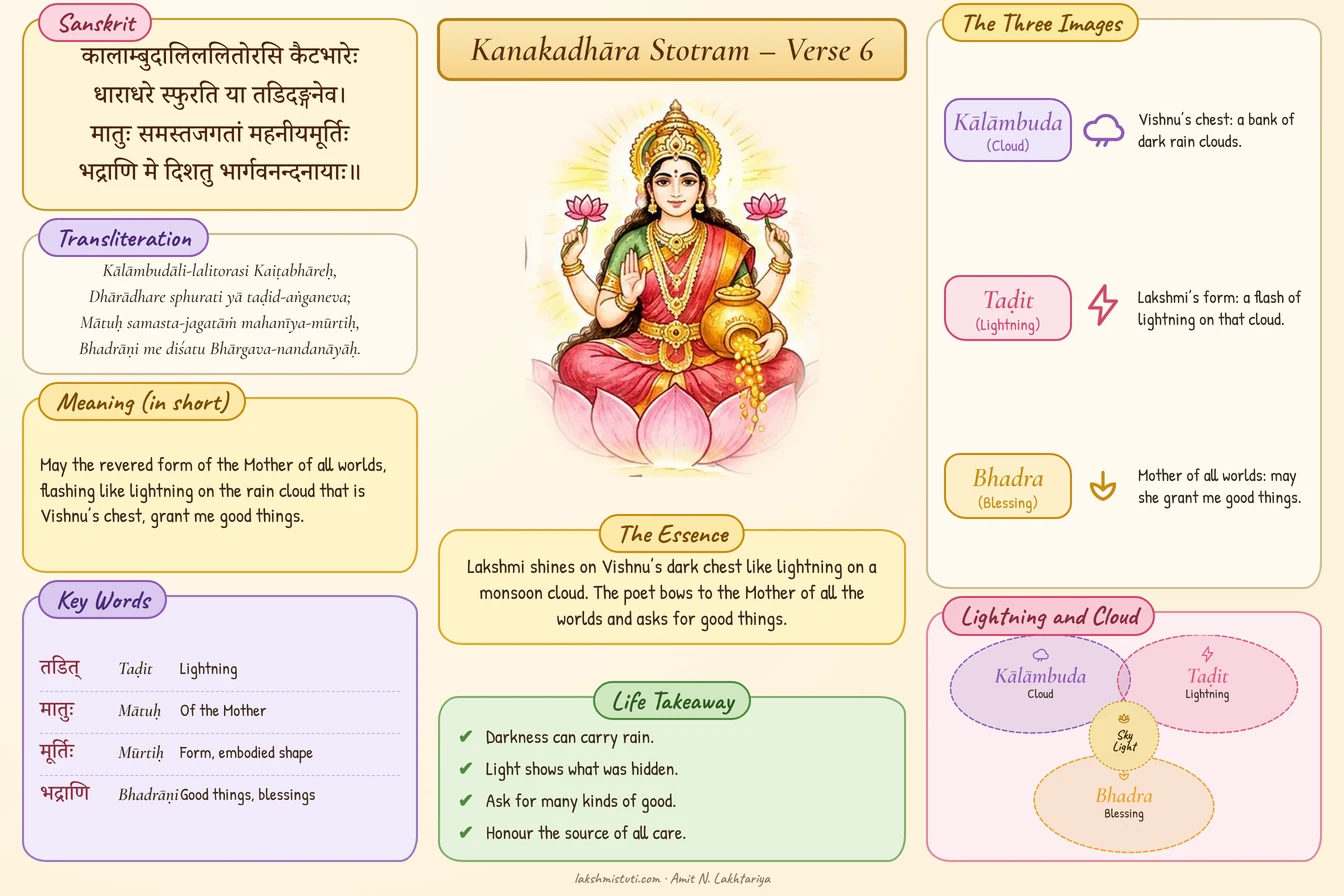
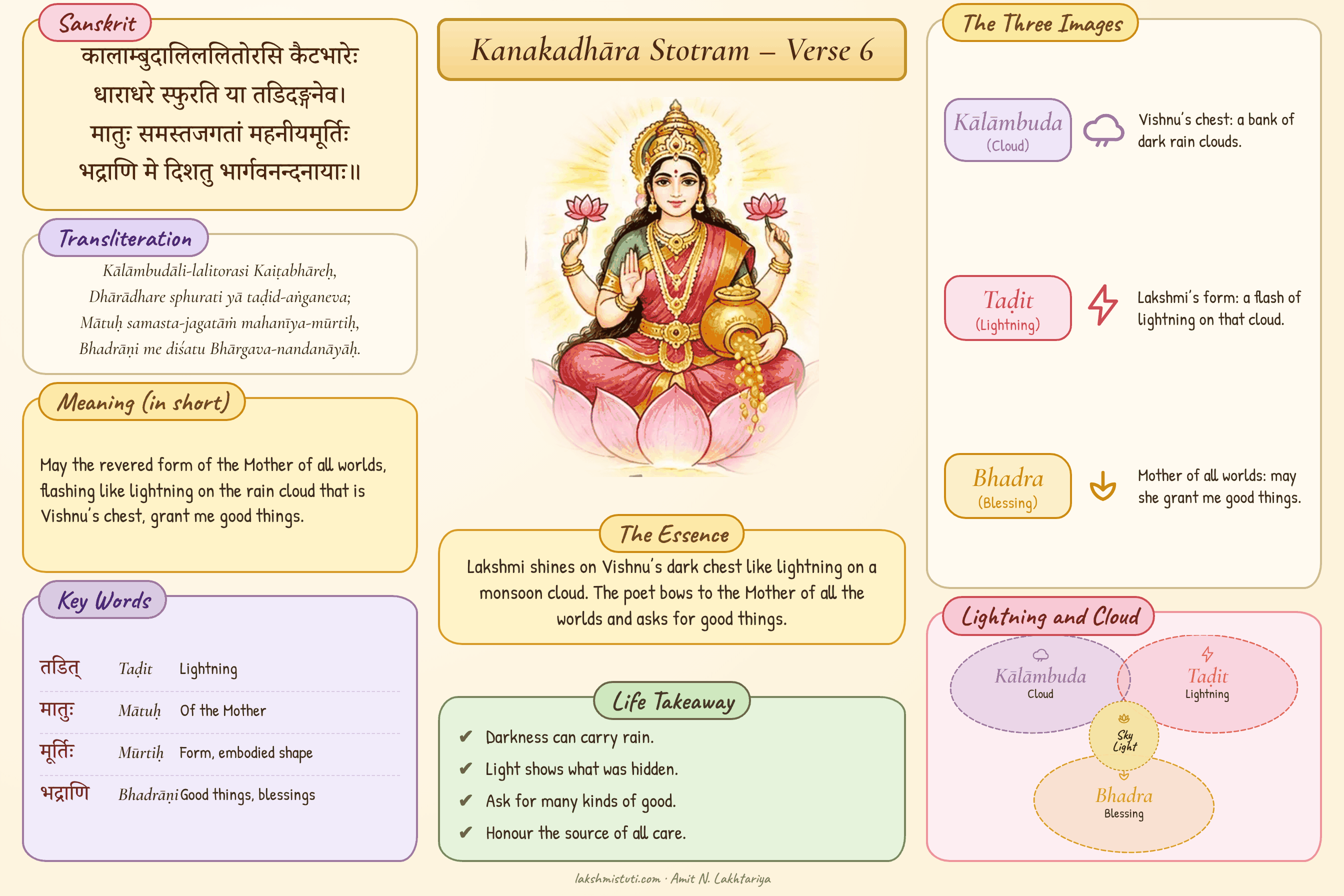
A one-page summary of the verse: Sanskrit, meaning, key ideas, key words and a takeaway. On a phone, open it full screen.
Word-by-word meaning
The literal meaning of each word.
| Sanskrit | Meaning |
|---|---|
| कालाम्बुदालिललितोरसिKāla-ambuda-āli-lalita-urasi | On the chest, lovely as a bank of dark clouds |
| कैटभारेःKaiṭabhāreḥ | Of the enemy of Kaiṭabha (Vishnu) |
| धाराधरेDhārā-dhare | On the rain-bearing cloud |
| स्फुरतिSphurati | Flashes, gleams |
| याYā | She who; the one which |
| तडिदङ्गनेवTaḍid-aṅganā iva | Like lightning pictured as a woman |
| मातुः समस्तजगताम्Mātuḥ samasta-jagatām | Of the Mother of all the worlds |
| महनीयमूर्तिःMahanīya-mūrtiḥ | The form worthy of reverence |
| भद्राणिBhadrāṇi | Good things, blessings |
| मे दिशतुMe diśatu | May she grant to me |
| भार्गवनन्दनायाःBhārgava-nandanāyāḥ | Of the daughter of Bhṛgu (Lakshmi) |
Notes on each word
Kāla is black or dark; ambuda is a cloud, literally “giver of water” (ambu, water, and da, giving); āli is a row or bank; lalita is charming, graceful; uras is the chest, and the ending means “on”. Together: on the chest that is lovely like a bank of dark clouds. The sounds join as kālāmbudāli-lalitorasi.
Kaiṭabha is the demon who, in tradition, was slain by Vishnu together with Madhu; ari is an enemy. So Kaiṭabhāri is Vishnu. In Verse 5 he was named by one of the pair, Madhujit; here by the other. The ending marks “of”.
Dhārā is a stream, a falling line of rain; dhara is a bearer. So dhārādhara is “the bearer of streams”, a rain cloud. The ending means “on”: the place where the lightning flashes.
The root sphur is to flash, quiver, glint. Like vibhāti in Verse 5, this is a plain statement of how the form appears, not a wish.
A feminine “which”. It points forward to the feminine mahanīya-mūrtiḥ, the revered form, in the third line: the form that flashes.
Taḍit is lightning; aṅganā is a woman, a lady; iva is “like”. The words run together as taḍid-aṅganeva. Lightning is pictured as a lady, so the flash has a figure and a grace. Readers also take it as “a woman bright as lightning”; the picture is the same.
Mātṛ is mother; the ending marks “of”. Samasta is all, entire; jagat is world, and jagatām is “of the worlds”. The text writes the last as jagatāṁ when it joins the next word.
Mahanīya is “to be honoured”, from mah, to honour and revere. Mūrti is a form, an embodied shape. This is the thing Śaṅkarācārya addresses: her revered form, which shines on the cloud.
Bhadra is good, auspicious, fortunate. The plural means “good things”, many kinds of well-being, not one gift.
The root diś is to point out, assign, grant. Diśatu is “let her grant, may she bestow”. Me is “to me”. This is the prayer of the verse.
Bhārgava means belonging to the sage Bhṛgu. Nandanā is a daughter (the masculine nandana is a son), literally one who gives delight. Tradition calls Lakshmi Bhārgavī, born as the daughter of Bhṛgu. The ending marks “of”.
Deeper spiritual insights
Interpretation and reflection: ideas that help us read the verse, not part of the text itself.
Before we begin
In verse five, we saw Lakshmi’s loving glances transform into a necklace of blue sapphires upon Lord Vishnu’s chest.
Now, in verse six, Śaṅkarācārya gives us a magnificent visual image: Goddess Lakshmi shining like a flash of lightning against the dark body of Lord Vishnu, who resembles a rain-bearing monsoon cloud.
It is a beautiful meeting of light and darkness, of nature and divinity. Let us decode it carefully.
“May the magnificent form of the daughter of Bhṛgu, the revered Mother of all the worlds, who shines like a maiden of lightning upon the beautiful, dark, rain-cloud-like chest of Kaiṭabhāri, Lord Vishnu, bestow auspicious blessings upon me.”
1The literary meaning
“O Mother Lakshmi, You shine upon the dark and beautiful chest of Lord Vishnu like a brilliant streak of lightning across a monsoon cloud.
You are the magnificent and venerable Mother of all creation, the beloved daughter of Sage Bhṛgu.
May Your divine presence bring auspiciousness, goodness and prosperity into my life.”
2In simple English
Śaṅkarācārya compares Vishnu’s dark complexion to a beautiful rain-filled cloud. Lakshmi, shining upon him, resembles a flash of lightning against that cloud.
He then remembers her universal identity: she is not merely Vishnu’s beloved consort, but the revered Mother of all worlds.
And he prays: “O Mother of the Universe, may Your magnificent presence bring goodness and auspiciousness into my life.”
3Two expressions deserve particular attention
Kaiṭabhāreḥ: Kaiṭabha was a demon associated with the traditional account of Vishnu’s cosmic victory. The name identifies Vishnu as the slayer of Kaiṭabha.
Bhārgava-nandanāyāḥ: Lakshmi is called the daughter of Bhṛgu. This is one of her traditional names and associations.
4The poetry hidden in the verse
Now imagine the scene. The sky is filled with enormous dark monsoon clouds. They are deep blue, almost black, carrying the promise of rain. There is a certain majesty in their darkness.
Śaṅkarācārya asks us to see Lord Vishnu in those clouds. He is the great sustainer, calm and majestic, with a complexion like the rain-filled sky.
And then, suddenly, there is light! A brilliant streak of lightning illuminates the darkness. That lightning is Lakshmi.
But notice something extraordinary: Śaṅkarācārya does not simply say that Lakshmi shines beside Vishnu. He compares her to a taḍid-aṅganā, a maiden of lightning. What a beautiful personification! Lightning becomes a graceful woman, dancing across the dark sky. And the dark sky becomes the divine body of Vishnu.
Imagine the contrast:
- The deep, dark blue of Vishnu.
- The radiant golden brilliance of Lakshmi.
- The sudden illumination that makes the entire sky glow.
For a moment, the darkness itself becomes beautiful because the lightning reveals its splendour.
And then Śaṅkarācārya expands the scene beyond the two divine figures. He calls Lakshmi mātuḥ samasta-jagatām, the Mother of all the worlds. We have moved from a beautiful intimate image of two divine beings to a cosmic vision of the Mother of the entire universe. That is the extraordinary journey of this verse. A flash of lightning becomes the Mother of creation.
And the prayer is simple: may that divine radiance illuminate my life too.
5Four deeper insights
A. Light and darkness are not always enemies
What the verse says: Lakshmi shines like lightning against Vishnu’s dark, rain-bearing-cloud-like form.
What we may contemplate: Darkness here is not portrayed as something evil. It is the majestic darkness of a cloud carrying rain. The cloud gives water; the lightning reveals its beauty.
In our lives, difficult periods can sometimes carry the possibility of renewal. We should not romanticize suffering, but neither should we assume that every dark period is without purpose. Sometimes a difficult season teaches us patience, resilience and discernment.
B. Lakshmi is more than material wealth
What the verse says: She is the Mother of all worlds, samasta-jagatām mātā.
This is a much larger description than simply calling her the Goddess of wealth. As a devotional reflection, Lakshmi represents the sustaining and nourishing abundance of life. Think of the different forms of abundance:
- Dhana: material wealth.
- Dhānya: food and nourishment.
- Vidyā: knowledge.
- Dhairya: courage and patience.
- Santāna: family continuity.
- Kīrti: honour and good reputation.
These are traditional categories of prosperity often associated with Lakshmi worship. They help us appreciate why her role is understood so broadly.
C. The meaning of Bhārgava-nandanā
Why does Śaṅkarācārya specifically call Lakshmi the daughter of Bhṛgu? The name connects the Goddess with an ancient lineage of Vedic tradition.
It also gives the prayer a personal devotional quality. Śaṅkarācārya is not invoking an abstract idea of prosperity. He is addressing a revered divine Mother through one of her traditional identities.
D. From beauty to blessing
The earlier verses repeatedly described Lakshmi’s eyes, glances and affection. Here, Śaṅkarācārya makes a larger prayer: bhadrāṇi me diśatu, may she grant me auspiciousness.
This is a meaningful change. He is no longer asking only for a moment of her glance. He asks for the goodness that her presence can bring into life.
It reminds us that the purpose of prayer is not simply to ask for things, but also to become receptive to a life of greater goodness.
6Reflection for today
I want to leave you with a thought arising from the image of the monsoon cloud and lightning. A cloud can be enormous, powerful and majestic. Yet a single flash of lightning can illuminate the entire sky. Similarly, sometimes a small moment of wisdom can change the way we see an enormous problem.
Consider these questions:
- Where in my life do I need greater clarity?
- Am I measuring prosperity only by financial growth?
- Can I use my success to nourish and support others, just as rain nourishes the earth?
The third question is particularly important. Wealth becomes truly meaningful when it creates something good beyond ourselves.
Three Sanskrit treasures to remember
- Taḍit – lightning, a flash of illumination; in this verse, the poetic image of Lakshmi’s radiant presence
- Mūrtiḥ – form or manifestation, the visible expression of something divine or sacred
- Bhadrāṇi – auspicious blessings and goodness; not merely good fortune, but the flourishing and well-being of life
7The essence of verse six
In this verse, Śaṅkarācārya gives us one of the most memorable images in the hymn: Lakshmi is the lightning. Vishnu is the magnificent monsoon cloud. Together, they reveal the beauty of divine abundance.
He then addresses Lakshmi as the Mother of all worlds and asks her to grant auspiciousness.
The central thought: true prosperity is not merely the accumulation of wealth. It is the arrival of light, wisdom, nourishment and goodness in our lives.
A question to carry into Verse 7
A glimpse of verse seven: it takes us in a fascinating direction. Śaṅkarācārya now describes how even Manmatha (Kāma, the god of love) obtained a place in the heart of Lord Vishnu through the influence of Lakshmi’s glance. He then makes a personal prayer that her gentle, languid half-glance may fall upon him.
In Verse 7 we will see how the hymn moves from the cosmic image of lightning to the delicate power of a single glance.
Practical meditation
- Five-minute meditation, The Light of the Mother: a quiet contemplation after reciting verse six. Minute 1, recitation: recite the verse slowly, paying particular attention to bhadrāṇi me diśatu Bhārgava-nandanāyāḥ.
- Minute 2VisualisationImagine a vast monsoon sky, dark and majestic. A beautiful flash of golden lightning illuminates it.
- Minute 3ContemplationVisualise Lakshmi as the radiant Mother of the universe. Let the image represent nourishment, compassion and abundance.
- Minute 4Personal reflectionThink about one difficult situation in your life. Ask yourself what wisdom, patience or courage might help you navigate it.
- Minute 5Prayer“O Mother of all worlds, may Your light guide my decisions. May there be prosperity in my home, wisdom in my work, compassion in my heart and auspiciousness in all that I undertake.”
True prosperity is not merely the accumulation of wealth; it is the arrival of light, wisdom, nourishment and goodness in our lives.
This meditation is a devotional practice for attention and reflection; it does not promise a supernatural result or guarantee material wealth.