Home › Kanakadhāra Stotram › Verse 21
The verse
॥ श्लोक २१ ॥
देवि प्रसीद जगदीश्वरि लोकमातः
कल्याणगात्रि कमलेक्षणजीवनाथे।
दारिद्र्यभीतिहृदयं शरणागतं माम्
आलोकय प्रतिदिनं सदयैरपाङ्गैः॥
॥ श्री महालक्ष्म्यै नमः ॥
Devi prasīda jagadīśvari lokamātaḥ
Kalyāṇagātri kamalekṣaṇa-jīvanāthe;
Dāridrya-bhīti-hṛdayaṁ śaraṇāgataṁ mām
Ālokaya pratidinaṁ sadayair apāṅgaiḥ.
Meaning in short
O Goddess, be gracious! O sovereign of the world, mother of the worlds, one of auspicious form, whose lord of life is the lotus-eyed Vishnu: look upon me every day with compassionate sidelong glances, me who have come for refuge with a heart afraid of poverty.
A prayer from a frightened heart: be gracious, I have come for refuge, look on me kindly every day.
Key highlights
- Prasīda Grace: be gracious, be pleased with me
- Dāridrya Fear: a heart afraid of poverty
- Śaraṇāgatam Refuge: one who has come for shelter
- Apāṅga Glance: a kind look, every day
Explore the four appeals
Tap a card to open its meaning and a question to carry with you.
PrasīdaGrace
Prasīda means “be gracious”. It comes from a root meaning to settle, as water settles and turns clear, and from it comes prasāda, grace. The first request is not for money but for her favour and a calm mind.
Pause and reflect: Where do I need calm more than I need a solution?
DāridryaFear
Dāridrya-bhīti is the fear of poverty. The verse names the fear, not the want. As a reflection, fear of loss can remain even when there is enough, and it can be a worry about money or about what we have not yet learned to trust.
Pause and reflect: What am I really afraid of losing?
ŚaraṇāgatamRefuge
Śaraṇāgata is one who has come to a shelter. It is not giving up effort. As a reflection, it is the humility to do one’s part and to say honestly what is beyond one’s control.
Pause and reflect: What am I carrying alone that I could ask for help with?
ApāṅgaGlance
Apāṅga is the corner of the eye, and a sidelong glance. Śaṅkarācārya asks for it every day, with compassion. The same image of the glance runs through the hymn, from Verse 8 to Verse 9, and here it is asked for in its own right.
Pause and reflect: How would my day change if I began it with a kind look?
Sketch note
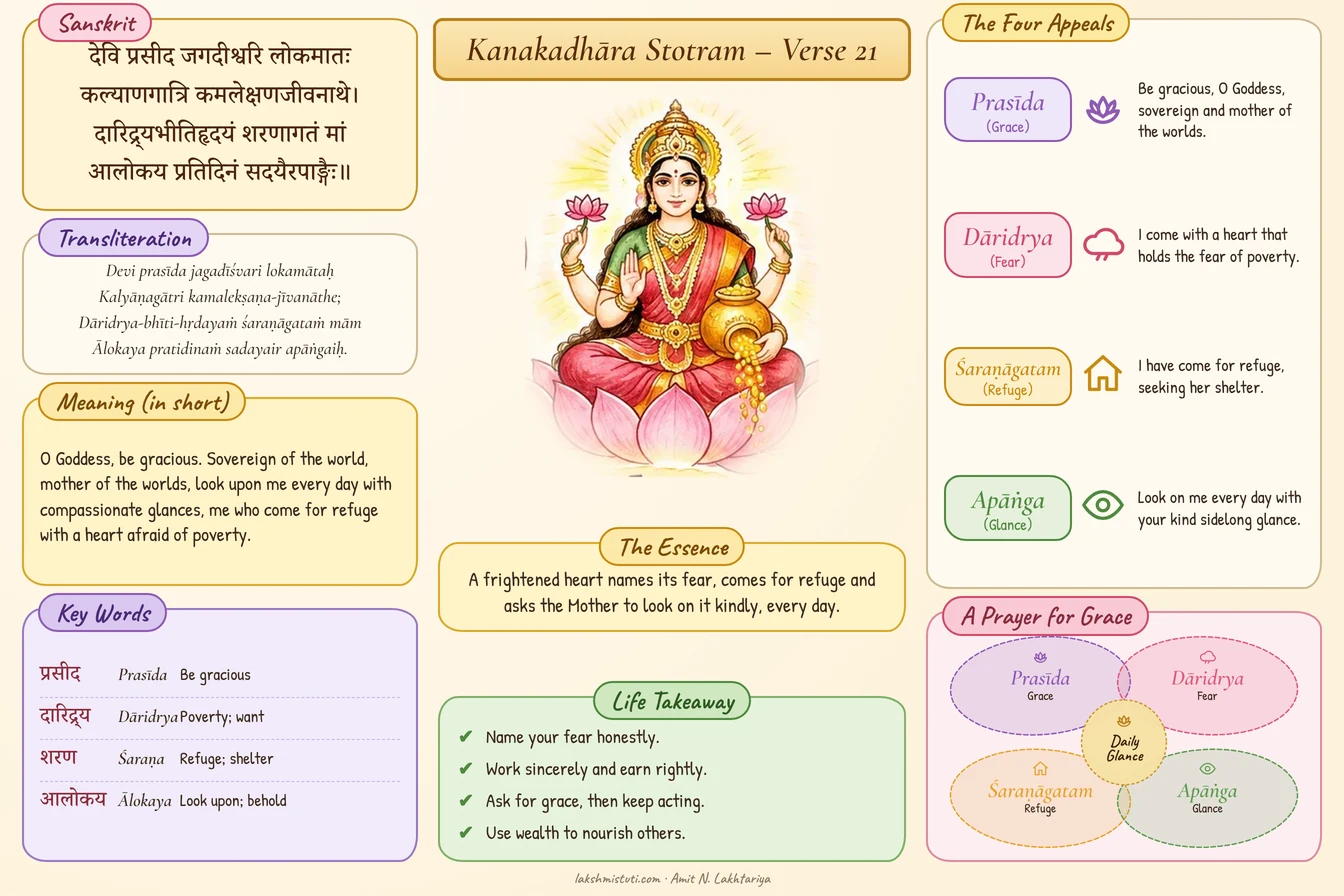
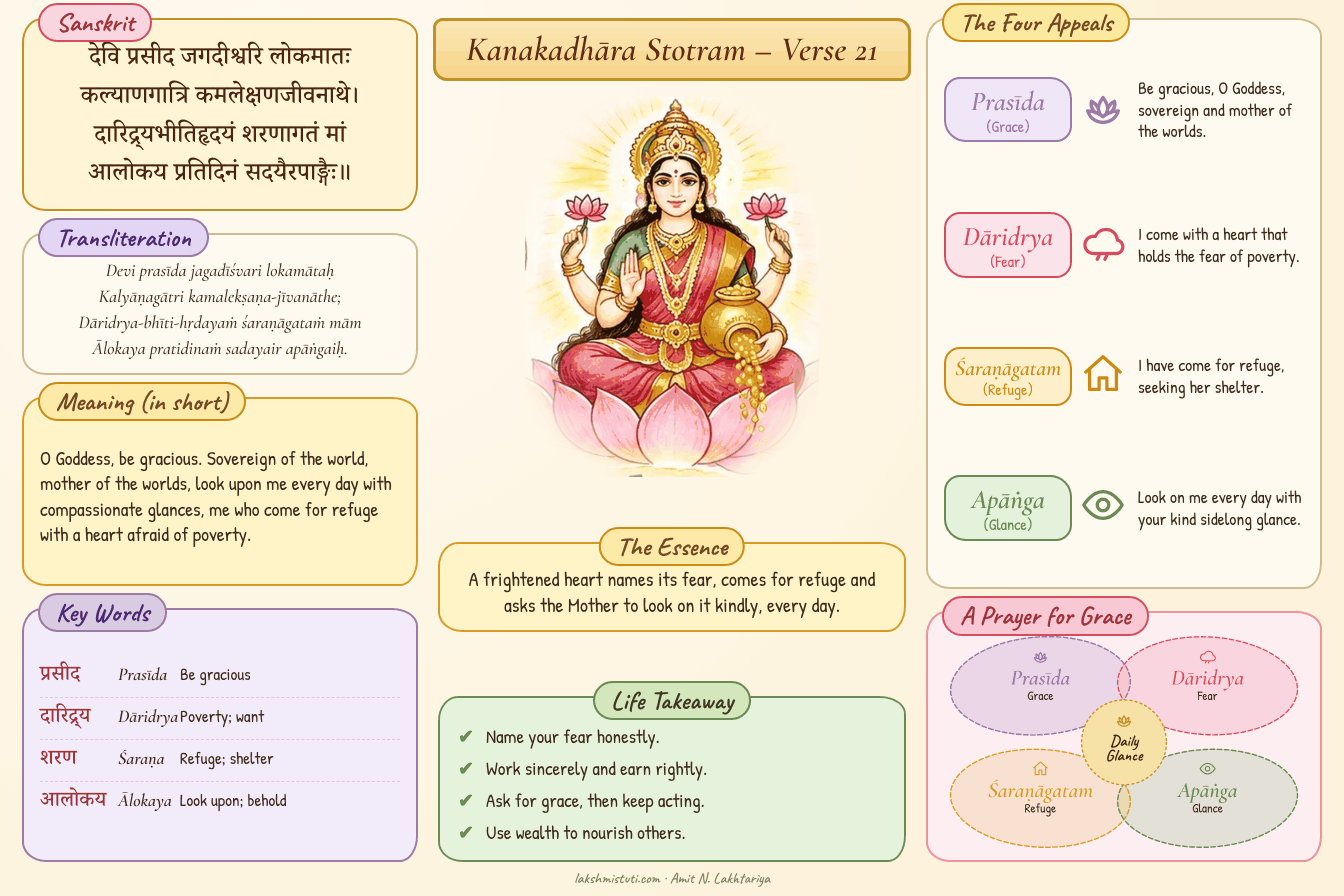
A one-page summary of the verse: Sanskrit, meaning, key ideas, key words and a takeaway. On a phone, open it full screen.
Word-by-word meaning
The literal meaning of each word.
| Sanskrit | Meaning |
|---|---|
| देविDevi | O Goddess |
| प्रसीदPrasīda | Be gracious; be pleased |
| जगदीश्वरिJagat-īśvari | O sovereign of the world |
| लोकमातःLoka-mātaḥ | O mother of the worlds |
| कल्याणगात्रिKalyāṇa-gātri | O one of auspicious form |
| कमलेक्षणजीवनाथेKamala-īkṣaṇa-jīvanāthe | O one whose lord of life is the lotus-eyed |
| दारिद्र्यभीतिहृदयंDāridrya-bhīti-hṛdayaṁ | Whose heart holds the fear of poverty |
| शरणागतंŚaraṇāgataṁ | One who has come for refuge |
| मांMām | Me |
| आलोकयĀlokaya | Look upon; behold |
| प्रतिदिनंPratidinaṁ | Every day |
| सदयैरपाङ्गैःSadayair apāṅgaiḥ | With compassionate sidelong glances |
Notes on each word
Devī is a goddess, and this is the call form. The verse opens by calling her, before any request: she is addressed first and asked second.
Prasīda is a command, second person singular, from pra + the root sad, “to settle”. The idea is of a troubled surface becoming clear and calm, as water does when it settles. From the same root comes prasāda, grace. So the first request is not for money; it is “be gracious to me”.
Jagat is the world, literally “that which moves”; īśvarī is a mistress, a sovereign. The final t of jagat turns into d before the vowel, giving jagadīśvarī, and the long final ī shortens in the call form: jagadīśvari.
Loka is a world or realm; mātṛ is a mother, and mātaḥ is its call form. Śaṅkarācārya moves from “sovereign” to “mother”: the first word is about her rank, the second about how he dares to approach her.
Kalyāṇa is auspicious, good, well-being; gātra is a limb or body. So she is “the one whose form is auspicious”. This site follows the reading kalyāṇagātri, as in the text we checked.
Kamala is a lotus; īkṣaṇa is the eye, and kamalekṣaṇa is “lotus-eyed”, a name of Vishnu. Jīvanātha is “lord of one’s life”, a husband. So she is the one whose lord of life is the lotus-eyed Vishnu. The a and ī join into e.
Dāridrya is poverty, want; bhīti is fear; hṛdaya is the heart. Together they describe the speaker: “one whose heart is full of the fear of want”. It is the one place in the hymn where he names his fear plainly.
Śaraṇa is shelter, refuge; āgata is arrived, come. So śaraṇāgata is someone who has come to a refuge. Together with the previous word, it describes mām, “me”: the one with a fearful heart who has come for shelter.
Mām is “me”, in the form used for the object of the verb: the one she is asked to look upon. The long phrases before it all describe him.
Ālokaya is a command, from ā + the root lok, “to see”. It means look at, look upon with attention. Prasīda asked for her grace; this word asks for her attention.
Prati means “each” and dina is a day. The request is not for one gift on one day, but for her glance every day.
Sa is “with” and daya is compassion, so sadaya is compassionate. Apāṅga is the outer corner of the eye, and so a sidelong glance. The ending -aiḥ means “by means of”. The visarga turns into r before the vowel of the next word, giving sadayair apāṅgaiḥ.
Deeper spiritual insights
Interpretation and reflection: ideas that help us read the verse, not part of the text itself.
Before we begin
We have now reached the closing movement of the Stotram. The last two verses belong together: Verse 21 is the devotee’s final personal appeal to the Divine Mother; Verse 22 is the concluding benediction describing the fruit of praising her.
There is a beautiful progression here. Śaṅkarācārya first places his fears before the Goddess, and then closes by praising the spiritual and worldly good fortune of those who remember her daily.
“O Goddess, be gracious! O Sovereign of the Universe, Mother of all worlds, embodiment of auspiciousness and beloved of the lotus-eyed Lord! I have taken refuge in you, my heart troubled by the fear of poverty. Look upon me every day with your compassionate sidelong glances.”
1A more poetic rendering
O Mother of the Universe, be gracious to me. O Auspicious One, beloved of the Lotus-eyed Lord, I come to you with a heart burdened by the fear of want. Having taken refuge at your feet, may your compassionate glance rest upon me, every day.
A grammatical observation: prasīda and ālokaya are both imperative forms. The devotee makes two direct requests: “Be gracious” and “Look upon me.” The entire verse is a personal prayer, not merely a description of Lakshmi.
2The four profound expressions
Image 1 – Jagadīśvari, Lokamātaḥ
Two extraordinary titles are placed together: jagadīśvarī, Sovereign Lady of the universe, and lokamātā, Mother of all worlds.
Notice the balance. She is the supreme ruler, yet she is also the Mother. Her authority is not separated from affection. A ruler may command, but a mother nurtures. Śaṅkarācārya brings these two dimensions together in Lakshmi. This also connects with Verse 19, where she was described as jagatāṁ jananīm, the Mother of the worlds.
Contemplation: The highest power is not merely the power to govern; it is the power to protect, nourish and sustain.
Image 2 – Kalyāṇagātri: the embodiment of auspiciousness
Kalyāṇa is auspiciousness, welfare, goodness, and gātra is body, limb or form. Śaṅkarācārya addresses Lakshmi as the one whose very form is auspicious.
This is more than physical beauty. Her presence itself is associated with welfare, harmony and goodness. In earlier verses, we saw the Goddess as golden, lotus-bearing and radiant. Here, he gathers those qualities into a larger idea: kalyāṇa. Auspiciousness is not merely having good fortune. It is the presence of what contributes to a good and harmonious life.
Image 3 – Kamalekṣaṇa-jīvanāthe: beloved of the lotus-eyed Lord
Kamala is lotus, īkṣaṇa is eye or vision, so kamalekṣaṇa is the lotus-eyed Lord, Vishnu; jīvanātha is the beloved Lord, or one who is dear as life itself.
Śaṅkarācārya again invokes Lakshmi’s inseparable relationship with Vishnu. This is not an incidental description. Throughout the Stotram, he repeatedly identifies Lakshmi through her relationship with Nārāyaṇa, Hari, Dāmodara and Murāri. The repeated references remind us that Lakshmi is not simply a deity of wealth. She belongs to the larger divine principle of preservation, harmony and sustaining order.
Image 4 – Dāridrya-bhīti-hṛdayam: a heart troubled by the fear of poverty
This is perhaps the most human expression in the entire closing prayer. Dāridrya is poverty or deprivation, bhīti is fear and hṛdaya is heart. Śaṅkarācārya does not hide his vulnerability. He admits that his heart is troubled by the fear of poverty.
Let us not dilute the meaning: poverty here does include material deprivation. This is a hymn to Lakshmi, and the prayer for material well-being is genuine. But the expression also invites a wider reflection. Fear of deprivation can affect the mind even when a person possesses considerable resources. The fear of losing what one has can become another form of poverty of the heart.
He asks for the Goddess’s compassionate attention rather than pretending to be fearless.
3The importance of śaraṇāgati
Śaraṇāgataṁ mām means: “Me, who has taken refuge.” In Hindu devotional thought, śaraṇāgati is surrender or taking refuge in the Divine. It does not necessarily mean abandoning one’s responsibilities or efforts. Rather, it means recognising the limits of one’s own control while continuing to act with sincerity.
There is a meaningful sequence in this verse: the devotee recognises the greatness of the Goddess; he admits his own fear and vulnerability; he takes refuge in her; and he asks for her compassionate glance every day.
The prayer is not simply, “Remove my poverty.” It is, “Do not turn your compassionate gaze away from me.”
4Why does he ask for the glance every day?
Pratidinam is every day, sadayaiḥ is compassionate and apāṅgaiḥ is with sidelong glances. Recall Verse 20: karuṇā-pūra-taraṅgitair apāṅgaiḥ. There, the devotee asked for glances overflowing with waves of compassion. Now, he asks that those compassionate glances continue every day.
The difference is subtle but beautiful. Verse 20: let your compassion look towards me. Verse 21: let that compassionate attention remain with me, day after day. It is a prayer for continuing grace, not a one-time blessing.
5Philosophical reflection
Śaṅkarācārya openly admits his fear of poverty. Spirituality does not require pretending that practical difficulties do not exist.
The devotee takes refuge in the Goddess, but the verse does not instruct him to abandon worldly duties. Faith and effort can walk together.
The final request is for a compassionate glance. Material security matters, but the devotee also seeks the assurance that he is not abandoned.
6The final appeal of the devotee to the Mother
This verse brings together the central emotional themes of the Stotram: faith, vulnerability, surrender and compassion. The devotee does not approach the Goddess as someone who has achieved everything. He approaches as someone who needs her grace.
May the Divine Mother look upon us with compassion every day, not only when we are in difficulty, but also when we are prosperous, so that we never lose humility, gratitude or righteousness.
How to pronounce the key words
Devi prasīda jagadīśvari lokamātaḥ: de-vi pra-see-da ja-ga-dee-shva-ri lo-ka-maa-tah. Kalyāṇagātri kamalekṣaṇa-jīvanāthe: kal-yaa-na-gaa-tri ka-ma-lek-sha-na jee-va-naa-the. Dāridrya-bhīti-hṛdayaṁ śaraṇāgataṁ mām: daa-rid-rya-bhee-ti-hri-da-yam sha-ra-naa-ga-tam maam. Ālokaya pratidinaṁ sadayair apāṅgaiḥ: aa-lo-ka-ya pra-ti-di-nam sa-da-yair a-paan-gaih.
A question to carry into Verse 22
After twenty-one verses of describing Lakshmi’s beauty, divine power, compassion and auspiciousness, Śaṅkarācārya now speaks about those who praise her through this Stotram. Verse 22, stuvanti ye stutibhir amībhir anvaham…, is a phalaśruti-like concluding benediction, a statement about the fruits associated with the regular recitation and contemplation of the hymn.
The closing thought is especially significant: the devotee is not promised only wealth, but virtues, great fortune and a mind respected by the wise.
Practical meditation
- Recite each line slowly. Jagadīśvari, Lokamātaḥ: “Remember that the Divine Mother is the source of protection and nourishment.”
- Kalyāṇagātri: “Invite auspiciousness into your thoughts, words and actions.”
- Kamalekṣaṇajīvanāthe: “Contemplate the inseparable divine relationship of Lakshmi and Nārāyaṇa.”
- Dāridryabhītihṛdayaṁ śaraṇāgataṁ mām: “Acknowledge your fears honestly, without shame.”
- Ālokaya pratidinaṁ sadayair apāṅgaiḥ: “Ask for the strength to live each day under the guidance of compassion.” Then pray: “O Mother, protect me from deprivation, but also protect my heart from greed, fear and ingratitude.”
The final appeal of the devotee to the Mother: may her compassion look upon us every day, in difficulty and in prosperity, so that we never lose humility, gratitude or righteousness.
This meditation is a devotional practice for attention and reflection; it does not promise a supernatural result or guarantee material wealth.