Home › Kanakadhāra Stotram › Verse 15
The verse
॥ श्लोक १५ ॥
नमोऽस्तु कान्त्यै कमलेक्षणायै
नमोऽस्तु भूत्यै भुवनप्रसूत्यै।
नमोऽस्तु देवादिभिरर्चितायै
नमोऽस्तु नन्दात्मजवल्लभायै॥
॥ श्री महालक्ष्म्यै नमः ॥
Namo ’stu kāntyai kamalekṣaṇāyai
Namo ’stu bhūtyai bhuvana-prasūtyai;
Namo ’stu devādibhir arcitāyai
Namo ’stu nandātmaja-vallabhāyai.
Meaning in short
Let there be a bow to her who is loveliness and whose eyes are lotuses. Let there be a bow to her who is prosperity, the mother of the worlds. Let there be a bow to her who is worshipped by the gods and others. Let there be a bow to her who is the beloved of Nanda’s son.
Four bows to her radiance, her prosperity, the worship she receives and the one she loves.
Key highlights
- Kānti Radiance: loveliness with lotus eyes
- Bhūti Prosperity: well-being, mother of the worlds
- Arcitā Worship: honoured by the gods and others
- Nandātmaja Beloved: of the son of Nanda
Explore the four bows
Tap a card to open its meaning and a question to carry with you.
KāntiRadiance
Kānti is loveliness and radiance, the glow that draws the eye. The first line bows to her as radiance and as lotus-eyed. A reflection: a first sign of her is a certain brightness; wealth without it can feel cold.
Pause and reflect: What brings real brightness to my work and home?
BhūtiProsperity
Bhūti comes from bhū, “to be”: being, flourishing, prosperity. The second line bows to her as prosperity and as mother of the worlds. A reflection: here prosperity is a way of being fully alive, not only an amount.
Pause and reflect: Where am I only surviving, and where am I thriving?
ArcitāWorship
Arcitā means worshipped, and devādi means the gods and others. In Verse 13 her mercy went out to the gods; here their worship comes to her. A reflection: the verse puts honour and mercy in both directions.
Pause and reflect: What do I honour in practice, not only in word?
NandātmajaBeloved
Nandātmaja is the son of Nanda, that is Krishna. It is the fifth name in a row for her beloved: Puruṣottama, Nārāyaṇa, Śārṅgāyudha, Dāmodara and now Nandātmaja, while she stays the same.
Pause and reflect: What stays the same in me while my circumstances change?
Sketch note
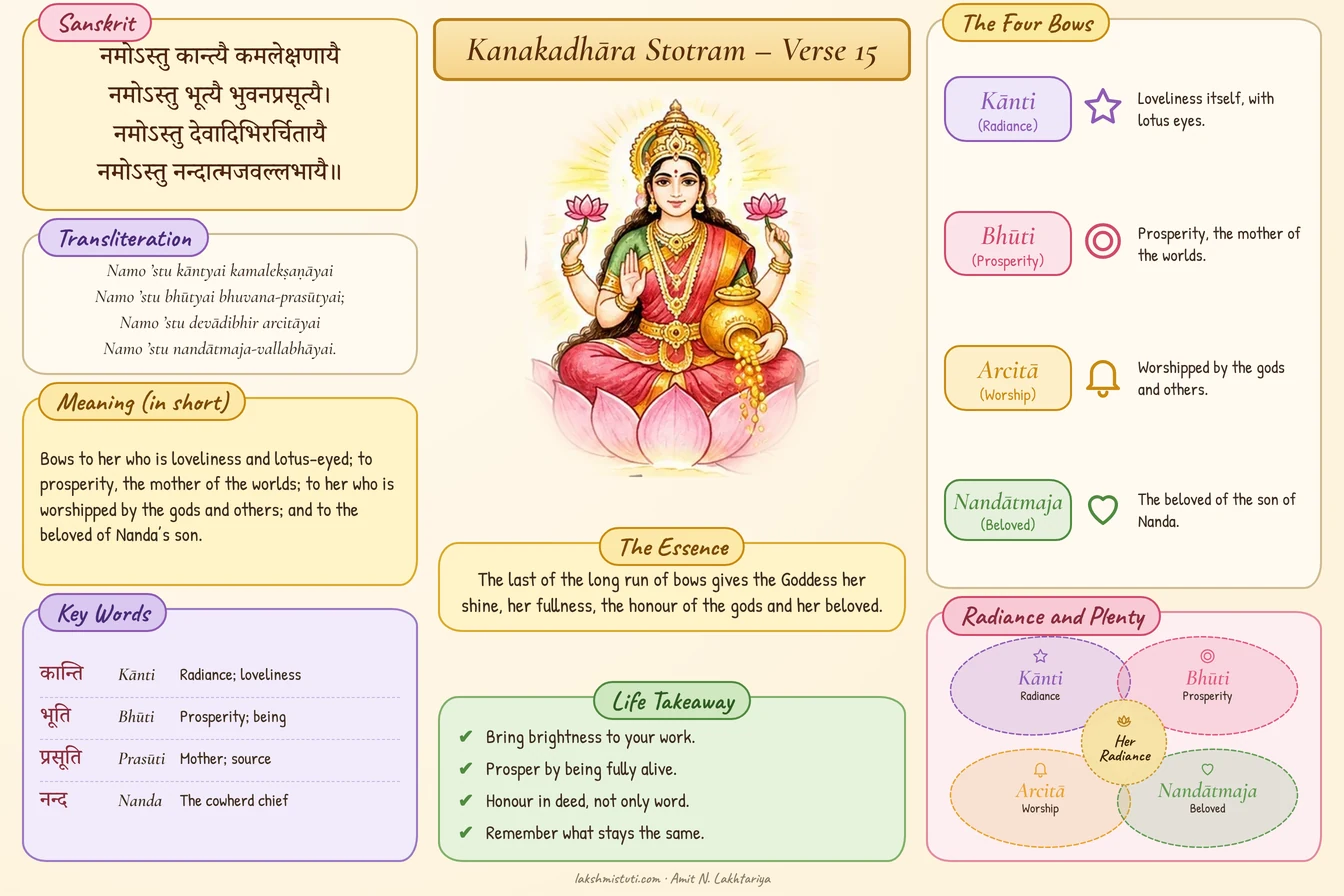
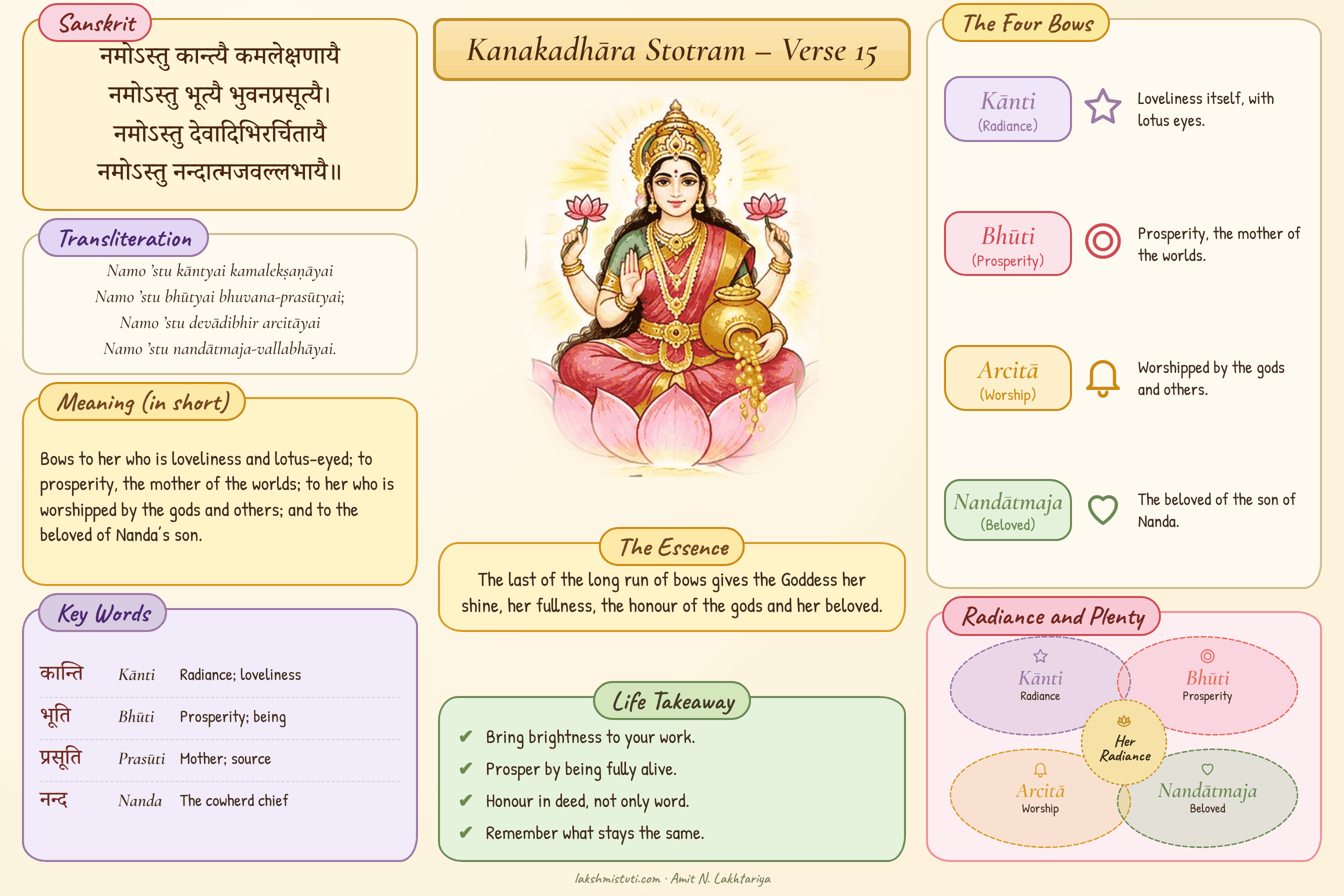
A one-page summary of the verse: Sanskrit, meaning, key ideas, key words and a takeaway. On a phone, open it full screen.
Word-by-word meaning
The literal meaning of each word.
| Sanskrit | Meaning |
|---|---|
| नमः अस्तुNamo ’stu | Let there be a bow |
| कान्त्यैKāntyai | To Kānti, loveliness and radiance |
| कमलेक्षणायैKamala-īkṣaṇāyai | To her whose eyes are like lotuses |
| भूत्यैBhūtyai | To Bhūti, prosperity and well-being |
| भुवनप्रसूत्यैBhuvana-prasūtyai | To the mother of the worlds |
| देवादिभिरर्चितायैDevādibhir arcitāyai | To her who is worshipped by the gods and others |
| नन्दात्मजवल्लभायैNanda-ātmaja-vallabhāyai | To the beloved of Nanda’s son |
Notes on each word
The familiar opening: namaḥ, a bow, and astu, “let it be”, joined as namo ’stu. It begins each of the four lines.
Kānti is loveliness, radiance, a beauty that attracts, from a root meaning “to desire, to shine”. It is a feminine word ending in -i, so its “to” form is -yai: kāntyai. It is one of the Goddess’s names for her shining beauty.
Kamala is a lotus; īkṣaṇa is the eye, from the root īkṣ, “to see”. So she is lotus-eyed, the same picture as saroruhākṣi in a later verse. The a and ī join into e, giving kamalekṣaṇā.
Bhūti comes from the root bhū, “to be, to become”. It means being, flourishing, prosperity, well-being. It is a feminine word in -i, so its “to” form is bhūtyai. In the tradition it is a name of Lakshmi herself.
Bhuvana is a world; prasūti is bringing forth, birth, and so a mother or a source. So she is the one from whom the worlds are brought forth. The ending -yai is again “to”, from prasūti.
Devādi is “the gods and the rest”; -bhiḥ means “by”, in the plural. Arcitā is “worshipped, honoured”, from the root arc. The visarga of -bhiḥ becomes r before the vowel a, so it is written devādibhir arcitāyai.
Nanda is the cowherd chief who raised Krishna; ātmaja is “born of oneself”, a son. So nandātmaja is the son of Nanda, that is Krishna, a form of Vishnu. Vallabhā is a beloved. She is the beloved of Nanda’s son.
Deeper spiritual insights
Interpretation and reflection: ideas that help us read the verse, not part of the text itself.
Before we begin
We have now reached a particularly beautiful verse in our study.
In Verse 13, Śaṅkarācārya praised Lakshmi as the sovereign of the world. In Verse 14, he described her divine identity and her inseparable relationship with Vishnu.
In Verse 15, Śaṅkarācārya moves from her beauty to her creative power, from her splendour to her role as the mother of the universe, and finally to her intimate association with Krishna. There is a remarkable progression in these four lines.
“O Mother, I bow to you, radiant and lotus-eyed. I bow to you, prosperity itself and mother of the worlds. I bow to you, whom the gods and others worship. I bow to you, beloved of Nanda’s son.”
1The four divine descriptions
First – Kānti, Kamalekṣaṇā: radiance and lotus eyes
Śaṅkarācārya begins with kānti, not merely physical beauty but divine radiance. Then comes kamalekṣaṇā: she whose eyes resemble the lotus. In Indian poetic tradition, lotus-like eyes suggest tenderness, serenity, beauty and compassion.
But consider the sequence: first Śaṅkarācārya praises her radiance, then her eyes. The eyes are especially significant in devotional poetry because the divine glance (kaṭākṣa) is often understood as a symbol of grace.
Contemplation: The true beauty of a person is not only in appearance, but in the compassion reflected through their eyes.
Second – Bhūti, Bhuvana-prasūti: prosperity and mother of the worlds
This is arguably the philosophical heart of the verse. Bhūti has a much wider meaning than money. It can represent prosperity, well-being, power, splendour and auspicious abundance. Bhuvana-prasūti describes the Goddess as the mother or source of the worlds.
Śaṅkarācārya has moved from the beauty of her eyes to the origin of the universe itself. Lakshmi is not being praised merely as someone who distributes wealth to individuals. She is associated with the very abundance and flourishing of existence.
Contemplation: Prosperity is not simply what we possess; it is also the power that allows life, society and the world to flourish.
Third – Devādibhir-arcitā: worshipped by the gods
Deva means god or celestial being. Ādi means beginning with or including others. Arcita means worshipped or honoured. Even the gods offer reverence to her.
This is a significant poetic statement. The Goddess is not merely a source of prosperity for human beings; she is worthy of reverence even among the celestial beings. It also reinforces her universal stature, already introduced in Verse 13.
Contemplation: True greatness does not need to announce itself. Its worth is recognised through its qualities and the good it brings.
Fourth – Nandātmaja-vallabhā: beloved of Nanda’s son
Nandātmaja means the son of Nanda, Krishna. Vallabhā means beloved. Śaṅkarācārya addresses Lakshmi as the beloved of Krishna.
In Vaishnava theology, Krishna is understood as an incarnation of Vishnu. Lakshmi, the eternal divine consort of Nārāyaṇa, is therefore associated with Krishna as well. This is not simply a reference to a human relationship. It is a devotional expression of the inseparability of Lakshmi and Vishnu, including Vishnu’s Krishna incarnation.
Contemplation: The Supreme is not only the source of the universe; the Supreme is also approached through love, affection and devotion.
2A deeper question: why does Śaṅkarācārya call Lakshmi both Bhūti and Bhuvana-prasūti?
I would like to pause here because these two words deserve special attention. Bhūti represents the manifestation of prosperity, splendour and well-being. Bhuvana-prasūti takes us to the source of the worlds themselves.
The distinction is subtle but important: Bhūti describes the abundance that becomes manifest, and Bhuvana-prasūti describes the maternal source from which the worlds arise.
In other words, Lakshmi is praised not only as the giver of prosperity but as the divine principle associated with the flourishing of creation. This is a much more expansive understanding of Lakshmi than the popular association with material wealth alone.
3Why does the verse end with Krishna?
| Verse | Final expression | Divine relationship |
|---|---|---|
| 13 | Śārṅgāyudha-vallabhā | Beloved of Vishnu, bearer of Śārṅga |
| 14 | Dāmodara-vallabhā | Beloved of Dāmodara |
| 15 | Nandātmaja-vallabhā | Beloved of Nanda’s son, Krishna |
Śaṅkarācārya repeatedly identifies Lakshmi through her relationship with Vishnu, but he changes the name of the Lord. Each name brings a different aspect of Vishnu into our contemplation: Śārṅgāyudha, Vishnu as the divine protector; Dāmodara, Krishna as the Lord who accepts the loving bond of Yaśodā; Nandātmaja, Krishna as the beloved child of Nanda and the Lord of Vṛndāvana.
There is a movement from majesty to intimacy. The Lord who sustains the universe is also the child of Nanda. And Lakshmi, the universal Goddess, is praised as his beloved. This is one of the beautiful ways devotional poetry bridges cosmic theology and personal devotion.
4The philosophical interpretation: four lessons for life
A person’s real brilliance comes from character, clarity, kindness and conduct.
Money is one form of prosperity, but health, knowledge, relationships, peace and meaningful work are also forms of abundance.
Like the maternal principle, contribute to the development of people and institutions around you.
Achievement and prosperity have little meaning if affection, humility and devotion disappear from life.
These are contemplative lessons inspired by the verse, rather than literal translations.
5Sanskrit vocabulary to remember
| Word | Meaning | Deeper association |
|---|---|---|
| Kānti | Radiance | Inner brilliance |
| Kamalekṣaṇa | Lotus-eyed | Compassionate divine vision |
| Bhūti | Prosperity | Flourishing and well-being |
| Bhuvana | World | Creation |
| Prasūti | Birth, source | Motherhood and origin |
| Arcita | Worshipped | Reverence |
| Nandātmaja | Son of Nanda | Krishna |
| Vallabhā | Beloved | Divine intimacy |
6The progression across Verses 13–15
There is a beautiful philosophical progression. Verse 13: Lakshmi is the sovereign of the world. Verse 14: Lakshmi is inseparable from Vishnu. Verse 15: Lakshmi is the source of the world’s abundance and is intimately associated with Krishna.
The three verses together present a Goddess who is simultaneously cosmic, sustaining, compassionate and deeply personal.
A question to carry into Verse 16
We have now completed our detailed study of Verses 12, 13, 14 and 15. One recurring idea deserves to be carried into the next part of our study: Śaṅkarācārya does not define Lakshmi through a single quality. He approaches her through beauty, origin, compassion, sovereignty, motherhood, prosperity and divine companionship.
Each name is a window. The Goddess is one; the dimensions of her glory are many. And perhaps that is why Śaṅkarācārya keeps returning to namo ’stu, because one salutation never seems enough. In Verse 16 the bows give way to a direct and personal prayer.
Practical meditation
- Recite each line slowly. Pause after each namo ’stu and allow its meaning to settle. Kāntyai Kamalekṣaṇāyai: “May my thoughts, words and actions develop the radiance of kindness and purity.”
- Bhūtyai Bhuvana-prasūtyai: “May prosperity enter my life, and may my presence become a source of growth for others.”
- Devādibhir-arcitāyai: “May I cultivate qualities worthy of respect, rather than merely seeking recognition.”
- Nandātmaja-vallabhāyai: “May love, devotion and humility remain at the centre of my life.”
She is the radiance of beauty, the abundance of existence, the motherly source of the worlds, and the beloved of the Supreme Lord.
This meditation is a devotional practice for attention and reflection; it does not promise a supernatural result or guarantee material wealth.