Home › Kanakadhāra Stotram › Verse 12
The verse
॥ श्लोक १२ ॥
नमोऽस्तु नालीकनिभाननायै
नमोऽस्तु दुग्धोदधिजन्मभूम्यै।
नमोऽस्तु सोमामृतसोदरायै
नमोऽस्तु नारायणवल्लभायै॥
॥ श्री महालक्ष्म्यै नमः ॥
Namo ’stu nālīka-nibhānanāyai
Namo ’stu dugdhodadhi-janma-bhūmyai;
Namo ’stu somāmṛta-sodarāyai
Namo ’stu nārāyaṇa-vallabhāyai.
Meaning in short
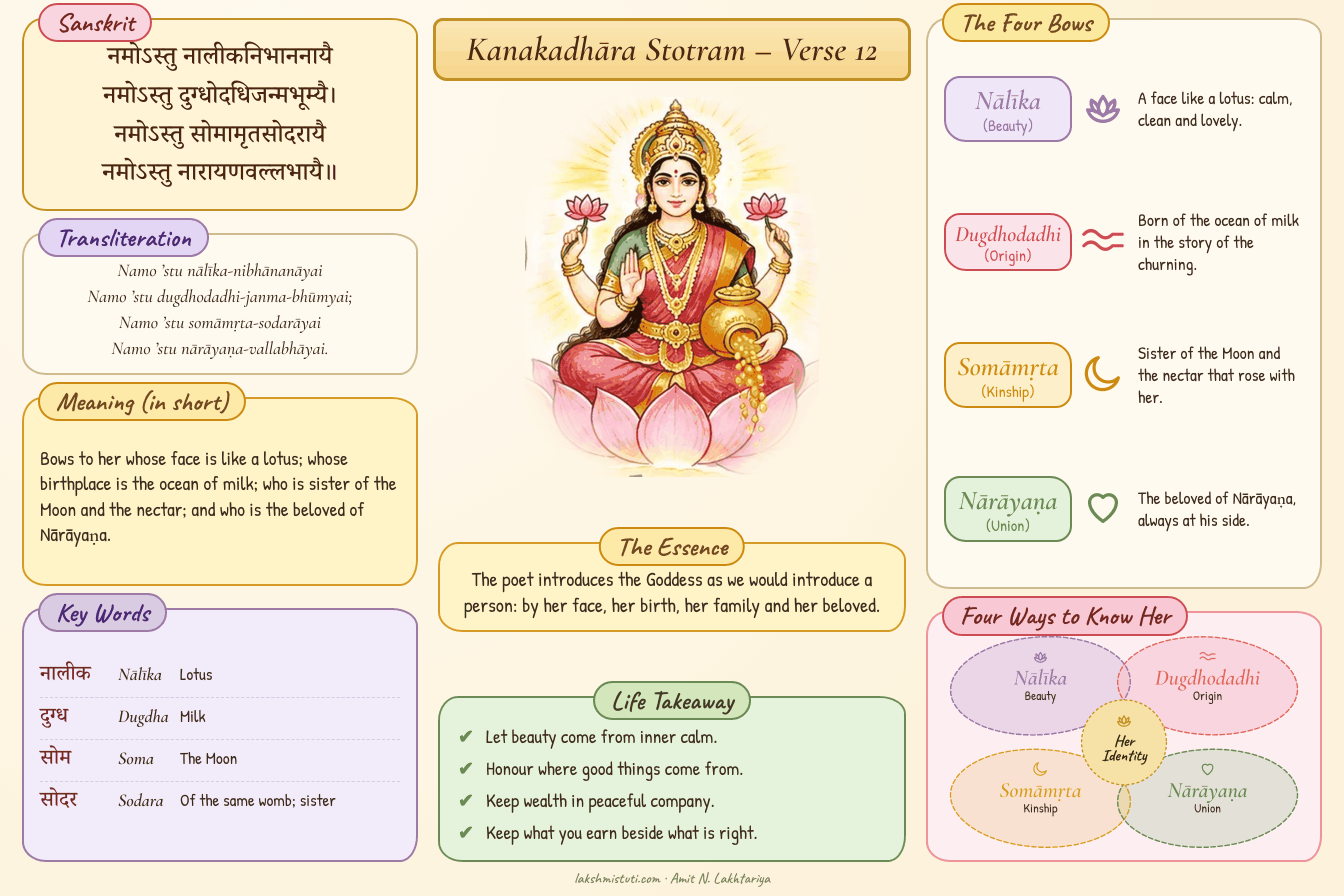
Let there be a bow to her whose face is like a lotus. Let there be a bow to her whose birthplace is the ocean of milk. Let there be a bow to her who is the sister of the Moon and of the nectar of immortality. Let there be a bow to her who is the beloved of Nārāyaṇa.
Four bows that tell us who she is: her face, her birth, her family and her beloved.
Key highlights
- Nālīka Beauty: a face like a lotus, calm and pure
- Dugdhodadhi Origin: born of the ocean of milk
- Somāmṛta Kinship: sister of the Moon and the nectar
- Nārāyaṇa Union: the beloved of Vishnu
Explore the four bows
Tap a card to open its meaning and a question to carry with you.
NālīkaBeauty
Nālīka is a lotus, and the first bow is to a face that looks like one. A lotus grows from mud and stays clean, which is why Indian poetry uses it for calm and purity. Śaṅkarācārya begins with her face, the part we look at first.
Pause and reflect: What does my face show people when I am under pressure?
DugdhodadhiOrigin
The tradition says Lakshmi rose from the ocean of milk when gods and demons churned it. Śaṅkarācārya bows to that birthplace. A reflection: in the old story good things come out of a long, shared effort, not from a single moment.
Pause and reflect: Which patient effort of mine should I not abandon yet?
SomāmṛtaKinship
Sodarā means born of the same womb, a sister. Lakshmi is called sister of the Moon and of the nectar of immortality because all three rose from the same ocean. Prosperity is brought up beside calm and beside what lasts.
Pause and reflect: Does what I am gathering come with calm, or only with worry?
NārāyaṇaUnion
Vallabhā is a beloved, and Nārāyaṇa is Vishnu. The four bows end where Lakshmi’s own story rests: at her husband’s side. Many readers take this as a reminder that wealth sits best beside what is right.
Pause and reflect: Is what I earn kept in the company of what is right?
Sketch note
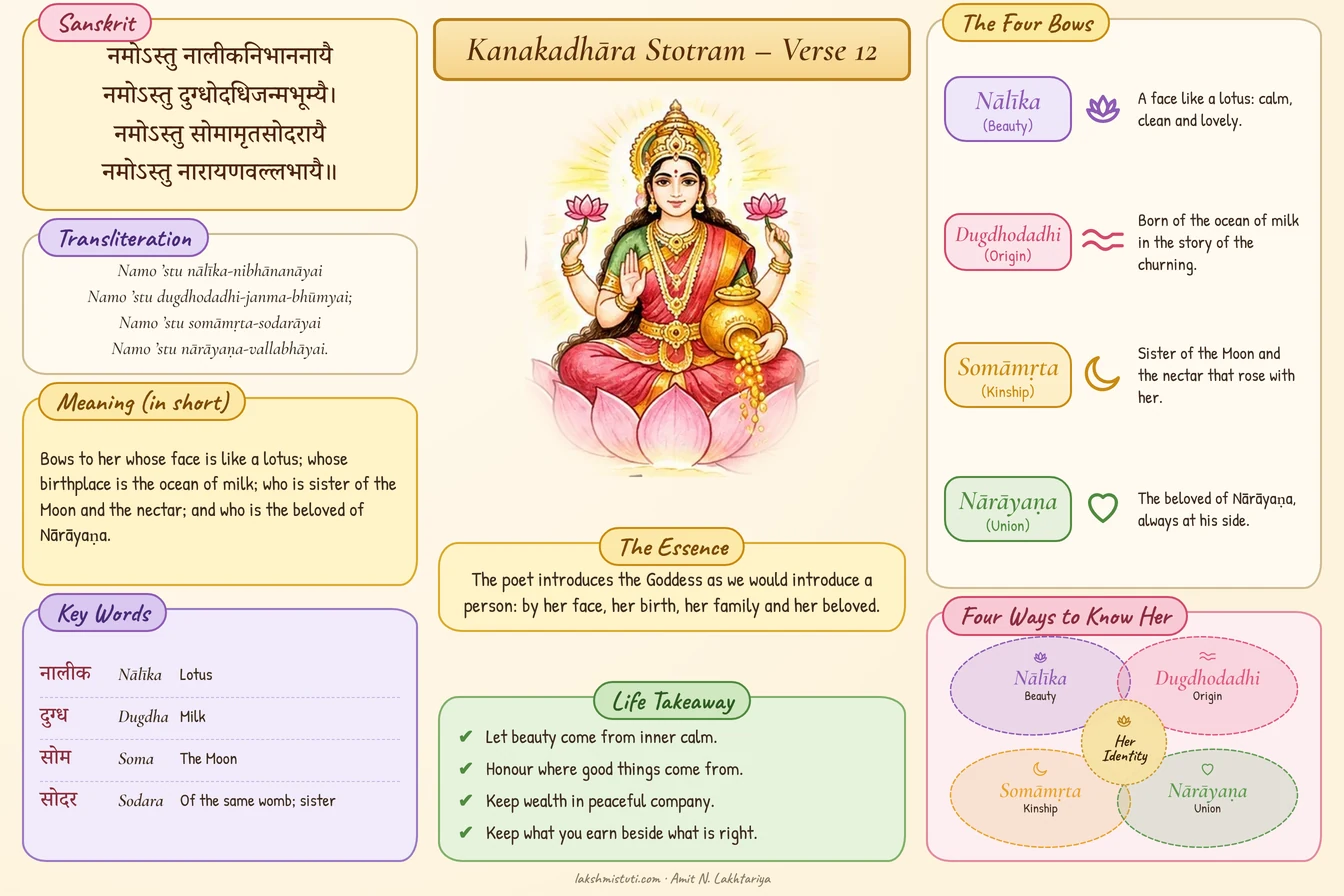
A one-page summary of the verse: Sanskrit, meaning, key ideas, key words and a takeaway. On a phone, open it full screen.
Word-by-word meaning
The literal meaning of each word.
| Sanskrit | Meaning |
|---|---|
| नमः अस्तुNamo ’stu | Let there be a bow |
| नालीकनिभाननायैNālīka-nibha-ānanāyai | To her whose face is like a lotus |
| दुग्धोदधिजन्मभूम्यैDugdha-udadhi-janma-bhūmyai | To her whose birthplace is the ocean of milk |
| सोमामृतसोदरायैSoma-amṛta-sodarāyai | To her who is the sister of the Moon and the nectar |
| नारायणवल्लभायैNārāyaṇa-vallabhāyai | To the beloved of Nārāyaṇa |
Notes on each word
Namaḥ is a bow, a salutation; astu means “let it be”. The two meet as namo ’stu, where the apostrophe marks the lost a of astu. As in Verse 11, the phrase opens every line, but here it comes first and the description follows.
Nālīka is a lotus; nibha means resembling, like; ānana is the face. So she is the one whose face looks like a lotus. The first two parts end in a and the third begins with ā, so they join into -nibhānana-. The ending -āyai means “to”, because namaḥ takes the “to” form.
Dugdha is milk; udadhi is an ocean (literally, a holder of water); janma is birth; bhūmi is ground, place. So dugdhodadhi is the ocean of milk, and the whole word means “to her whose place of birth is the ocean of milk”. Here bhūmi is a feminine word in -i, so its “to” form is -yai, as in śrutyai in the last verse.
Soma is usually taken here as the Moon; amṛta is the nectar of immortality, from a, not, and mṛta, dead. Sodarā is “of the same womb”: sa, same, and udara, womb or belly; sodarā is a sister and sodara a brother. So she is the sister of the Moon and of the nectar, because in the old story all three rose from the same ocean.
Nārāyaṇa is a name of Vishnu. Vallabhā is a beloved, a wife, the same word that ended the last verse. The ending means “to”. With this line the four bows reach the one person with whom Lakshmi’s own story is always joined.
Deeper spiritual insights
Interpretation and reflection: ideas that help us read the verse, not part of the text itself.
“O Mother, I bow to you whose face is like a lotus. I bow to you who were born in the ocean of milk. I bow to you, sister of the Moon and of the nectar of immortality. I bow to you, beloved of Nārāyaṇa.”
1What the verse says
Four bows, one in each line. Every line opens with namo ’stu, “let there be a bow”, and then describes the Goddess in the “to” form. She is never named in the verse; she is known by what is said of her.
2The four descriptions
First – Nālīka-nibhānanā: the lotus face
Nālīka is a lotus, nibha means “like” and ānana is the face. She is the one whose face is like a lotus.
In Indian poetry the lotus is the picture of calm and cleanliness, since it grows from mud and rises clean above the water. Notice what Śaṅkarācārya praises first: not her gold, but how she looks, and in it he finds peace.
As Verse 11 bowed to her qualities, this verse starts with something we can almost see.
Contemplation: A face that stays serene under pressure is a kind of wealth. What does my face show people when I am tired or worried?
Second – Dugdhodadhi-janma-bhūmi: born of the ocean of milk
Dugdha is milk, udadhi an ocean, janma birth and bhūmi ground or place. Her birthplace is the ocean of milk.
The Purāṇas tell of the churning of the ocean (samudra-manthana), when gods and demons churned the ocean of milk and many treasures rose from it, among them the Moon, the nectar of immortality and Lakshmi herself. The lists and the order differ from one text to another. The verse does not tell the story; it names her birthplace and trusts the listener to know it.
Contemplation: In the old story good fortune comes out of a long, shared effort, not in a single moment. Which patient effort of mine am I tempted to abandon?
Third – Somāmṛta-sodarā: sister of the Moon and the nectar
Soma is usually taken here as the Moon, amṛta is the nectar of immortality, and sodarā means “of the same womb”, a sister.
The sisterhood comes from the shared birth: the Moon, the nectar and Lakshmi all rose from the same ocean. The Moon is cool and gentle, the nectar is what does not die, and Lakshmi is prosperity. The Ashtalakshmi Stotram describes her the same way; its first stanza calls her the sister of the Moon.
Contemplation: Śaṅkarācārya puts prosperity beside calm and beside what lasts. Is what I am gathering keeping that company?
Fourth – Nārāyaṇa-vallabhā: the beloved of Nārāyaṇa
Nārāyaṇa is a name of Vishnu and vallabhā is a beloved. With this line the four bows reach the one person with whom Lakshmi’s own story is always joined.
In many pictures of the tradition she is seated beside him or pressing his feet. Many readers take this as a reminder that wealth sits best beside what is right and steady. That is a reflection, not a line of the text. The same word, vallabhā, closed Verse 11.
Contemplation: Is what I earn kept in good company, in peace of mind and in right conduct?
3A deeper question: why this journey from a face to an ocean to the sky to one person?
Notice how Śaṅkarācārya widens and then narrows his gaze. He begins with one face, steps back to a whole ocean, looks up to the sky for the Moon, and then comes back to a single person at her husband’s side.
It is like being introduced to someone you have heard about for years. First you see her face. Then you hear where she comes from. Then you meet her family. Last you learn whom she belongs to. Śaṅkarācārya gives no argument; he gives four pictures and lets the portrait build.
4The four bows at a glance
| Bow | Sanskrit | The picture | What it tells us |
|---|---|---|---|
| 1 | Nālīka-nibhānanā | A lotus face | How she looks: calm and clean |
| 2 | Dugdhodadhi-janma-bhūmi | The ocean of milk | Where she comes from |
| 3 | Somāmṛta-sodarā | The Moon and the nectar | Who her family is |
| 4 | Nārāyaṇa-vallabhā | The beloved of Nārāyaṇa | Whom she belongs to |
5How this verse follows the last
Verse 11 bowed to her as wisdom, delight, power and nourishment: qualities. This verse keeps the same run of salutations but changes the question. It no longer asks what she gives; it asks who she is, and answers with her face, her birth, her family and her beloved.
Three Sanskrit words to keep
- Nālīka – a lotus
- Sodarā – a sister, born of the same womb
- Vallabhā – a beloved
How to pronounce the key words
Namo ’stu: na-mo-stu. Nālīka-nibhānanāyai: naa-lee-ka-ni-bhaa-na-naa-yai. Dugdhodadhi-janma-bhūmyai: dug-dho-da-dhi-jan-ma-bhoom-yai. Somāmṛta-sodarāyai: so-maa-mri-ta-so-da-raa-yai. Nārāyaṇa-vallabhāyai: naa-raa-ya-na-val-la-bhaa-yai.
A question to carry into Verse 13
Verse 12 told us who she is: her face, her birth, her family and her beloved. The next verse keeps the same bows but asks a different question: where does she sit, what does she rule, and how does she feel towards those who come to her?
So carry this with you: when we think of someone powerful, do we also ask whether that person is merciful?
Practical meditation
- Minute 1The lotusPicture a lotus on still water and say silently, nālīka-nibhānanāyai namaḥ. Let your face and shoulders soften.
- Minute 2The oceanPicture a wide, pale ocean at dawn. Remember one good thing in your life that came from a long, patient effort.
- Minute 3The Moon and the nectarPicture the Moon over the water. Ask for a mind that is cool and unhurried.
- Minute 4The belovedSay nārāyaṇa-vallabhāyai namaḥ. Think of one value you want your work to stay beside, and ask that your earning keep its company.
- Minute 5A bowBow your head and give thanks for what is already in your life.
Reflection for today
- FaceWhat do people see in my face when I am under pressure?
- OriginWhich patient effort am I tempted to abandon?
- CompanyIs what I am gathering keeping good company, in peace of mind and in right conduct?
One honest answer is enough for today.
In four bows Śaṅkarācārya introduces the Goddess to us: her face, her birth, her family and her beloved. The thought to carry is that, in this picture, good fortune is never alone. It rises from a long churning, it is raised beside calm and nectar, and it stands beside what is right.
This meditation is a devotional practice for attention and reflection; it does not promise a supernatural result or guarantee material wealth.