Home › Kanakadhāra Stotram › Verse 7
The verse
॥ श्लोक ७ ॥
प्राप्तं पदं प्रथमतः खलु यत्प्रभावान्
माङ्गल्यभाजि मधुमाथिनि मन्मथेन।
मय्यापतेत्तदिह मन्थरमीक्षणार्धं
मन्दालसं च मकरालयकन्यकायाः॥
॥ श्री महालक्ष्म्यै नमः ॥
Prāptaṁ padaṁ prathamataḥ khalu yat-prabhāvān
Māṅgalya-bhāji madhu-māthini manmathena;
Mayy āpatet tad iha mantharam īkṣaṇārdhaṁ
Mandālasaṁ ca makarālaya-kanyakāyāḥ.
Meaning in short
May that slow and languid half-glance of the ocean’s daughter, by whose power Manmatha first gained a footing in the auspicious Vishnu, the crusher of Madhu, fall upon me here.
The glance that once gave Manmatha a footing in Vishnu: slow, languid and only half given. May it fall on me.
Key highlights
- Manmatha Love: the god of love gains a footing in Vishnu
- Prabhāva Power: the strength of her glance
- Mantharam Slowness: slow, languid and unhurried
- Īkṣaṇārdha Half-glance: the wish: let it fall on me
Explore the four images
Tap a card to open its meaning and a question to carry with you.
ManmathaLove
Manmatha is the god of love, with his sugarcane bow and flower arrows. The verse says that by the power of her glance he first gained a footing in Vishnu. A common reading is that her look is what made love possible.
Pause and reflect: Where does my own desire come from, and what guides it?
PrabhāvaPower
Prabhāva means power or influence. Śaṅkarācārya points to what the glance has already done and asks from that. Many prayers work this way: not by claiming a right but by pointing to what grace has done.
Pause and reflect: What has grace already done in my life that I can build on?
MantharamSlowness
The glance is mantharam, slow, and mandālasam, slow and languid. Nothing in these words is quick. It is the opposite of a rushed life, and Śaṅkarācārya asks for that unhurried quality.
Pause and reflect: Where could I slow down this week?
ĪkṣaṇārdhaHalf-glance
Īkṣaṇārdham is half a glance, as in Verse 3. The yat in the first line refers back to this half-glance: the one by whose power Manmatha found his place. Now Śaṅkarācārya asks that it fall on him.
Pause and reflect: What would change if a single moment of grace reached me?
Sketch note
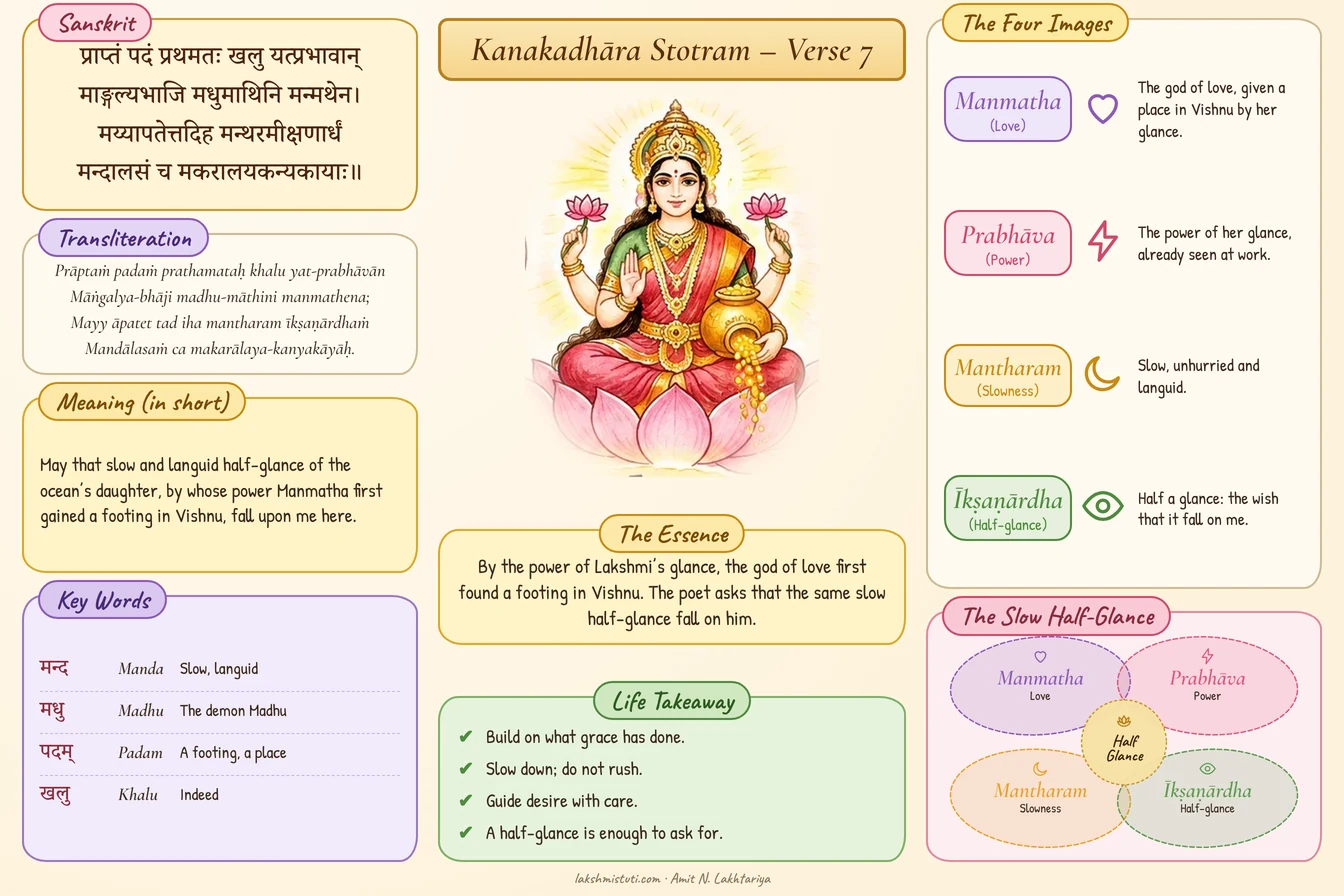
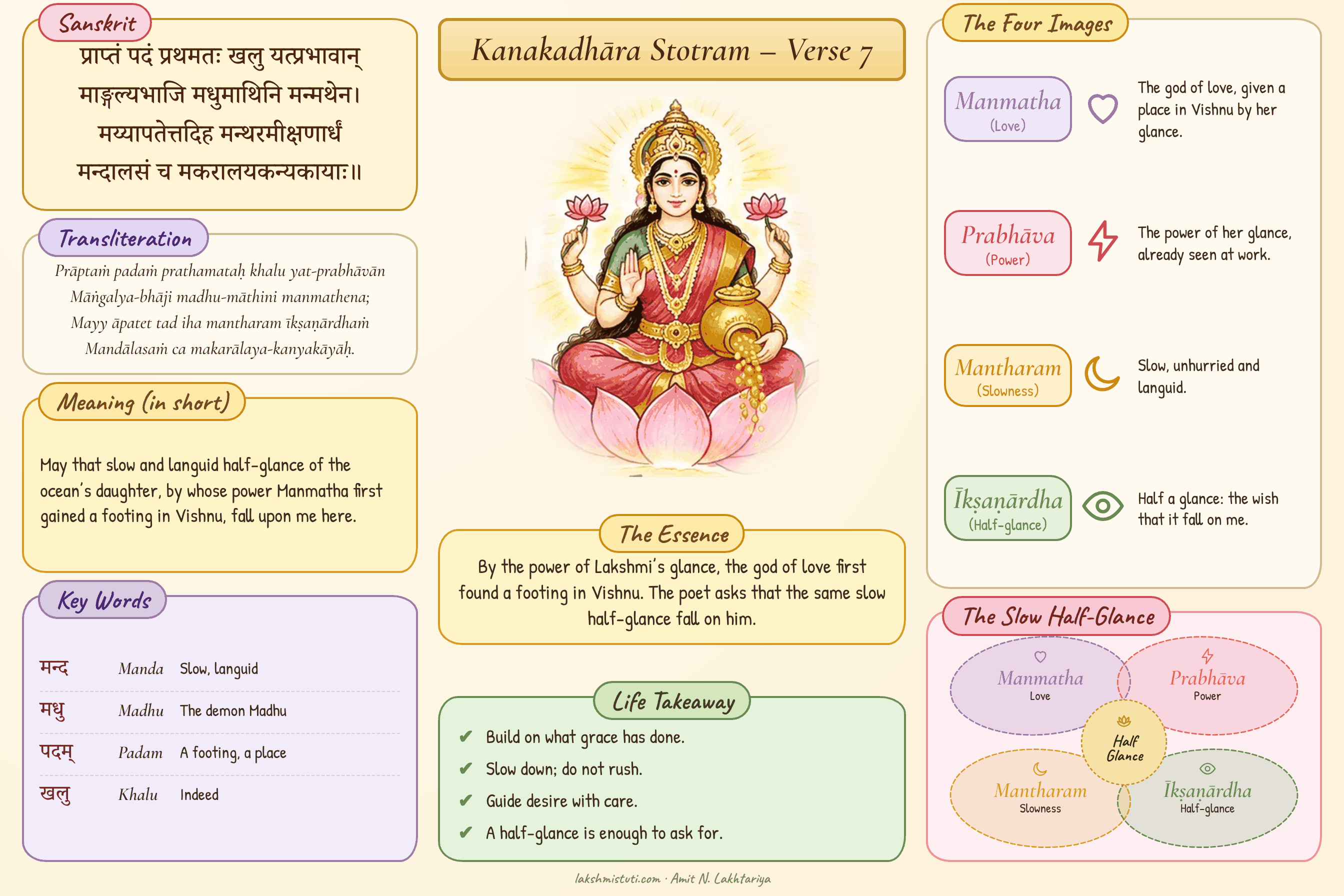
A one-page summary of the verse: Sanskrit, meaning, key ideas, key words and a takeaway. On a phone, open it full screen.
Word-by-word meaning
The literal meaning of each word.
| Sanskrit | Meaning |
|---|---|
| प्राप्तम्Prāptam | Has been obtained |
| पदम्Padam | A footing, a place |
| प्रथमतःPrathamataḥ | At first |
| खलुKhalu | Indeed |
| यत्प्रभावात्Yat-prabhāvāt | By the power of which |
| माङ्गल्यभाजिMāṅgalya-bhāji | In him who shares in auspiciousness |
| मधुमाथिनिMadhu-māthini | In the crusher of Madhu |
| मन्मथेनManmathena | By Manmatha, the god of love |
| मयिMayi | On me |
| आपतेत्Āpatet | May it fall |
| तत्Tat | That |
| इहIha | Here |
| मन्थरम्Mantharam | Slow |
| ईक्षणार्धम्Īkṣaṇārdham | Half a glance |
| मन्दालसम्Mandālasam | Slow and languid |
| चCa | And |
| मकरालयकन्यकायाःMakarālaya-kanyakāyāḥ | Of the daughter of the ocean |
Notes on each word
From pra and āp, to reach or gain. It is a past participle: “has been gained”. It goes with the next word: a footing has been gained.
Pada is a foot, a step, and so a place to stand, a position. Here it is the footing that Manmatha gained.
Prathama is first; the ending -taḥ gives “from the first, at first”. It says that this was where it began.
A small word for emphasis: “indeed, surely”.
Yat is “which” and points forward to tad īkṣaṇārdham, “that half-glance”, in the second line: it is the glance whose power is meant. Prabhāva is power, might, influence (from pra and bhū, to come forth). The ending means “by”. Before the next word, which begins with m, the final t becomes n: prabhāvān māṅgalya-.
Māṅgalya is auspiciousness, good fortune; bhāj means sharing in, having a part of. So he is the auspicious one. The ending means “in”.
Madhu is the name of a demon in the Vishnu tradition; māthin is one who churns or crushes (from math). So this is Vishnu. The next word tells who found a footing in him. The ending means “in”.
Manmatha is a name of Kāma, the god of love and desire. A traditional explanation is that it means “one who churns the mind” (manas, mind, and matha, churning). The ending means “by”: he is the one who gained the footing.
“In me, on me”. Before āpatet it is written mayy.
From ā (towards) and pat (to fall): to alight, to come down upon. The ending makes it a wish: “may it fall”. Śaṅkarācārya’s one request.
It points to the half-glance of the second line, whose power the first line has just described.
“Here, in this place”. He asks that it fall here, upon him as he stands.
Manthara describes a slow, unhurried movement; in Sanskrit it can also mean lingering or dull. Here it is the quality he asks of the glance: slow, not quick.
Īkṣaṇa is a look, a glance, from īkṣ, to see; ardha is half. The words join as īkṣaṇārdham. The same word was used in Verse 3.
Manda is slow, gentle; ālasa is languid, unhurried, as though relaxed and half asleep. The words join as mandālasam. It adds a softer, more drowsy slowness to mantharam.
Joins the two descriptions of the glance.
Makara is a sea creature of Indian myth, often shown like a crocodile; ālaya is an abode. So makarālaya is “the home of the makara”: the ocean. Kanyakā is a girl, a daughter. The ending means “of”: she is Lakshmi, born from the ocean.
Deeper spiritual insights
Interpretation and reflection: ideas that help us read the verse, not part of the text itself.
Before we begin
This verse is especially interesting because Śaṅkarācārya refers to Manmatha, the god of love, and the influence of Lakshmi’s glance upon Lord Vishnu.
“O Mother Lakshmi, it was through the power of your divine influence that Manmatha, the god of love, first obtained his place in Lord Vishnu. May that same beautiful, gentle, half-closed glance of yours, O Daughter of the Ocean, fall upon me too.”
1Three expressions that are particularly beautiful
Mantharam (मन्थरम्). A slow, unhurried movement. Śaṅkarācārya is not describing a hurried glance.
Īkṣaṇārdham (ईक्षणार्धम्). A half-glance, or even a fraction of a glance.
Mandālasam (मन्दालसम्). Softly languid, with a graceful, relaxed quality.
Notice how carefully Śaṅkarācārya chooses these words. He does not ask for a powerful or commanding look. He asks for a gentle, almost effortless glance.
2The full meaning
Literal meaning. Through whose influence Manmatha first obtained a place in the auspicious Lord Vishnu, the destroyer of Madhu, may that gentle, slow, gracefully languid half-glance of the daughter of the ocean fall upon me here.
In simple English. Śaṅkarācārya remembers the extraordinary influence of Lakshmi’s loving gaze. Even Manmatha, the god of love, found his place with Lord Vishnu through her divine influence. Now he makes a very humble request: “Mother, I do not ask for your entire attention. Even a gentle fraction of your glance upon me would be enough. May that grace enter my life.”
3The poetry hidden in the verse
Let us imagine the scene.
Lord Vishnu is seated in his divine abode. He is serene, majestic and complete in himself.
Beside him is Lakshmi, the Goddess of beauty, abundance and grace.
And somewhere in this divine world is Manmatha, the god of love, carrying his sugarcane bow and flower arrows. Manmatha represents the power of attraction and desire.
But here Śaṅkarācārya gives us an intriguing thought. Even Manmatha’s influence upon Vishnu is described through Lakshmi’s power. Śaṅkarācārya is celebrating her extraordinary influence.
There is a subtle shift in the imagery now. In the earlier verses, we watched Lakshmi’s eyes move towards Vishnu. We saw her glances become a necklace, and her radiance become lightning against a dark monsoon cloud. Now Śaṅkarācārya turns from describing the beauty of her glance to describing its influence.
And then comes the most delicate part. He asks for mantharam īkṣaṇārdham: a slow, gentle half-glance.
Imagine someone standing before a great queen. The queen need not speak. She need not make a grand gesture. A small movement of her eyes is enough to communicate recognition and kindness. That is the emotional world of this verse.
Śaṅkarācārya does not demand attention. He does not claim entitlement to divine favour. He simply asks: “Mother, may even a small fraction of your loving attention fall upon me.”
There is humility in that request, and there is extraordinary confidence in the power of grace.
The greatest blessing, Śaṅkarācārya suggests, need not arrive with great noise. It may begin with a single glance.
4Deeper spiritual insights
A. The power of a gentle influence
What the verse says: Lakshmi’s influence is associated with Manmatha obtaining a place in Vishnu.
What we may contemplate: Influence does not always come through authority, force or command. Sometimes it comes through affection, patience and gentle persuasion.
Think about our own lives. A kind word from a parent, a teacher’s encouragement or a spouse’s quiet support can influence decisions more deeply than a hundred instructions.
Contemplation: True influence often works softly.
B. The beauty of asking with humility
What the verse says: Śaṅkarācārya asks only for half a glance.
He could have asked for all the wealth of the universe. Instead, he asks for a moment of grace.
This is not necessarily a rejection of material prosperity. Remember, this is a hymn devoted to Lakshmi. Rather, it suggests that the devotee understands something important: before asking for the gifts, one seeks the grace of the giver.
C. Manmatha and the nature of desire
Manmatha represents desire and attraction.
A deeper philosophical reflection emerges here: desire is a powerful force in human life. It can inspire creation, relationships, ambition and achievement. But desire also needs direction. The verse encourages us to contemplate whether our desires are guided by wisdom and grace.
For example:
- The desire to earn wealth can become the desire to create value.
- The desire for recognition can become the desire to do meaningful work.
- The desire for success can become the desire to build something that benefits others.
Contemplation: We need not destroy ambition. We need to refine it.
D. The Daughter of the Ocean
Lakshmi is called Makarālaya-kanyakā, the daughter of the ocean. This reminds us of the traditional account of her emergence during the Samudra Manthan, the churning of the cosmic ocean.
The ocean is an extraordinary symbol: immeasurable, deep and full of hidden treasures. Lakshmi emerging from it suggests a beautiful devotional image of abundance arising from the depths of the cosmic ocean.
This is a traditional mythological association, not a literal historical event.
5Reflection for today
I would like to leave you with a thought that connects this verse with everyday life.
We often believe that big changes require big interventions. But sometimes:
- One opportunity changes a career.
- One encouraging word changes a person’s confidence.
- One wise decision changes a family’s future.
- One moment of clarity changes the direction of our lives.
A small thing can have an enormous influence.
Question for contemplation. If you could ask the Divine Mother for just one blessing today, what would it be? Would you ask for wealth, health, wisdom, peace, or the strength to make the right decisions?
There is no wrong answer. But it is worth knowing what your heart truly seeks.
Three Sanskrit treasures to remember
- Prabhāva (प्रभाव) – power or influence: the ability to bring about an effect, sometimes without force or command
- Manthara (मन्थर) – gentle and unhurried: a graceful slowness, free from agitation or haste
- Manmatha (मन्मथ) – the god of love and desire: a traditional name of Kāma, associated with attraction and the power of desire
6The essence of verse seven
Śaṅkarācārya describes Lakshmi’s extraordinary influence: even Manmatha obtains his place with Vishnu through her power. Yet he asks for something very small, just a gentle fraction of her loving glance.
There is a beautiful lesson here: ask with humility. Act with dedication. Let your desires be guided by wisdom. And never underestimate the power of a small blessing.
A question to carry into Verse 8
Looking ahead: Verse 8 brings us closer to the famous traditional story associated with the Kanakadhāra Stotram. Śaṅkarācārya now describes himself through a touching image: a helpless little bird, sitting in distress and waiting for the compassionate rain of wealth to fall upon it.
The imagery becomes more personal. The prayer becomes more emotional. In Verse 7, he asks for a gentle glance. In Verse 8, he will ask for that glance to become a rain of compassion and prosperity.
That transition is worth exploring slowly in our next study.
Practical meditation
- Minute 1RecitationSlowly chant mayy āpatet tad iha mantharam īkṣaṇārdham, and let the words settle.
- Minute 2VisualizationPicture Goddess Lakshmi seated beside Lord Vishnu. Imagine her gentle, compassionate gaze.
- Minute 3SilenceSit quietly. Do not ask for anything immediately. Simply experience the feeling of standing before the Divine Mother.
- Minute 4Examine your desiresAsk yourself, “Which of my ambitions deserve my energy? Which desires need to be refined or released?”
- Minute 5Prayer“O Mother Lakshmi, may Your grace guide my desires. May I work with dedication, remain humble in success, and use whatever prosperity I receive for the welfare of others.”
Śaṅkarācārya shows the great influence of Lakshmi’s glance and asks for only the smallest portion of it: ask with humility, act with dedication, let your desires be guided by wisdom, and never underestimate the power of a small blessing.
This meditation is a devotional practice for attention and reflection; it does not promise a supernatural result or guarantee material wealth.