Home › Kanakadhāra Stotram › Verse 3
The verse
॥ श्लोक ३ ॥
विश्वामरेन्द्रपदविभ्रमदानदक्षम्
आनन्दहेतुरधिकं मुरविद्विषोऽपि।
ईषन्निषीदतु मयि क्षणमीक्षणार्धम्
इन्दीवरोदरसहोदरमिन्दिरायाः॥
॥ श्री महालक्ष्म्यै नमः ॥
Viśvāmarendra-pada-vibhrama-dāna-dakṣam,
Ānanda-hetur adhikaṁ mura-vidviṣo 'pi;
Īṣan niṣīdatu mayi kṣaṇam īkṣaṇārdham,
Indīvarodara-sahodaram Indirāyāḥ.
Meaning in short
May even half a glance of Indirā (Lakshmi), a glance able to bestow the splendour of Indra’s station as lord of all the gods, an abundant source of joy even to Vishnu, the foe of Mura, and as soft as the inside of a blue lotus, settle lightly upon me, if only for a moment.
A glance that could bestow Indra’s throne, and Śaṅkarācārya asks for only half of it, for a moment.
Key highlights
- Indra Grandeur: the splendour of Indra’s station
- Ānanda Joy: an abundant source of joy even to Vishnu
- Indīvara Softness: soft as the inside of a blue lotus
- Īkṣaṇārdha Half-glance: the small request, for a moment
Explore the four images
Tap a card to open its meaning and a question to carry with you.
IndraGrandeur
The first line says her glance is skilled at bestowing the splendour of Indra’s station, the highest seat among the gods. It tells us how great the blessing is.
Pause and reflect: What would I really want from a blessing of such size?
ĀnandaJoy
Her glance is an abundant source of joy even to Vishnu, the foe of Mura. Love completes the picture: the power of the glance is also tenderness.
Pause and reflect: Do I use what power I have to bring joy to others?
IndīvaraSoftness
The blue lotus, indīvara, softens the grandeur of the first lines. The glance is as soft and deep as the inner blue of the flower. Power and gentleness are held together.
Pause and reflect: Where could I add softness to something I do with strength?
ĪkṣaṇārdhaHalf-glance
Īkṣaṇārdham is half a glance. Śaṅkarācārya asks for neither a kingdom nor riches: only a fraction of a look, resting on him for a moment. The request is modest, the aspiration large.
Pause and reflect: What small moment of grace or insight would change my direction?
Sketch note
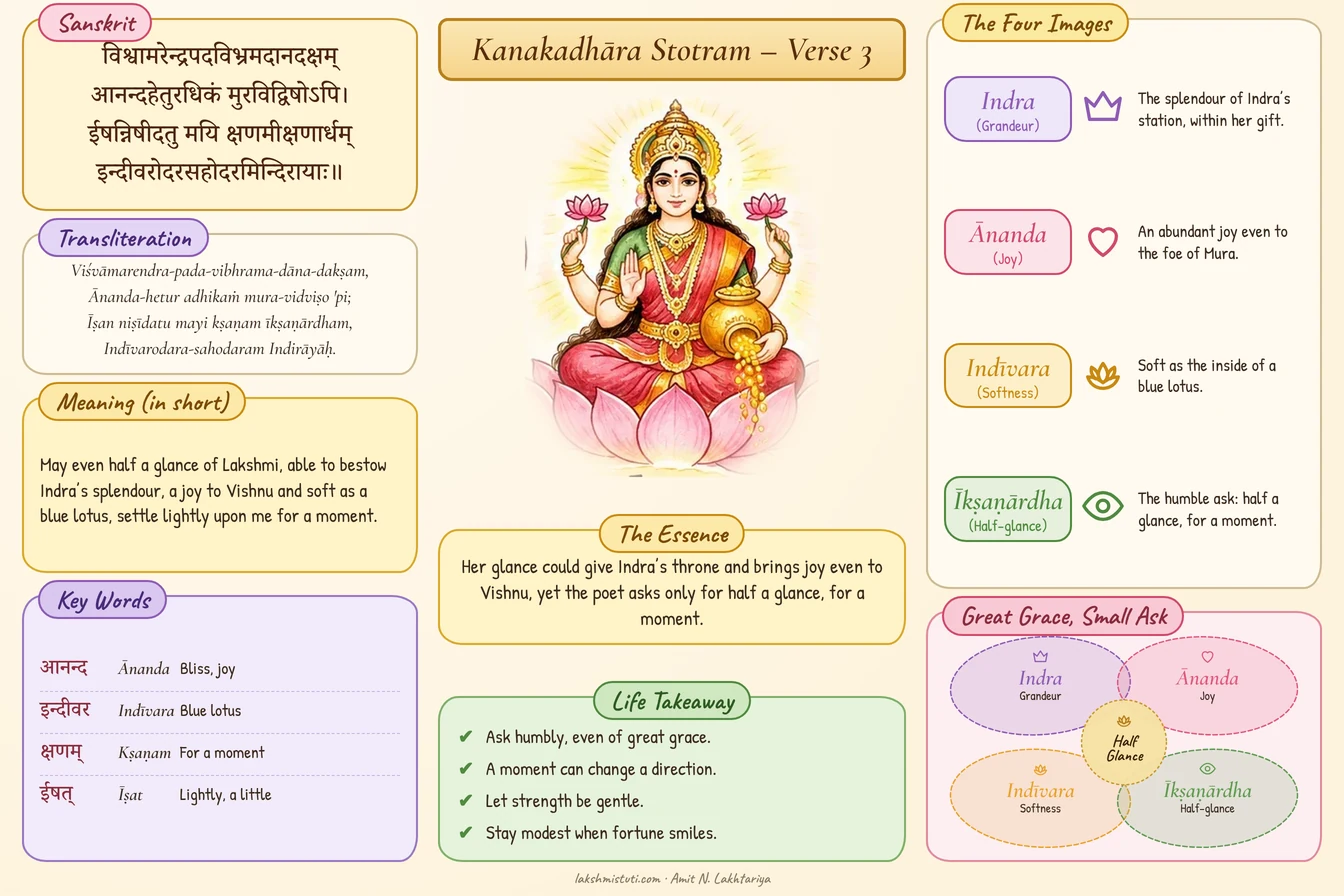
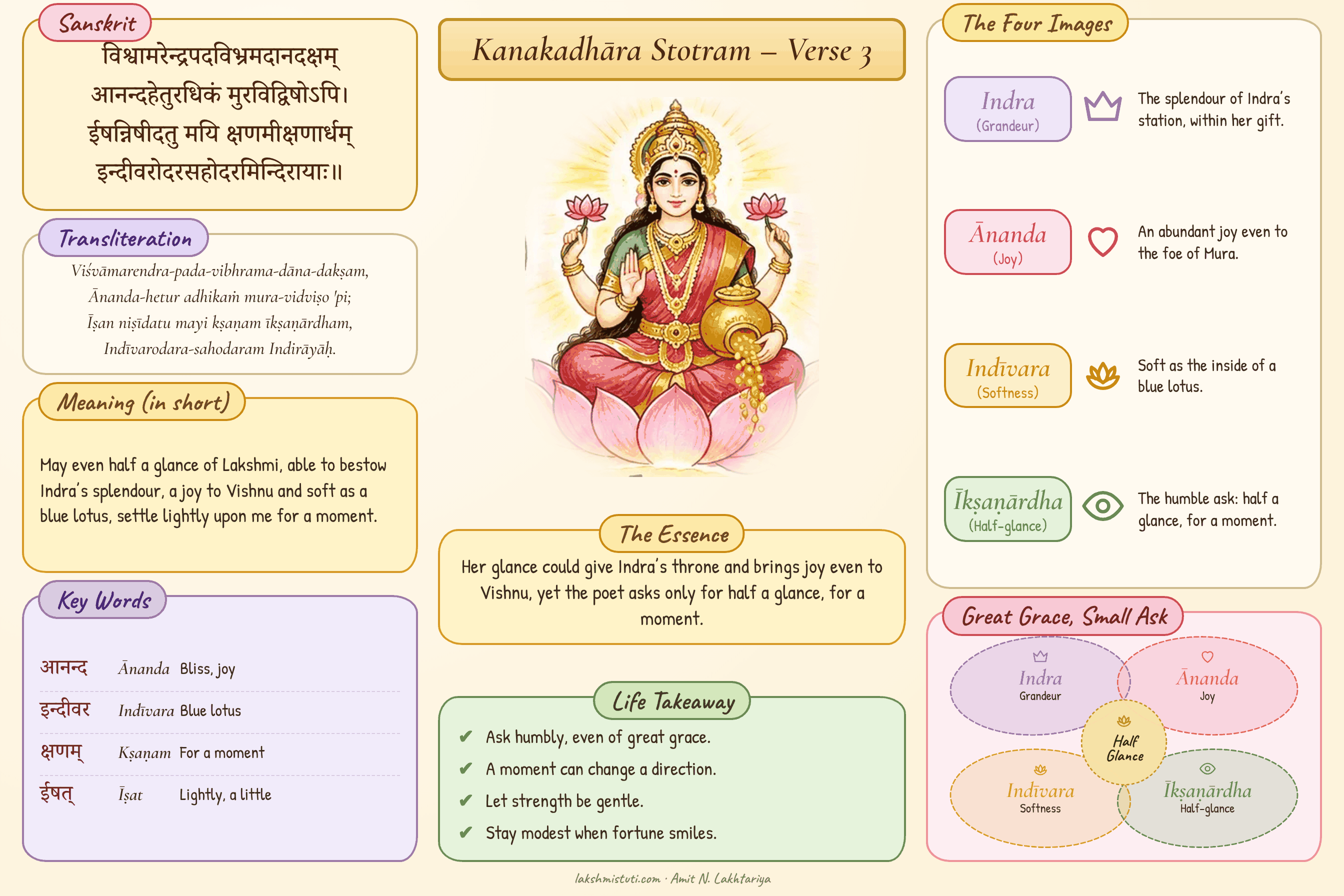
A one-page summary of the verse: Sanskrit, meaning, key ideas, key words and a takeaway. On a phone, open it full screen.
Word-by-word meaning
The literal meaning of each word.
| Sanskrit | Meaning |
|---|---|
| विश्वामरेन्द्रपदविभ्रमदानदक्षम्Viśvāmarendra-pada-vibhrama-dāna-dakṣam | Skilled in bestowing the splendour of Indra’s station as lord of all the gods |
| आनन्दहेतुःĀnanda-hetuḥ | A cause of joy |
| अधिकम्Adhikam | Abundantly, exceedingly |
| मुरविद्विषः अपिMura-vidviṣaḥ api | Even to the foe of Mura (Vishnu) |
| ईषत् निषीदतुĪṣat niṣīdatu | May it settle lightly |
| मयि क्षणम्Mayi kṣaṇam | Upon me, for a moment |
| ईक्षणार्धम्Īkṣaṇārdham | Half a glance; a fraction of a look |
| इन्दीवरोदरसहोदरम्Indīvarodara-sahodaram | Akin to the inside of a blue lotus |
| इन्दिरायाःIndirāyāḥ | Of Indirā (Lakshmi) |
Notes on each word
Viśva is all; amara is an immortal, a god; indra is lord, so viśvāmarendra is Indra, king of all the gods. Pada is station or rank; vibhrama is splendour, charm and the glamour of high office; dāna is giving; dakṣa is skilled or able. The final m of dakṣam joins the next word when the verse is recited without a pause (dakṣam + ānanda sounds as dakṣamānanda).
Ānanda is joy, bliss; hetu is cause or source.
Read with ānanda: a source of abundant joy. Translators also render it “even more”, but the sense is the same: the joy is great.
Mura is the demon of that name; vidviṣ is an enemy, one opposed to. So “the enemy of Mura” is Vishnu, the same Murāri we met in Verse 2. Api is “even” or “also”.
Īṣat is slightly, a little; niṣīdatu is “may it sit down, may it rest”. The two join as īṣan niṣīdatu. The picture is of something landing gently, as a bird alights.
Mayi is “on me”; kṣaṇa is an instant or a moment.
Īkṣaṇa is a look or glance (from the root īkṣ, to see); ardha is half. This is the thing Śaṅkarācārya asks to settle on him.
Indīvara is the blue lotus; udara is the interior (it also means belly); sahodara is literally “born of the same womb”, a sibling, and so “closely resembling”. The word udara appears twice inside this one compound.
Indirā is a name of Lakshmi; the ending marks “of”.
Deeper spiritual insights
Interpretation and reflection: ideas that help us read the verse, not part of the text itself.
Before we begin
In Verse 1 the glance of Lakshmi rested on Vishnu as a sidelong glance, and in Verse 2 as a garland of repeated glances.
Verse 3 spends most of its lines on how great that glance is, and then makes Śaṅkarācārya’s request in the shortest form possible: half a glance, for a moment.
“May the half-glance of Indirā, capable of bestowing the splendour of Indra’s exalted position and a source of immense joy even to Lord Vishnu, the slayer of Mura, rest lightly upon me for a moment. May that glance, whose beauty is akin to the inner blue of a lotus, bless me.”
1A more poetic rendering
O Goddess Indirā, your glance possesses the power to bestow the splendour of the king of the gods. It brings immense joy even to Lord Vishnu, the slayer of Mura.
May just half a glance of yours, beautiful like the deep blue interior of a lotus, rest upon me, even for a single moment.
Here, Murāri refers to Lord Vishnu, the slayer of the demon Mura, and Indirā is another name for Lakshmi. The verse praises the power of her glance and asks for its blessing.
2The meaning in simple English
“O Mother Lakshmi, your compassionate glance is so powerful that it can bestow great glory and bring joy even to Lord Vishnu. I ask for so little in comparison: may even a fraction of that divine glance rest upon me for one brief moment and bless my life.”
Notice the contrast: the power described is immense, but the request is remarkably humble.
3Three important compounds decoded
First – Viśvāmarendra-pada-vibhrama-dāna-dakṣam: the splendour of Indra’s station
The compound brings together the ideas of Indra, his position, its splendour, bestowal, and the ability to grant it.
Meaning: capable of bestowing the splendour and exalted position of Indra, king of the gods.
The idea is not simply that Lakshmi can give ordinary wealth. Her glance is described as powerful enough to confer extraordinary status and glory.
Second – Ānanda-hetur adhikaṁ mura-vidviṣo ’pi: a source of joy even to Vishnu
Meaning: a source of immense joy even to Lord Vishnu Himself, the enemy of the demon Mura.
This is an especially beautiful thought. The Goddess’s glance is not described only by what it can give to others; it is also associated with the joy of her divine consort.
Third – Īkṣaṇārdham: half a glance
Īkṣaṇa is a glance and ardha is half. Meaning: half a glance, or a mere fraction of a glance.
This is the emotional centre of the verse. After describing immense divine power, Śaṅkarācārya asks for only a tiny portion of it.
4The poetry hidden in the verse
There is something astonishing here. Śaṅkarācārya could have simply written: “Lakshmi is powerful. Please bless me.” Instead, he creates a scene that moves from the grandeur of a heavenly throne to the delicacy of a single glance.
Imagine the scene. First, picture Indra, the king of the gods, surrounded by the magnificence of his heavenly realm. His position represents extraordinary power, prestige, and splendour. Now imagine that the very glory associated with such a position lies within the reach of Lakshmi’s divine grace.
Then Śaṅkarācārya shifts our attention from the heavenly throne to Lord Vishnu. Her glance is a source of profound joy even to Him.
Finally, the grandeur becomes intimate. He asks: may even a fraction of that glance rest upon me for a moment. What a transition! From the throne of Indra to the humble devotee. From cosmic power to a moment of grace.
And then comes the lotus. The Goddess’s glance is described as akin to the inner blue of a lotus, a delicate image of beauty and colour that softens the majesty of the preceding lines.
Śaṅkarācārya sees what ordinary eyes miss: the greatest power can be expressed through the smallest gesture.
5The extraordinary contrast
| Image | What it brings |
|---|---|
| The grandeur of Indra | Heavenly authority, position, and splendour. |
| The joy of Vishnu | The divine consort is associated with profound bliss. |
| The lotus-like glance | Beauty expressed through a small, intimate image. |
The verse brings these three images together to express one prayer: may a little of the Goddess’s extraordinary grace reach the devotee.
6Five deeper insights
Insight 1 – The greatness of the blessing, the humility of the request
The first line speaks of the power to grant Indra’s exalted position.
Yet Śaṅkarācārya does not demand a kingdom, a throne, or riches. He asks for half a glance, resting upon him for a moment.
This contrast suggests a devotional attitude: the devotee recognises the greatness of the Divine without treating grace as something to be purchased or commanded.
Contemplation: Approach what you revere with humility, even when your aspirations are great.
Insight 2 – Even the powerful seek grace
Indra represents the highest authority among the gods in this imagery. Vishnu represents divine majesty and bliss. Yet the verse presents Lakshmi’s grace as significant to both.
The poetic message is that status and power are not the whole story. Even extraordinary greatness is described in relation to divine grace.
In everyday life, this can remind us that professional success, wealth, or authority should not make us forget gratitude, relationships, or the sources of our good fortune.
Insight 3 – The meaning of “just a moment”
The phrase kṣaṇam means “for a moment.” Śaṅkarācārya’s request is modest in duration, but immense in its aspiration.
We often imagine that transformation must arrive through some grand event. Yet a moment of insight, a word of wisdom, or an act of compassion can change the direction of a life.
This is a practical reflection inspired by the verse, rather than a literal promise that a brief prayer will automatically change one’s circumstances.
Insight 4 – The lotus as an image of beauty
The blue lotus brings a sense of delicacy to a verse otherwise concerned with sovereignty and power.
The lotus is deeply rooted in Indian religious and poetic imagery. It often evokes beauty, purity, freshness, and spiritual significance. Here, the specific comparison is to the inner part of the blue lotus. Its role is to make the Goddess’s glance vivid to the imagination.
Śaṅkarācārya does not merely tell us that the glance is beautiful. He gives us something to see.
Insight 5 – Grace and effort
The verse asks for divine blessing. It does not prescribe a practical programme for success.
We can nevertheless carry its spirit into our lives: pray with sincerity, work with integrity, manage resources prudently, and remain humble when circumstances favour us.
Contemplation: Grace may inspire our efforts; it should not become an excuse to abandon them.
7Reflection for today
Consider the contrast at the heart of this verse. Śaṅkarācārya invokes the glory of Indra’s throne, yet asks only for a fraction of the Goddess’s glance.
Let us carry three questions into the day:
- Ambition: Am I pursuing success while also cultivating the character needed to handle it?
- Humility: When things go well, do I remember the people, opportunities, and circumstances that helped me?
- Grace: Can I be grateful for what I already possess while continuing to work towards what I hope to achieve?
Choose one question to contemplate quietly.
8Three Sanskrit treasures
| Word | Meaning | Deeper association |
|---|---|---|
| Ānanda (आनन्द) | Bliss | A deep joy that goes beyond ordinary pleasure. |
| Īkṣaṇa (ईक्षण) | A glance | A look or act of seeing; in this verse, the object of the devotee’s prayer. |
| Dakṣa (दक्ष) | Capable or skilful | In the verse, it describes the Goddess’s capacity to bestow great glory. |
9The essence of Verse 3
Let us gather the verse into one final image.
A heavenly throne represents extraordinary power. Lord Vishnu represents divine majesty and bliss. The blue lotus gives the Goddess’s glance a delicate, vivid beauty.
Then Śaṅkarācārya turns towards his own prayer: may even half a glance rest upon me for a moment.
The heart of the verse is not merely the greatness of what Lakshmi can bestow. It is the humility with which Śaṅkarācārya seeks her grace.
Pronunciation guide
Viśvāmarendra: vish-vaa-ma-ren-dra. Vibhrama: vi-bhra-ma. Dakṣam: dak-sham. Mura-vidviṣaḥ: mu-ra-vid-vi-shah. Īṣan niṣīdatu: ee-shan ni-shee-da-tu. Īkṣaṇārdham: eek-sha-naar-dham. Indīvarodara: in-dee-va-ro-da-ra.
Read the verse slowly, giving each line time to settle. Our goal is not speed; it is understanding.
A question to carry into Verse 4
Next is Verse 4, āmīlitākṣam adhigamya mudā mukundam…
Having asked for half a glance, we now turn to the eye itself: the eye of Lakshmi, half-closed and unblinking, resting with joy on Mukunda, the root of bliss.
Practical meditation
- Minute 1Become stillSit comfortably and breathe naturally. Allow the day’s concerns to settle, and do not force the mind to become empty.
- Minutes 2–3Recite the verseRead the Sanskrit slowly, resting on īṣan niṣīdatu mayi kṣaṇam īkṣaṇārdham. Let its meaning settle: may even a fraction of the glance rest upon me for a moment.
- Minute 4Visualise the lotusImagine a blue lotus in still water, and let it represent the beauty and serenity of the Goddess’s glance. You do not need to force a vision; simply contemplate the image.
- Minute 5Offer a prayerSay silently, “O Mother Lakshmi, may I receive the wisdom to recognise my blessings, the humility to remain grounded, and the discernment to use my resources for good.”
Aspire greatly, remain humble, and remember that prosperity is most meaningful when accompanied by wisdom and gratitude.
This meditation is a devotional practice for attention and reflection; it does not promise a supernatural result or guarantee material wealth.