Home › Kanakadhāra Stotram › Verse 14
The verse
॥ श्लोक १४ ॥
नमोऽस्तु देव्यै भृगुनन्दनायै
नमोऽस्तु विष्णोरुरसि स्थितायै।
नमोऽस्तु लक्ष्म्यै कमलालयायै
नमोऽस्तु दामोदरवल्लभायै॥
॥ श्री महालक्ष्म्यै नमः ॥
Namo ’stu devyai bhṛgu-nandanāyai
Namo ’stu viṣṇor urasi sthitāyai;
Namo ’stu lakṣmyai kamalālayāyai
Namo ’stu dāmodara-vallabhāyai.
Meaning in short
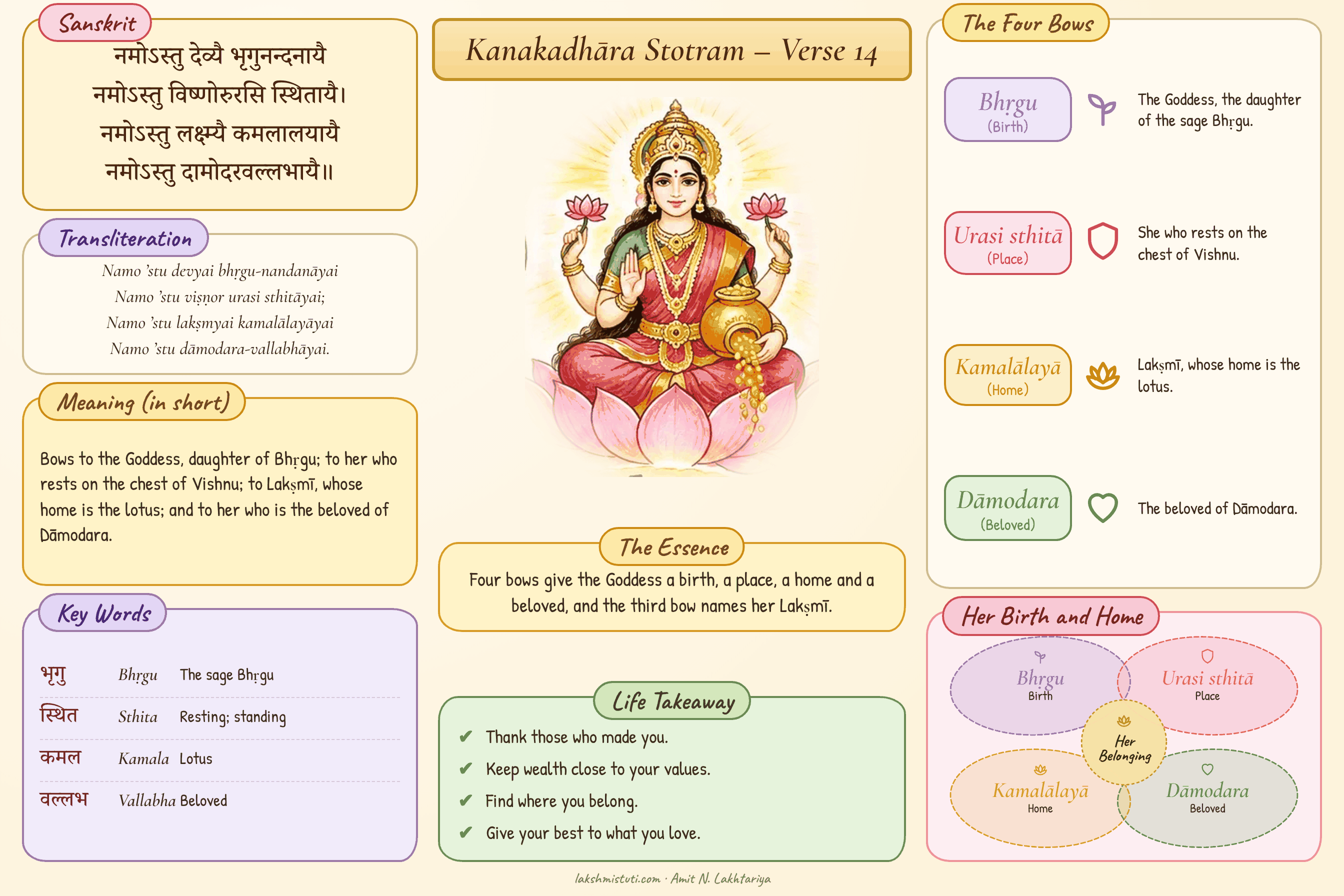
Let there be a bow to the Goddess, the daughter of Bhṛgu. Let there be a bow to her who rests on the chest of Vishnu. Let there be a bow to Lakṣmī, whose home is the lotus. Let there be a bow to her who is the beloved of Dāmodara.
Four bows that say where she is from, where she rests, where she lives and to whom she belongs.
Key highlights
- Bhṛgu Birth: the daughter of the sage Bhṛgu
- Urasi sthitā Place: she rests on Vishnu’s chest
- Kamalālayā Home: the lotus is her dwelling
- Dāmodara Beloved: of the rope-bellied Vishnu
Explore the four bows
Tap a card to open its meaning and a question to carry with you.
BhṛguBirth
Bhṛgu is an ancient sage, and nandanā is a daughter. The tradition says Lakshmi was first born as his daughter and later rose again from the ocean of milk. A reflection: she is honoured both for a human family and for a cosmic birth.
Pause and reflect: Whom do I thank for what I have become?
Urasi sthitāPlace
Urasi sthitā means resting on the chest. Pictures of Vishnu show a mark and a jewel on his chest where she is said to dwell. A reflection: in this picture wealth rests near the heart, not at a distance from it.
Pause and reflect: Is my work kept close to what I value?
KamalālayāHome
Kamalālayā means whose home is the lotus. In Verse 13 the lotus was her seat; here it is her home. A seat is where you sit, a home is where you belong.
Pause and reflect: Where in my life do I feel at home?
DāmodaraBeloved
Dāmodara means “with a rope round the belly”, a name from the story of child Krishna bound by his foster mother. Śaṅkarācārya picks Vishnu’s gentlest form. His name changes from verse to verse while she stays the same.
Pause and reflect: To whom or what do I owe my best effort?
Sketch note
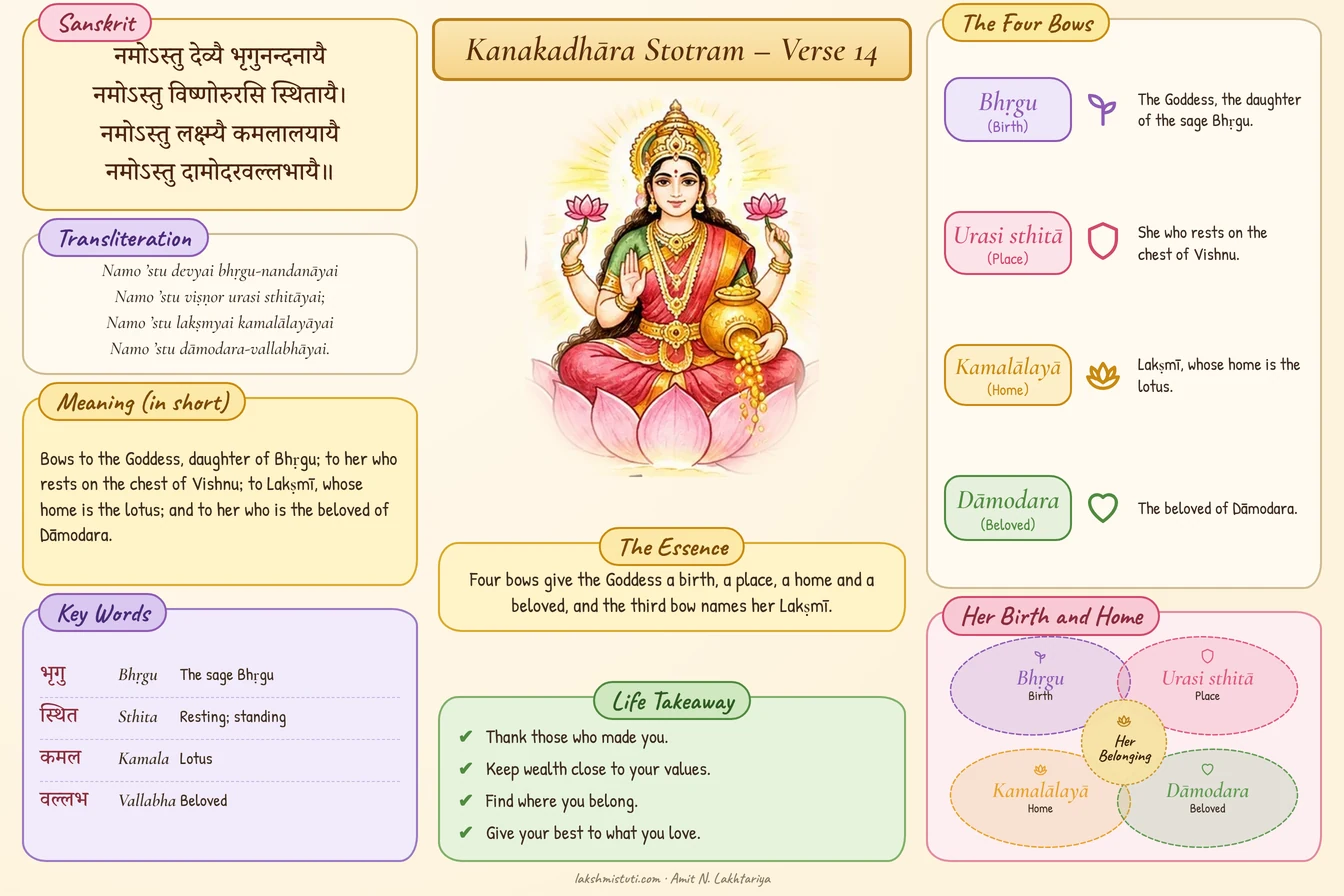
A one-page summary of the verse: Sanskrit, meaning, key ideas, key words and a takeaway. On a phone, open it full screen.
Word-by-word meaning
The literal meaning of each word.
| Sanskrit | Meaning |
|---|---|
| नमः अस्तुNamo ’stu | Let there be a bow |
| देव्यैDevyai | To the Goddess |
| भृगुनन्दनायैBhṛgu-nandanāyai | To the daughter of Bhṛgu |
| विष्णोरुरसि स्थितायैViṣṇor urasi sthitāyai | To her who stays on the chest of Vishnu |
| लक्ष्म्यैLakṣmyai | To Lakṣmī |
| कमलालयायैKamala-ālayāyai | To her whose home is the lotus |
| दामोदरवल्लभायैDāmodara-vallabhāyai | To the beloved of Dāmodara |
Notes on each word
As in the verses before, namaḥ (a bow) and astu (let it be) join into namo ’stu. It opens every line, so the verse is four bows said in one breath.
Devī is a goddess, the feminine of deva, a god. The ending -yai means “to”: a feminine word ending in a long ī takes -yai in this form, so devī becomes devyai. Here “the Goddess” is simply her title, before the other descriptions are added.
Bhṛgu is the name of an ancient sage. Nandana is a child, literally “one who delights”, and the feminine nandanā is a daughter. So she is the daughter of Bhṛgu. The Purāṇic tradition says that Lakshmi was first born as the daughter of Bhṛgu, and later rose again from the ocean of milk.
Viṣṇoḥ is “of Vishnu”; urasi is “on the chest”, from uras, chest; sthitā is “standing, staying, resting”. The visarga of viṣṇoḥ becomes r before the vowel of urasi, so the words read viṣṇor urasi. She is the one who rests on Vishnu’s chest, close to his heart.
Lakṣmī is the Goddess’s own name, from a root meaning “to see, to mark”: good fortune that is visible. As a feminine word ending in a long ī, it takes -yai for “to”: lakṣmyai. After three lines of descriptions, Śaṅkarācārya finally bows to her by name.
Kamala is a lotus; ālaya is a home, a dwelling. So she is “the one whose home is the lotus”. The a of kamala and the ā of ālaya join into ā: kamalālaya. The same idea was in Verse 5, where she is called lotus-dwelling.
Dāmodara is a name of Vishnu in his Krishna form: dāman is a rope and udara is the belly, “the one with a rope round his belly”, from the story of the child Krishna tied by his foster mother. Vallabhā is a beloved. So she is the beloved of Dāmodara.
Deeper spiritual insights
Interpretation and reflection: ideas that help us read the verse, not part of the text itself.
Before we begin
In Verse 13, Adi Śaṅkarācārya praised Mahalakshmi as the sovereign of the world, the embodiment of compassion and the beloved of Vishnu.
In Verse 14, he takes us into a more intimate dimension of her identity. He invokes her through her association with Sage Bhṛgu, her place on Vishnu’s chest, her lotus abode and her relationship with Dāmodara.
There is a beautiful progression here: from the cosmic Goddess to the eternally beloved divine consort.
“O Mother, I bow to you, the Goddess, daughter of Bhṛgu. I bow to you who rest on Vishnu’s chest. I bow to you, Lakṣmī, who live in the lotus. I bow to you, beloved of Dāmodara.”
1Understanding the four descriptions
First – Bhṛgu-nandanā: daughter of Sage Bhṛgu
This is a fascinating name because it connects Lakshmi with the ancient sage Bhṛgu.
In certain Purāṇic traditions, Lakshmi is described as Bhārgavī, the daughter of Bhṛgu. There is another well-known account in which Lakshmi emerges during the churning of the Ocean of Milk (samudra-manthana).
These are different strands of sacred tradition. We should not force them into one single chronological biography. They convey different dimensions of the Goddess’s divine manifestation.
Contemplation: Divinity is associated not only with cosmic splendour but also with the wisdom and spiritual lineage represented by the sages.
Second – Viṣṇor urasi sthitā: she who resides on Vishnu’s chest
This is one of the most recognisable images in Vaishnava tradition. Lakshmi is depicted residing upon the chest of Lord Vishnu. The chest is also associated with the sacred mark called Śrīvatsa.
This image expresses something profound: Lakshmi is not distant from Nārāyaṇa. She is eternally united with him. Vishnu represents the sustaining principle of the universe; Lakshmi represents auspiciousness, grace and prosperity.
Contemplation: Preservation without grace would be incomplete; prosperity without protection would be unstable.
Third – Kamalālayā: she whose abode is the lotus
Kamala means lotus, and ālaya means abode. The lotus is one of the most important symbols in Indian spiritual literature. It represents purity amidst worldly circumstances, beauty without attachment, spiritual elevation, and the ability to flourish without being overcome by one’s surroundings.
Notice that Śaṅkarācārya has already used the golden lotus image in Verse 13. Here he returns to the lotus, but with a different emphasis: not merely her throne, but her abode.
Contemplation: Let the world be your field of action, but do not allow its impurities to become your nature.
Fourth – Dāmodara-vallabhā: beloved of Dāmodara
Dāmodara is a famous name of Lord Krishna. It comes from the well-known childhood episode in which Yaśodā ties Krishna with a rope around his waist. Dāma means rope and udara means belly.
The infinite Lord, who sustains the universe, allows himself to be lovingly bound by his mother’s affection. Śaṅkarācārya calls Lakshmi the beloved of this Dāmodara.
In Vaishnava theology, Krishna is understood as an incarnation of Vishnu. Thus the verse brings Lakshmi’s relationship with Nārāyaṇa into the intimate devotional world of Krishna.
Contemplation: The Supreme is not only the cosmic protector; the Supreme is also accessible through love.
2A subtle connection: Bhṛgu-nandanā and the story of Bhṛgu
The first line deserves special attention. Sage Bhṛgu is an important figure in Hindu sacred literature. One famous story describes Bhṛgu testing the Trimūrti to understand who was most worthy of reverence.
In the account commonly associated with the Bhāgavata Purāṇa, Bhṛgu visits Vishnu and strikes his chest with his foot. Vishnu responds with humility and concern for the sage’s foot. Lakshmi, who resides on Vishnu’s chest, is displeased by this act, and in some traditions the story is connected with her departure from Vaikuṇṭha.
This story is sometimes used to explain the association between Lakshmi, Bhṛgu and Vishnu. However, the details differ among tellings, so we should not treat every version as identical. The deeper point is the relationship between Lakshmi, Bhṛgu and Vishnu: the verse brings together the world of the sages, the divine abode and the sustaining Lord.
3Why does Śaṅkarācārya use so many different names for Lakshmi?
| Verse | Names and descriptions | Dimension revealed |
|---|---|---|
| 12 | Lotus-faced, born of the Ocean of Milk, sister of Soma and Amṛta, beloved of Nārāyaṇa | Divine origin and beauty |
| 13 | Seated on a golden lotus, sovereign of the world, compassionate, beloved of Vishnu | Sovereignty and compassion |
| 14 | Daughter of Bhṛgu, residing on Vishnu’s chest, lotus-abode, beloved of Dāmodara | Divine identity and intimacy |
Why does he repeat namo ’stu? Because each name reveals a different relationship with the same divine reality. There is also a devotional technique at work: nāma-stuti, worship through divine names and attributes. Śaṅkarācārya is not merely describing the Goddess. He is bowing to each quality, one by one.
It is rather like looking at a diamond from different angles. The diamond remains one, but every angle reveals a different brilliance.
4Philosophical interpretation: four lessons for life
Prosperity should have a foundation in knowledge and values.
Wealth and achievement need stability, protection and responsibility.
Participate fully in the world without becoming a prisoner of it.
Even the highest divine principle is celebrated through affection and devotion.
This is not a literal translation; it is a reflection drawn from the verse’s imagery.
5Cosmic and intimate: Verse 13 and Verse 14
One particularly beautiful contrast emerges when we compare the last two verses. Verse 13 calls Lakshmi the sovereign of the world. Verse 14 calls her the beloved of Dāmodara, the Lord who allowed himself to be bound by a mother’s love.
The Goddess is both cosmic and intimate. She is the power behind universal prosperity, yet she is also the beloved presence beside the Lord.
Three Sanskrit words to keep
- Uras – the chest
- Ālaya – a home, a dwelling
- Sthitā – one who stands or rests
A question to carry into Verse 15
Next: Verse 15, namo ’stu kāntyai kamalekṣaṇāyai…
Here Śaṅkarācārya introduces another fascinating set of names: Kānti, Bhūti, Bhuvana-prasūti and Nandātmaja-vallabhā. The verse takes us from divine beauty to the very source of the worlds, and finally to Krishna.
Practical meditation
- Recite each line slowly, pausing after the salutation. Bhṛgu-nandanāyai: “May wisdom and noble values guide the prosperity of my life.”
- Viṣṇor urasi sthitāyai: “May grace always remain close to the sustaining force of my life.”
- Kamalālayāyai: “May I remain pure, even while living and working in the material world.”
- Dāmodara-vallabhāyai: “May love, humility and devotion find a place in my heart.”
Lakshmi is the divine grace that dwells with wisdom, remains inseparable from preservation, flourishes in purity and expresses itself through love.
This meditation is a devotional practice for attention and reflection; it does not promise a supernatural result or guarantee material wealth.