Home › Kanakadhāra Stotram › Verse 5
The verse
॥ श्लोक ५ ॥
बाह्वन्तरे मधुजितः श्रितकौस्तुभे या
हारावलीव हरिनीलमयी विभाति।
कामप्रदा भगवतोऽपि कटाक्षमाला
कल्याणमावहतु मे कमलालयायाः॥
॥ श्री महालक्ष्म्यै नमः ॥
Bāhvantare madhujitaḥ śrita-kaustubhe yā,
Hārāvalīva harinīlamayī vibhāti;
Kāmapradā bhagavato 'pi kaṭākṣa-mālā,
Kalyāṇam āvahatu me kamalālayāyāḥ.
Meaning in short
May the garland of sidelong glances of Lakshmi, whose home is the lotus, bring welfare to me: the garland which shines like a necklace of sapphires on the chest of Madhujit (Vishnu), where the Kaustubha jewel rests, and which grants wishes even to the Lord himself.
Her glances become a necklace of sapphires on Vishnu’s chest, and Śaṅkarācārya asks that they bring welfare to him.
Key highlights
- Hāra Necklace: glances shining like a string of sapphires
- Kaustubha Jewel: beside the Kaustubha on Vishnu’s chest
- Kāmapradā Wishes: a glance that grants wishes, even to the Lord
- Kalyāṇa Welfare: the prayer for goodness, not only money
Explore the four images
Tap a card to open its meaning and a question to carry with you.
HāraNecklace
Śaṅkarācārya turns the picture around: her necklace is made of her own glances, worn on Vishnu. Each loving look is a blue gem, and a row of looks becomes a string of jewels.
Pause and reflect: What are the small, repeated kindnesses that make up my own necklace?
KaustubhaJewel
The Kaustubha is the jewel said to have risen at the churning of the ocean, the same churning in which Lakshmi arose. The verse places her glances beside it, on the chest of Madhujit.
Pause and reflect: What do I treasure that I would not call a possession?
KāmapradāWishes
Kāmapradā means giver of wishes. A devotional reading is that her grace is inseparable from Vishnu’s power to sustain the world. Wishes are many: wealth, but also security and peace.
Pause and reflect: If my wishes were all granted, which would matter most?
KalyāṇaWelfare
The last word asks for kalyāṇa: goodness, auspiciousness, welfare. A life can have money and still lack kalyāṇa. Śaṅkarācārya asks for the larger thing.
Pause and reflect: Where in my life is welfare missing even though money is not?
Sketch note
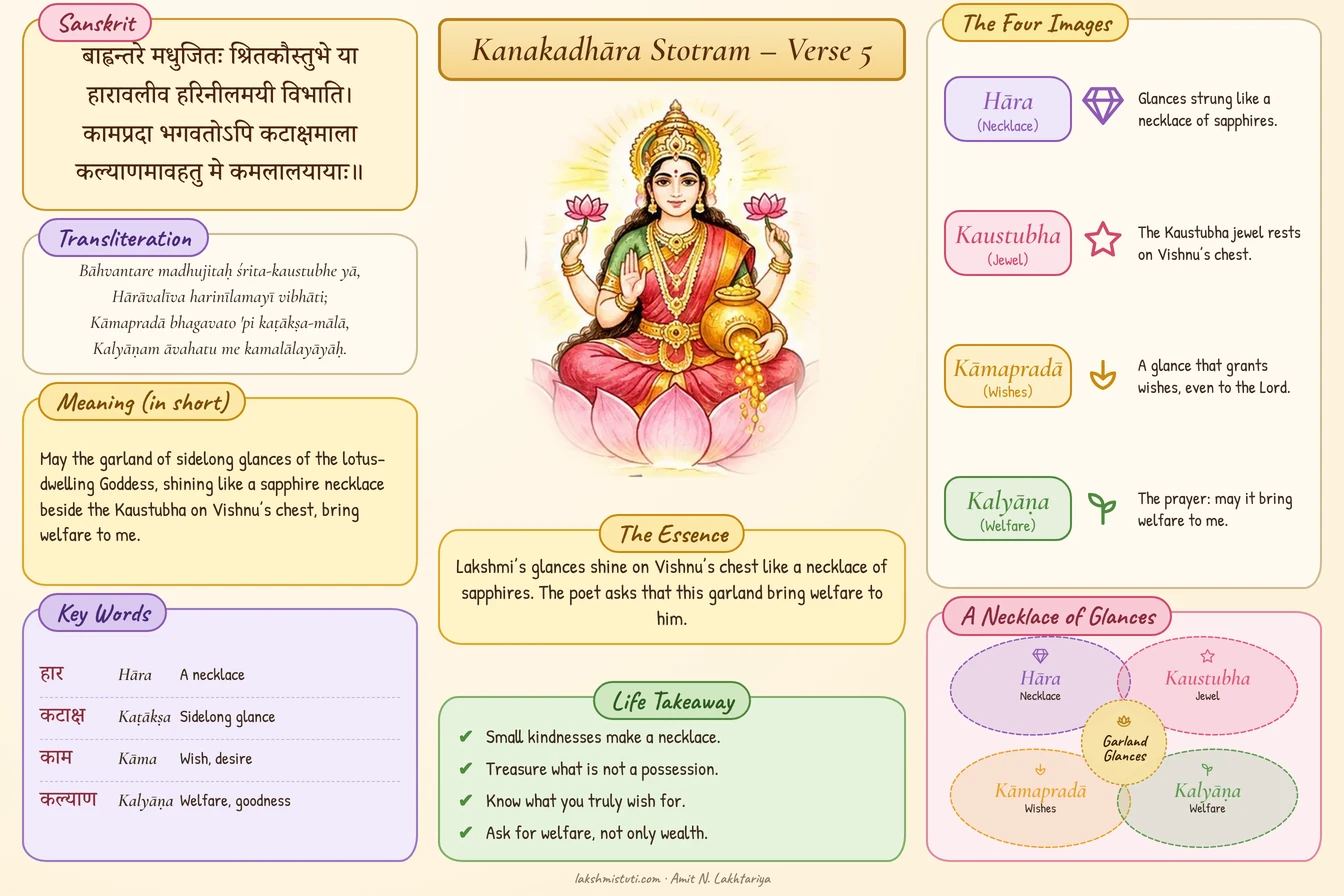
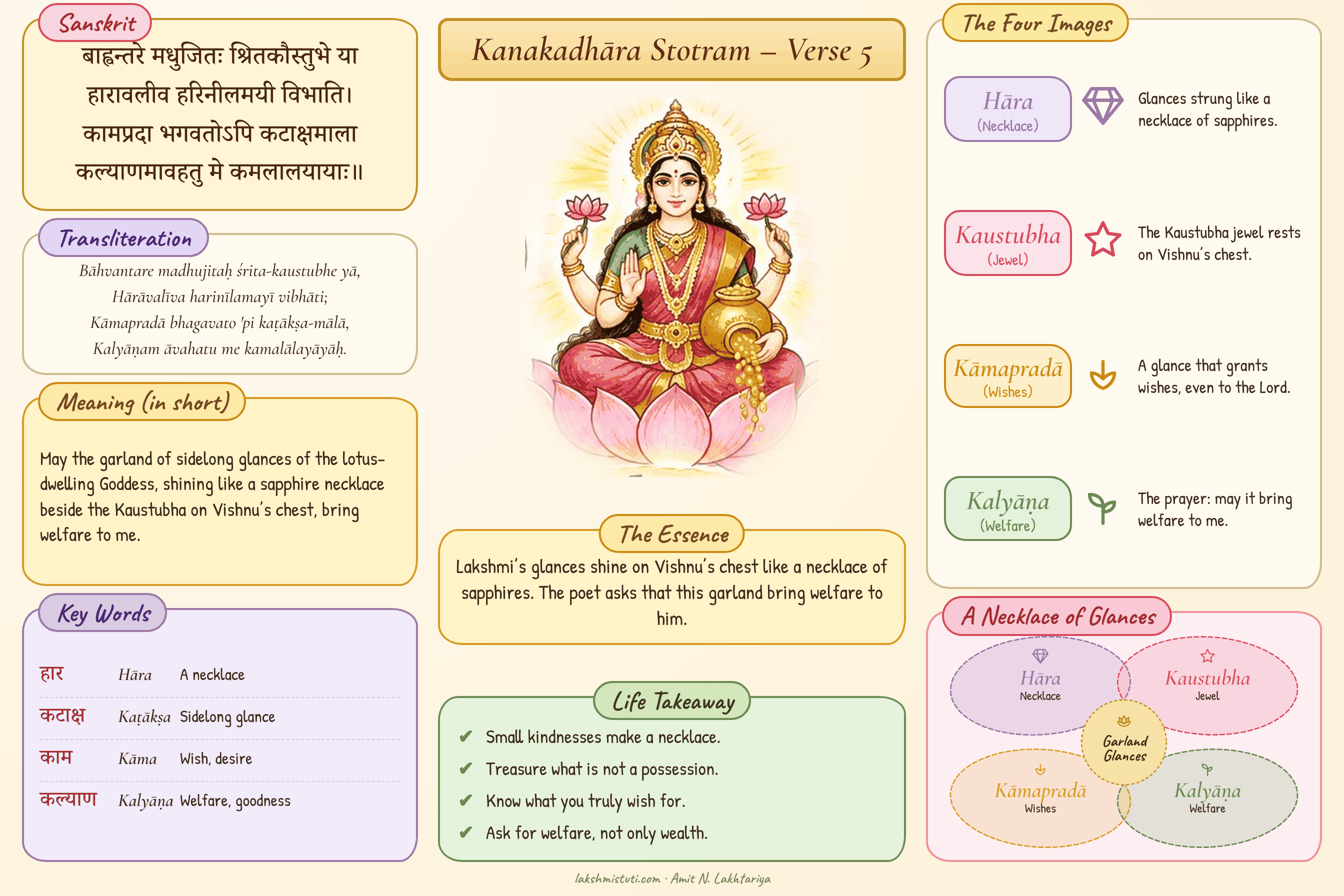
A one-page summary of the verse: Sanskrit, meaning, key ideas, key words and a takeaway. On a phone, open it full screen.
Word-by-word meaning
The literal meaning of each word.
| Sanskrit | Meaning |
|---|---|
| बाह्वन्तरेBāhv-antare | In the space between the arms; on the chest |
| मधुजितःMadhu-jitaḥ | Of the conqueror of Madhu (Vishnu) |
| श्रितकौस्तुभेŚrita-kaustubhe | Where the Kaustubha jewel rests |
| याYā | Which (she who, that which) |
| हारावलीवHārāvalī iva | Like a necklace |
| हरिनीलमयीHari-nīla-mayī | Made of sapphire; deep-blue gem |
| विभातिVibhāti | Shines, gleams |
| कामप्रदाKāma-pradā | Giver of wishes |
| भगवतः अपिBhagavato ’pi | Even to the Lord (Vishnu) |
| कटाक्षमालाKaṭākṣa-mālā | A garland of sidelong glances |
| कल्याणम् आवहतु मेKalyāṇam āvahatu me | May it bring welfare to me |
| कमलालयायाःKamalālayāyāḥ | Of her whose home is the lotus (Lakshmi) |
Notes on each word
Bāhu is the arm; antara is the space within or between. The space between the arms is the chest. When bāhu meets antare, the u turns into v: bāhv-antare. The ending means “in, on”.
Madhu is a demon, who in tradition was slain by Vishnu together with Kaiṭabha. Jit is one who conquers. So Madhujit is “the conqueror of Madhu”, a name of Vishnu. The ending marks “of”.
Śrita is one who has taken shelter or settled; Kaustubha is the famous jewel of Vishnu, which tradition says rose from the churning of the ocean and rests on his chest. The word describes the chest: the chest on which the Kaustubha has settled.
A feminine “which”. It looks ahead to kaṭākṣa-mālā, the garland of glances, in the third line, and tells us the first two lines are describing that garland.
Hāra is a necklace or string; āvalī is a row or line; iva is “like”. The words run together as hārāvalīva. A row of jewels strung along the chest.
Nīla is blue; harinīla is the name of a blue gem, usually rendered sapphire. -Mayī means “made of, full of”, and its feminine ending agrees with the garland. So the glances are a necklace of deep-blue jewels.
Bhā is to shine; the prefix vi adds brilliance. This is a plain statement of how the garland looks: it shines. The wish does not come until the last line.
Kāma is desire, wish (it can also mean love); prada is giver. The feminine ending agrees with the garland: the garland of glances is the giver.
Bhagavat is the Blessed Lord, here Vishnu. Api is “even”. The two join as bhagavato ’pi. The surprise is in the word “even”: her glance is a giver of wishes to the Lord himself.
Kaṭākṣa is a sidelong, gracious glance; mālā is a garland. This is not a physical necklace but a garland made of glances, the heart of the verse.
Kalyāṇa is what is good and auspicious: welfare, well-being. Ā-vah is to bring; āvahatu is “let it bring, may it bring”. Me is “to me”. The words join as kalyāṇam āvahatu me. This is the wish of the whole verse.
Kamala is the lotus; ālaya is a dwelling. So the one whose dwelling is the lotus is Lakshmi. The ending marks “of”: the garland of glances of Lakshmi.
Deeper spiritual insights
Interpretation and reflection: ideas that help us read the verse, not part of the text itself.
Before we begin
In the earlier verses, we explored Lakshmi’s loving glances toward Lord Vishnu. In this verse, Śaṅkarācārya paints another beautiful image: Lakshmi’s eyes, her graceful sidelong glances, and the way divine beauty seems to adorn Vishnu himself.
“May the garland of sidelong glances of Lakshmi, the Goddess who dwells in the lotus, shine like a necklace of deep-blue sapphires upon the chest of Madhujit, Lord Vishnu, where the Kaustubha jewel rests. May that garland of glances, which fulfils even the desires of Bhagavān himself, bring auspiciousness and well-being to me.”
1A more poetic rendering
“O Mother Lakshmi, Your beautiful glances form a radiant necklace around the chest of Lord Vishnu. They shine like a string of precious blue sapphires beside his divine Kaustubha jewel.
Your loving gaze is so powerful that it fulfils even the wishes of the Supreme Lord himself.
May that same beautiful garland of Your glances bring auspiciousness into my life.”
2In simple English
Śaṅkarācārya imagines Lakshmi’s repeated loving glances as a beautiful necklace adorning Vishnu’s chest.
The necklace is not made of gold or diamonds. It is made of her loving looks.
And he prays that this divine grace may bring goodness into his own life.
3A few important expressions deserve special attention
Madhujit: Vishnu is called the conqueror of the demon Madhu.
Kaustubha: the celebrated divine jewel associated with Vishnu’s chest.
Kaṭākṣa-mālā: not a physical necklace, but a garland made of glances. This is the heart of the verse.
4The poetry hidden in the verse
This is one of my favourite images in the hymn.
Imagine Lord Vishnu standing in divine splendour. His complexion is deep and beautiful, like a dark monsoon sky. Upon his chest rests the magnificent Kaustubha jewel, radiant with its own celestial brilliance.
And beside him is Lakshmi. She looks at him. Her eyes move gently towards him, then away, and then return.
Remember the second verse? There, Śaṅkarācārya compared her repeated glances to a female bee moving around a great lotus (Verse 2). Now he takes that imagery one step further. He says that her glances have become a necklace!
Imagine this: every loving glance from Lakshmi is like one precious blue sapphire. Her repeated glances form a beautiful garland, resting across Vishnu’s chest, near the Kaustubha jewel.
What an extraordinary poetic imagination! An ordinary poet might describe Lakshmi wearing a necklace of precious stones. Śaṅkarācārya turns the idea around. Lakshmi’s necklace is made of her own loving glances. The beauty is not in the ornament. The beauty is in the affection that creates it.
And then comes an astonishing expression: kāmapradā bhagavato ’pi. She fulfils the desires even of Bhagavān himself. Śaṅkarācārya is suggesting that her grace is not insignificant even in relation to the Supreme Lord.
The scene is intimate, yet the language is cosmic. That is the magic of this verse.
5Four deeper insights
A. Grace is itself an ornament
The verse describes Lakshmi’s glances as a necklace. A necklace is traditionally worn to enhance beauty. But here, her affection itself becomes the ornament.
Contemplation: Our achievements, wealth, titles and possessions may decorate our lives. But kindness, affection, generosity and integrity are the ornaments that give life its real beauty.
B. The meaning of Kāmapradā
The word kāmapradā means the bestower of desires or fulfiller of wishes. It is tempting to interpret this only as a prayer for material wealth. But consider a broader reflection: what do we truly desire?
- Wealth, but also security.
- Success, but also fulfilment.
- Recognition, but also respect.
- Comfort, but also peace.
The verse invites us to place our desires before the Goddess with humility. It does not say that every desire must be fulfilled exactly as we imagine. We can also pray for the wisdom to recognise which desires are truly worth pursuing.
C. Why mention that she fulfils even Bhagavān’s desires?
This is perhaps the most intriguing part of the verse. Śaṅkarācārya places Lakshmi’s power in a relationship with Vishnu himself.
One devotional interpretation is that Lakshmi represents divine grace and compassion, inseparable from the sustaining power of Vishnu. The Supreme is not portrayed as distant or devoid of relationship. The verse celebrates the loving completeness of the divine pair.
This is a theological reflection on the imagery, rather than a claim that the verse explains a formal doctrine.
D. Prosperity and auspiciousness
Notice that the final prayer is not simply for money. Śaṅkarācārya asks for kalyāṇam.
This word carries the sense of goodness, auspiciousness, welfare and flourishing. A life can have money and still lack kalyāṇam. True well-being requires more than accumulation.
6Reflection for today
I would like you to think about one particular question: if Lakshmi’s garland is made of loving glances rather than precious stones, what are the ornaments of our own lives?
Perhaps they are:
- The blessings of our parents.
- The affection of our family.
- The trust of our colleagues.
- The ability to help someone in need.
- The satisfaction of earning honestly.
We spend considerable time building wealth. That is necessary and worthwhile. But let us also build a life worthy of the wealth we accumulate.
Three Sanskrit treasures to remember
- Kaustubha – the divine jewel, a symbol of the extraordinary splendour associated with Lord Vishnu
- Kaṭākṣa-mālā – a garland of sidelong glances, a beautiful poetic expression that transforms loving attention into an ornament
- Kalyāṇam – auspiciousness and well-being, more than material success: the flourishing of life
7The essence of verse five
In this verse, Śaṅkarācārya transforms Lakshmi’s loving glances into a celestial necklace adorning Lord Vishnu. He then asks that this garland of divine grace bring kalyāṇam into his own life.
The central thought is beautiful: the greatest ornaments of life are not always the things we possess. Sometimes, they are the love we receive, the grace we experience and the goodness we share.
8One connection to remember before Verse 6
| Verse | The image of her eyes |
|---|---|
| 2 | Lakshmi’s eyes move like a bee around a lotus |
| 4 | We see the delicate expression of her eyes |
| 5 | Her glances become a necklace of blue sapphires |
| 6 | Her presence upon Vishnu’s dark chest becomes something even more spectacular: a flash of lightning against a gathering monsoon cloud |
There is a lovely continuity in the imagery, from the bee, to the eye, to the necklace, and now to the lightning.
A question to carry into Verse 6
Verse 6 transforms Lakshmi’s presence upon Vishnu’s dark chest into something even more spectacular: a flash of lightning against a gathering monsoon cloud.
Practical meditation
- Five-minute meditation, The Garland of Grace. Minute 1, recitation: recite the verse slowly, particularly the phrase kāmapradā bhagavato ’pi kaṭākṣa-mālā.
- Minute 2VisualisationPicture the Kaustubha jewel shining upon Vishnu’s chest. Imagine Lakshmi’s loving glances forming a beautiful garland around it.
- Minute 3ContemplationThink of the people whose affection, guidance and kindness have enriched your life.
- Minute 4Examine your desiresAsk yourself, “Are my ambitions leading me towards a better life, or merely towards more possessions?”
- Minute 5Prayer“O Mother Lakshmi, may my desires be guided by wisdom. May my prosperity bring happiness not only to me, but also to those whose lives touch mine. May my life be filled with kalyāṇam.”
The greatest ornaments of life are not always the things we possess; sometimes they are the love we receive, the grace we experience and the goodness we share.
This meditation is a devotional practice for attention and reflection; it does not promise a supernatural result or guarantee material wealth.