Home › Kanakadhāra Stotram › Verse 8
The verse
॥ श्लोक ८ ॥
दद्याद्दयानुपवनो द्रविणाम्बुधाराम्
अस्मिन्नकिञ्चनविहङ्गशिशौ विषण्णे।
दुष्कर्मघर्ममपनीय चिराय दूरं
नारायणप्रणयिनीनयनाम्बुवाहः॥
॥ श्री महालक्ष्म्यै नमः ॥
Dadyād dayānupavano draviṇāmbudhārām,
Asminn akiñcana-vihaṅga-śiśau viṣaṇṇe;
Duṣkarma-gharmam apanīya cirāya dūram,
Nārāyaṇa-praṇayinī-nayanāmbuvāhaḥ.
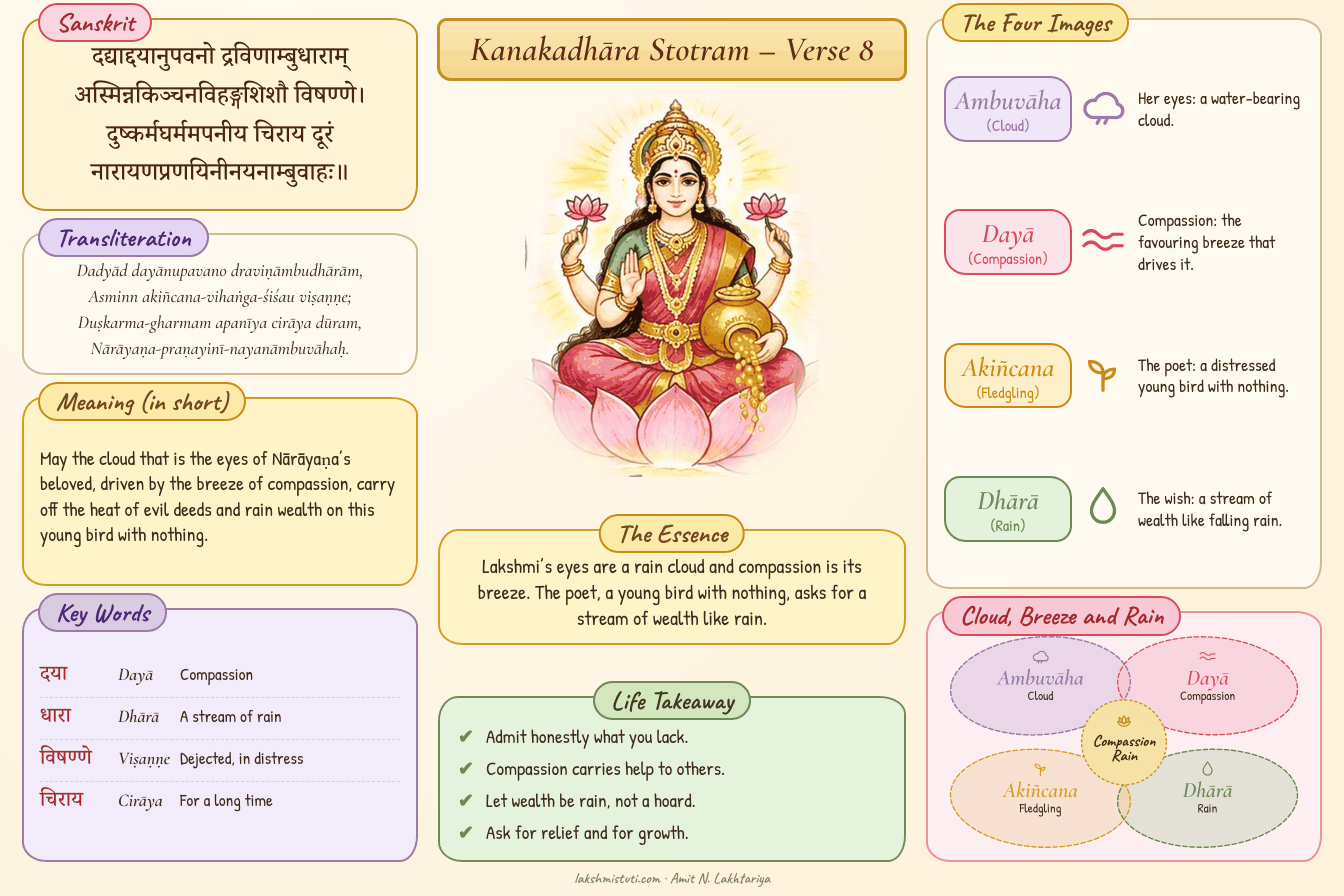
Meaning in short
May the water-bearing cloud that is the eyes of Nārāyaṇa’s beloved, with compassion as its favouring breeze, having driven the heat of evil deeds far away for a long time, give a stream of wealth like falling rain to this distressed young bird who has nothing.
Her eyes are a rain cloud, compassion the breeze that carries it, and Śaṅkarācārya a young bird with nothing, waiting.
Key highlights
- Ambuvāha Cloud: her eyes are a water-bearing cloud
- Dayā Compassion: the favouring breeze that carries it
- Akiñcana Fledgling: a young bird with nothing
- Dhārā Rain: wealth as a stream of rain
Explore the four images
Tap a card to open its meaning and a question to carry with you.
AmbuvāhaCloud
Nārāyaṇa-praṇayinī-nayana-ambuvāhaḥ: her eyes are a water-carrying cloud. In the heat of the verse’s picture, a cloud gathering far away is hope that a bird cannot make happen, only wait for.
Pause and reflect: What am I waiting for that I cannot make happen?
DayāCompassion
Dayā-anupavana: compassion is the favouring wind. The cloud holds the water, but it is the wind that brings it near. Resources, too, often reach people through someone’s compassion.
Pause and reflect: Whose compassion has carried something to me?
AkiñcanaFledgling
Akiñcana means one who has not even a little. Śaṅkarācārya calls himself a young bird with nothing, in distress. The prayer begins from honest helplessness, not from a list of merits.
Pause and reflect: Can I name honestly what I lack, without shame?
DhārāRain
The wish is for draviṇa-ambu-dhārā, a stream of wealth like rain. Rain falls, feeds and moves on. The verse also asks that the heat of wrong deeds be carried away for a long time.
Pause and reflect: Do I treat what I have as rain that feeds others, or as a hoard?
Sketch note
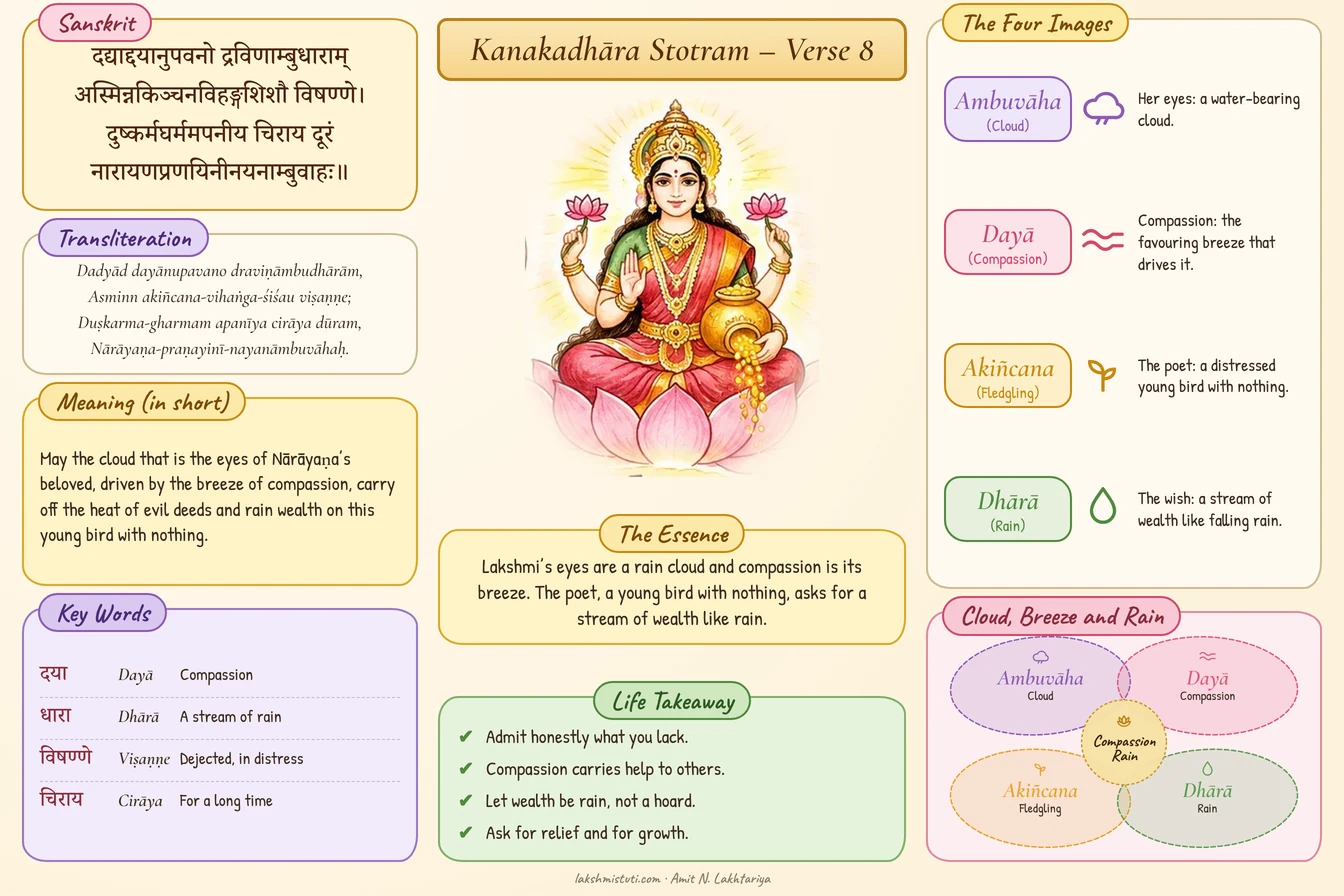
A one-page summary of the verse: Sanskrit, meaning, key ideas, key words and a takeaway. On a phone, open it full screen.
Word-by-word meaning
The literal meaning of each word.
| Sanskrit | Meaning |
|---|---|
| दद्यात्Dadyāt | May it give |
| दयानुपवनःDayā-anupavanaḥ | The one whose favouring breeze is compassion |
| द्रविणाम्बुधाराम्Draviṇa-ambu-dhārām | A stream of the water of wealth |
| अस्मिन्Asmin | On this one |
| अकिञ्चनविहङ्गशिशौAkiñcana-vihaṅga-śiśau | On the young bird that has nothing |
| विषण्णेViṣaṇṇe | Dejected, in distress |
| दुष्कर्मघर्मम्Duṣkarma-gharmam | The heat of evil deeds |
| अपनीयApanīya | Having carried away, having removed |
| चिरायCirāya | For a long time |
| दूरम्Dūram | Far away |
| नारायणप्रणयिनीनयनाम्बुवाहःNārāyaṇa-praṇayinī-nayana-ambuvāhaḥ | The water-carrying cloud that is the eyes of Nārāyaṇa’s beloved |
Notes on each word
From the root dā, to give. The ending makes it a wish: “may it give, let it give”. It is the main verb of the verse; everything else says who gives, what is given, to whom and what is driven away. Before the next word it is written dadyād.
Dayā is compassion; anu is “along, following”; pavana is wind. An anupavana is a wind that carries something along, a favourable breeze. A cloud goes where the wind sends it; Śaṅkarācārya’s picture is a cloud that compassion itself drives towards the one who needs it. The words join as dayānupavanaḥ.
Draviṇa is wealth, goods, riches; ambu is water; dhārā is a stream or a falling shower. So the shower is of water that is wealth: wealth falling like rain. The final m marks it as the thing given.
The “on” form of idam, “this”. Śaṅkarācārya points to himself: on this one, here.
Kiñcana is “anything”, so akiñcana is one who has not even a little, who has nothing. Vihaṅga is a bird, one who goes through the sky. Śiśu is a child, a young one, a fledgling. The ending means “on”. The devotee is pictured as a nestling with nothing of its own.
From vi and sad, to sit: to sit sunk down in sorrow. The ending agrees with the fledgling: on the one who sits there, downcast.
Duṣ- is bad; karma is a deed or action, so duṣkarma is a wrong or harmful act. Gharma is heat, the scorching heat of the sun. The compound pictures the results of wrong action as a burning heat. The final m marks it as what is carried away.
From apa (away) and nī (to lead): to lead away, take off. The ending -ya means “having done”.
Cira is long (in time). It tells us the relief is hoped to last, not to pass at once.
Used as an adverb: the heat is to be driven far off, not merely eased.
Nārāyaṇa is a name of Vishnu. Praṇayinī is a beloved, a woman who is loved (from praṇaya, affection). Nayana is the eye. Ambu is water and vāha carrying, so ambuvāha is “carrier of water”, a rain cloud. Śaṅkarācārya does not say the eyes are like a cloud: they are the cloud. This is the grammatical subject, the giver. The words join as nayanāmbuvāhaḥ.
Deeper spiritual insights
Interpretation and reflection: ideas that help us read the verse, not part of the text itself.
Before we begin
Let us move gently into the eighth verse.
There is an important change in the hymn here. Until now, Śaṅkarācārya has largely described the beauty, affection and extraordinary power of Goddess Lakshmi’s glances. Now the prayer becomes more personal: he seeks her compassionate attention for someone in need.
We will explore not only what he asks, but also the beautiful imagery through which he asks it.
“O Mother Lakshmi, your eyes are like clouds filled with the waters of compassion. Let a gentle breeze of kindness carry those clouds towards me. I am like a little bird, helpless and distressed, with no possessions and nowhere to turn. May your compassionate gaze shower a stream of prosperity upon me, washing away the scorching heat of my past misdeeds and bringing relief to my life.”
1This verse is rich in compound words: unlocking the most important one
| Part of the compound | Meaning |
|---|---|
| Nārāyaṇa | Lord Vishnu |
| Praṇayinī | His beloved, Lakshmi |
| Nayana | Her eyes |
| Ambuvāha | A cloud carrying water |
Together, nārāyaṇa-praṇayinī-nayanāmbuvāhaḥ is: the rain-bearing cloud of the eyes of Lakshmi, the beloved of Lord Vishnu.
And another beautiful compound: akiñcana-vihaṅga-śiśuḥ, a helpless little bird that possesses nothing. This is the image through which Śaṅkarācārya now describes the devotee.
2The full meaning
Literal meaning. May the rain-bearing cloud of the eyes of Lakshmi, the beloved of Lord Nārāyaṇa, accompanied by the breeze of compassion, shower streams of wealth upon this distressed, helpless little bird who possesses nothing, removing far away and for a long time the scorching heat of past misdeeds.
In simple English. Śaṅkarācārya now presents himself as a helpless little bird. He has no wealth, no resources and no protection. He looks towards Lakshmi and asks her to shower her compassion upon him, just as rain clouds bring relief to a thirsty earth.
Notice the progression: in Verse 7, he asked for a gentle glance. In Verse 8, he asks that the glance become a shower of compassion and prosperity.
3The poetry hidden in the verse
This verse is particularly moving.
Imagine a tiny bird sitting in its nest. It is young, vulnerable and helpless. It cannot fly far. It cannot search for food independently. It has no wealth, no possessions, no security.
Above it, the sun is scorching. The little bird is distressed.
Then, far away, clouds begin to gather. A gentle breeze starts moving through the air. The clouds travel towards the thirsty land, carrying the promise of rain.
And finally, the rain arrives. The little bird receives relief.
Now Śaṅkarācārya transforms this entire natural scene into a divine prayer.
- The little bird is the devotee.
- The scorching heat is the suffering associated with unfavourable past actions.
- The rain-bearing clouds are Lakshmi’s eyes.
- The gentle breeze is her compassion.
What an extraordinary imagination!
But there is an even more beautiful detail. Śaṅkarācārya does not describe Lakshmi simply as a Goddess holding a pot of gold and distributing wealth. He describes her eyes as rain clouds. Why?
Because rain does not ask the earth whether it deserves water before nourishing it. It falls, giving life to the thirsty soil. Śaṅkarācārya longs for that kind of compassionate grace.
And then comes the most touching part: asminn akiñcana-vihaṅga-śiśau viṣaṇṇe, “upon this distressed little bird who possesses nothing.”
Śaṅkarācārya does not present himself as powerful, accomplished or deserving. He presents himself as helpless. It is a remarkable change in tone.
In the earlier verses, we admired Lakshmi’s beauty. Now we feel the vulnerability of the person praying to her. Śaṅkarācārya has brought us from the splendour of Vaikuṇṭha to a tiny bird waiting for rain. And that is where the emotional power of this verse lies.
4Deeper spiritual insights
A. The humility of acknowledging our limitations
What the verse says: The devotee compares himself to an impoverished, distressed little bird.
What we may contemplate: There are moments in life when our knowledge, money, influence and abilities are simply not enough.
We can work hard, plan carefully and make sound decisions, while accepting that we cannot control every outcome. For someone responsible for professional work, family and financial decisions, this distinction is particularly meaningful: effort is our responsibility, but absolute control is not.
Contemplation: Acknowledging our limitation is not weakness. It is intellectual and spiritual honesty.
B. The meaning of the rain-bearing eyes
What the verse says: Lakshmi’s eyes are compared to clouds carrying water.
Spiritual reflection: Compassion is not merely an emotion. It becomes meaningful when it brings relief to someone who is suffering.
Think of someone who is struggling financially. A kind word may comfort them, but helping them find employment, arranging food or supporting their education can bring tangible relief.
Contemplation: This verse reminds us that prosperity becomes sacred when it nourishes life.
C. What is the scorching heat of Duṣkarma?
The expression duṣkarma-gharmam is especially important.
- Duṣkarma: unfavourable or harmful actions.
- Gharma: heat or scorching heat.
Śaṅkarācārya imagines the consequences of wrongdoing as an oppressive heat from which he seeks relief. A deeper reflection is that our past actions can create consequences that follow us.
The prayer is not necessarily an invitation to escape responsibility for those actions. Rather, we may understand it as a prayer for relief, purification and the strength to live differently.
Contemplation: Grace and personal responsibility need not be opposites.
D. Wealth as rain, not merely accumulation
There is an interesting distinction between two ways of looking at wealth. One is to see wealth as something to collect and protect. The other is to see wealth as something that nourishes life, much like rain.
The second image is especially powerful in this verse. Rain benefits the earth, plants, animals and human beings. Its value lies in what it sustains. Similarly, wealth has a larger purpose when it supports families, creates opportunities, provides security and helps those who need assistance.
Contemplation: The deeper message: prosperity should circulate like rain, not remain stagnant like water in a closed vessel.
5Reflection for today
I would like to pause at the little bird.
It is such a simple image, yet it contains a profound lesson. We spend much of our lives trying to become strong, independent, successful and secure. There is nothing wrong with that.
But sometimes, even the strongest person needs compassion. Even the wisest person needs guidance. Even the wealthiest person may experience helplessness. This verse reminds us that accepting help is not a failure. And receiving compassion should make us more compassionate towards others.
Consider these three questions:
- Where in my life do I need to accept that I cannot control everything?
- Are there past mistakes whose consequences I need to address rather than merely regret?
- Can I become a source of relief for someone who is struggling?
The third question is particularly beautiful. Perhaps we cannot always make it rain, but we can certainly carry an umbrella for someone.
Three Sanskrit treasures to remember
- Dayā (दया) – compassion: the willingness to understand suffering and respond with kindness
- Akiñcana (अकिञ्चन) – one who possesses nothing: a word expressing complete helplessness and dependence
- Ambuvāha (अम्बुवाह) – cloud, carrier of water: a beautiful metaphor for the eyes of the Goddess, carrying the promise of compassion
6The essence of verse eight
In this verse, Śaṅkarācārya makes one of the most heartfelt prayers of the hymn. He places himself before the Divine Mother as a helpless little bird, waiting for the rain of her compassion. He asks her eyes to become rain-bearing clouds, carrying prosperity and washing away the scorching heat of past misdeeds.
The essence is: when life makes us feel helpless, humility opens the heart to compassion. And when we receive abundance, we should become a source of nourishment for others.
A question to carry into Verse 9
A glimpse of Verse 9: it takes us from the image of a helpless little bird to a much wider vision. Śaṅkarācārya now speaks of people whose noble understanding and devotion have enabled them to attain even the exalted position of Indra through Lakshmi’s compassionate glance. He then asks for her beautiful gaze to bring puṣṭi, nourishment, growth and flourishing, to his own life.
There is an interesting contrast:
- Verse 8: the helpless little bird asking for rain.
- Verse 9: the spiritually accomplished seeking the highest blessings.
We will explore why Śaṅkarācārya places these two images next to each other.
Practical meditation
- Minute 1RecitationSlowly repeat nārāyaṇa-praṇayinī-nayanāmbuvāhaḥ. Think of Lakshmi’s eyes as clouds filled with compassion.
- Minute 2VisualizationImagine a tiny bird waiting for rain. Dark clouds gather, and gentle rain begins to fall.
- Minute 3Inner reflectionIdentify one area of your life where you feel uncertain, vulnerable, or in need of support.
- Minute 4ResolveAsk yourself, “Is there someone around me who is waiting for a little help, just as that bird waits for rain?”
- Minute 5Prayer“O Mother Lakshmi, remove the heat of my past mistakes. Give me the strength to correct my actions, the wisdom to make better decisions, and the generosity to become a source of relief for others.”
When life makes us feel helpless, humility opens the heart to compassion, and when we receive abundance, we should become a source of nourishment for others.
This meditation is a devotional practice for attention and reflection; it does not promise a supernatural result or guarantee material wealth.