Home › Kanakadhāra Stotram › Verse 19
The verse
॥ श्लोक १९ ॥
दिग्घस्तिभिः कनककुम्भमुखावसृष्ट-
स्वर्वाहिनीविमलचारुजलप्लुताङ्गीम्।
प्रातर्नमामि जगतां जननीमशेष-
लोकाधिनाथगृहिणीममृताब्धिपुत्रीम्॥
॥ श्री महालक्ष्म्यै नमः ॥
Dig-ghastibhiḥ kanaka-kumbha-mukhāvasṛṣṭa-
svarvāhinī-vimala-cāru-jala-plutāṅgīm,
Prātar namāmi jagatāṁ jananīm aśeṣa-
lokādhinātha-gṛhiṇīm amṛtābdhi-putrīm.
Meaning in short
At dawn I bow to the mother of the worlds, the wife of the lord of all the worlds, the daughter of the ocean of nectar, whose body is bathed in the pure and lovely water of the heavenly river, poured from the mouths of golden pots by the elephants of the directions.
The elephants of the directions bathe the Goddess at dawn, and Śaṅkarācārya bows to the Mother of the worlds.
Key highlights
- Digghasti Elephants: the guardians of the directions bathe her
- Kumbha Pots: golden pots pour the heavenly water
- Prātaḥ Dawn: Śaṅkarācārya bows at the start of the day
- Amṛtābdhi Ocean: she is the daughter of the ocean of nectar
Explore the four parts of the scene
Tap a card to open its meaning and a question to carry with you.
DigghastiElephants
Dik is a direction and hastin an elephant. In the tradition eight great elephants guard the eight directions. Here they serve her. A reflection: this is the largest scale in the hymn, and it is a scene of service, not of display.
Pause and reflect: Who supports me from every direction?
KumbhaPots
Kanaka is gold and kumbha a pot, and the water is poured from their mouths. The water is the river of heaven, pure and lovely, vimala and cāru. A reflection: the verse puts cleansing at the centre of prosperity.
Pause and reflect: What do I want washed away before I begin?
PrātaḥDawn
Prātar means in the morning. Śaṅkarācārya chooses the first hour for his bow. A reflection: the first hour is when attention is least spoken for, and giving it first to gratitude changes what the rest of the day is built on.
Pause and reflect: How do I use my first quarter hour?
AmṛtābdhiOcean
Amṛtābdhi-putrī is the daughter of the ocean of nectar. The tradition tells that Lakshmi rose from the ocean when gods and demons churned it. This is the tradition’s story; the verse gives only the phrase.
Pause and reflect: What do I owe to the world that raised me?
Sketch note
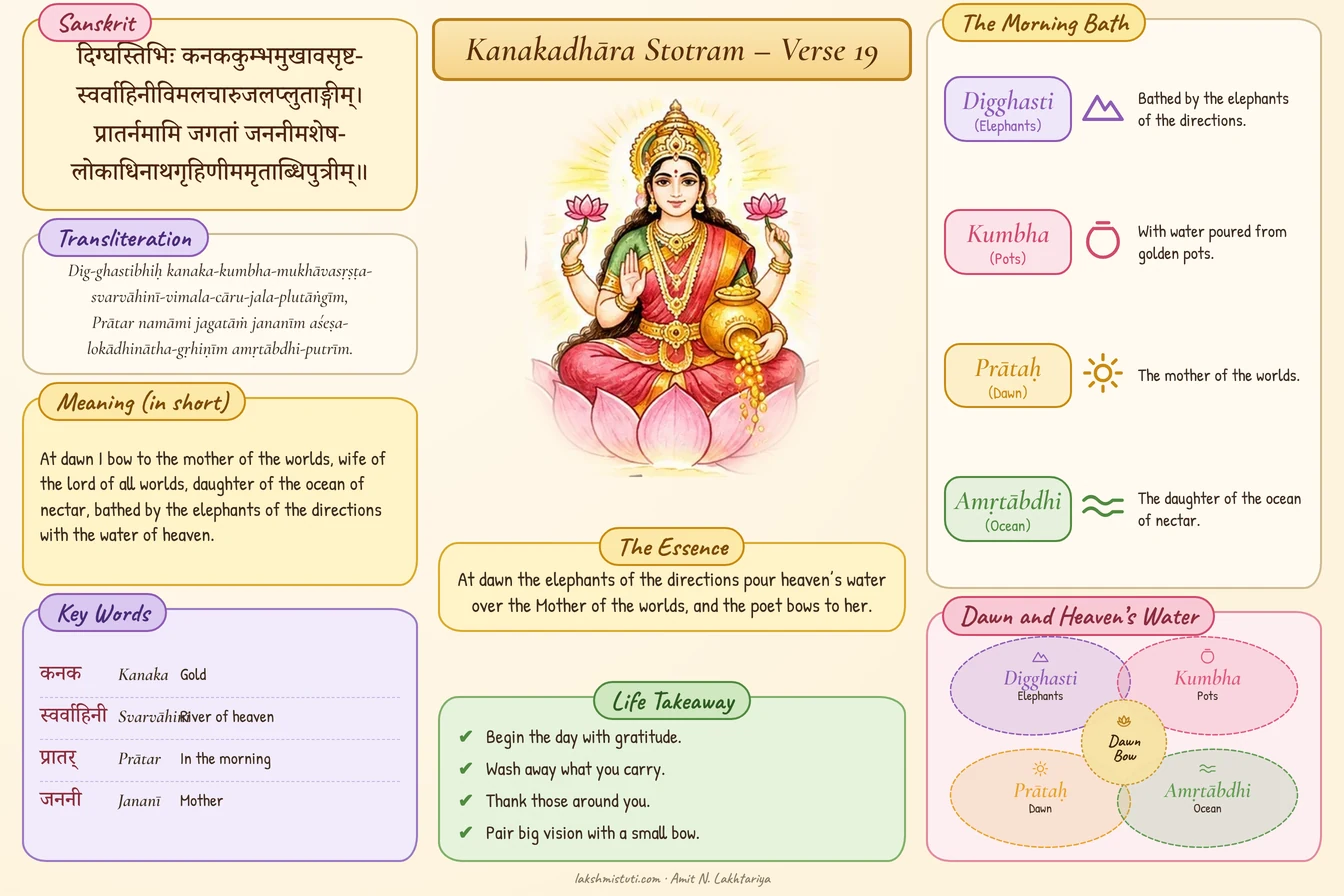
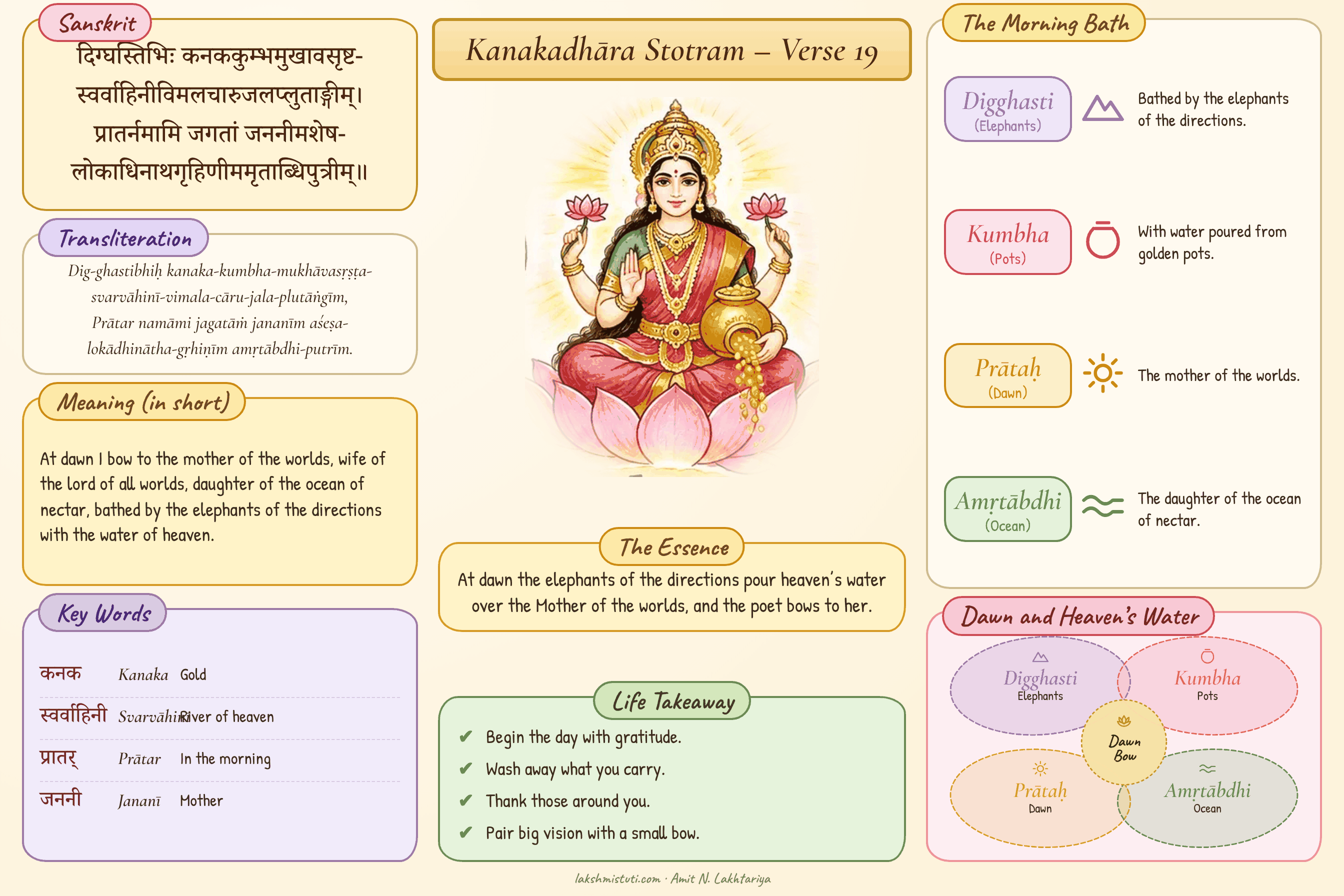
A one-page summary of the verse: Sanskrit, meaning, key ideas, key words and a takeaway. On a phone, open it full screen.
Word-by-word meaning
The literal meaning of each word.
| Sanskrit | Meaning |
|---|---|
| दिग्घस्तिभिःDig-ghastibhiḥ | By the elephants of the directions |
| कनककुम्भमुखावसृष्टKanaka-kumbha-mukhāvasṛṣṭa | Poured from the mouths of golden pots |
| स्वर्वाहिनीSvar-vāhinī | The river of heaven |
| विमलचारुजलप्लुताङ्गीम्Vimala-cāru-jala-plutāṅgīm | Whose body is bathed in pure, lovely water |
| प्रातःPrātaḥ | In the morning, at dawn |
| नमामिNamāmi | I bow |
| जगताम्Jagatām | Of the worlds |
| जननीम्Jananīm | The mother |
| अशेषलोकाधिनाथगृहिणीम्Aśeṣa-lokādhinātha-gṛhiṇīm | The wife of the lord of all the worlds |
| अमृताब्धिपुत्रीम्Amṛtābdhi-putrīm | The daughter of the ocean of nectar |
Notes on each word
Dik is a direction; hastin is an elephant, literally “one with a hand”, the trunk. In the tradition the eight directions are guarded by eight great elephants, the diggajas. The consonant h becomes gh after the g, so dik and hasti are written dig-ghasti. The ending -bhiḥ means “by”, in the plural.
Kanaka is gold. Kumbha is a pot. Mukha is a mouth, an opening. Avasṛṣṭa is “poured down, released”, from ava and the root sṛj, “to let go”. The pots are golden, and the water is poured from their mouths.
Svar is heaven, the sky. Vāhinī is “a flowing one”, a river. So it is the heavenly river, which the tradition identifies with the Gaṅgā in her heavenly form. It is the source of the water in the pots.
Vimala is stainless, cāru is lovely, jala is water, pluta is bathed, flooded. Aṅgī means “having limbs”, a body. The final -īm is the “whom” form: it is her, the one whose body is bathed in pure, lovely water.
The visarga becomes r before the next word, so it appears as prātar. It places the whole scene, and Śaṅkarācārya’s bow, at the start of the day.
From nam, “to bow”, in the first person. It is the main verb: “I bow to her”, and it governs every “whom” form in the verse.
Jagat is “that which moves”, the world. The ending -ām is “of”, in the plural: of the worlds.
Jananī is a mother, from the root jan, “to be born, to give birth”. The final -m marks “whom”, the object of namāmi.
Aśeṣa is “without remainder”, entire. Loka is a world. Adhinātha is an overlord. Gṛhiṇī is the mistress of the house, a wife. The a of loka and the a of adhinātha join into ā. So she is the lady of the house of the lord of all worlds.
Amṛta is nectar, “the deathless”. Abdhi is an ocean. Putrī is a daughter. The tradition connects this with the churning of the ocean, from which she is said to have risen. The a of amṛta and the a of abdhi join into ā.
Deeper spiritual insights
Interpretation and reflection: ideas that help us read the verse, not part of the text itself.
Before we begin
This verse gives us one of the grandest images in the Stotram: Mahalakshmi receiving a royal ceremonial bath from the celestial elephants of the directions. The imagery is not merely decorative. It portrays the entire cosmos honouring the Goddess of auspiciousness and abundance.
“In the morning, I bow to the Mother of all the worlds, whose body is bathed in the pure and beautiful waters of the heavenly river, poured from golden vessels by the elephants of the directions; who is the divine consort of the Lord of all worlds, and the daughter of the Ocean of Nectar.”
1A more poetic rendering
At dawn I bow to the Mother of the universe, bathed in celestial waters poured from golden vessels by the mighty elephants guarding the directions; the eternal consort of the Lord of all worlds, the radiant daughter of the Ocean of Nectar.
The verse describes the Goddess through a long chain of compounds, culminating in the principal action: prātar namāmi, “in the morning, I bow”.
2The four images hidden in the verse
Image 1 – Digghastibhiḥ: the elephants of the directions
In traditional Hindu cosmology, the directions are guarded by powerful celestial elephants, often called Diggajas. They represent the guardianship and stability of the cosmic quarters. These elephants are shown pouring sacred water upon Lakshmi.
Notice the scale of the image: not ordinary attendants, but guardians of the directions themselves are participating in her worship.
Contemplation: The whole world, in every direction, acknowledges the source of auspiciousness. Prosperity is not a private possession; it is connected with the harmony and well-being of the larger world.
Image 2 – Kanaka-kumbha-mukhāvasṛṣṭa: golden vessels and celestial water
Kanaka is gold, kumbha a ceremonial pot or vessel, mukha an opening or mouth, and avasṛṣṭa means poured forth. The water is described as coming from golden vessels. It is not ordinary water in the poetic imagination: it is the pure, beautiful water of the celestial river.
This is the imagery of abhiṣeka, a sacred ceremonial bathing, traditionally associated with honouring and consecrating a deity or sovereign. The golden vessels convey splendour; the pure water conveys sanctity. Together they create an image of divine royal consecration.
Image 3 – Jagatāṁ jananīm: the Mother of all worlds
Here Śaṅkarācārya moves beyond the beautiful iconography and gives Lakshmi a universal identity: Mother of all worlds. This is a significant expression.
In earlier verses, we encountered Lakshmi as the beloved of Nārāyaṇa, the lotus-dwelling Goddess and the giver of prosperity to the three worlds. Now she is addressed as the Mother of the worlds themselves. The word jananī is not merely an affectionate title. It expresses the idea of a source from which life and creation emerge.
Image 4 – Lokādhinātha-gṛhiṇīm and Amṛtābdhi-putrīm: the consort of the Lord and daughter of the Ocean of Nectar
She is the divine consort of the Lord of all worlds. The expression gṛhiṇī carries the sense of the mistress of the household or consort: not simply a domestic role, but the complementary presence of the divine feminine in the cosmic order.
She is also the daughter of the Ocean of Nectar. This recalls the traditional account of samudra-manthana, the churning of the Ocean of Milk, from which Lakshmi emerged along with other divine treasures. The ocean is associated with nectar and immortality, hence the poetic expression amṛtābdhi.
3The deeper significance of the royal abhiṣeka
There is a beautiful distinction between the previous verse and this one. Verse 18 presents Lakshmi through her lotus, garments, fragrance and divine beauty. Verse 19 presents her as a universal sovereign, honoured through a celestial abhiṣeka.
The image resembles the consecration of a great queen. But here the ceremony is cosmic: the elephants of the directions pour heavenly water, golden vessels are used, and the Mother of all worlds receives the sacred bath. This is also the traditional Gaja-Lakshmi motif, in which elephants flank or bathe Lakshmi.
4Three layers worth noticing
Lakshmi is worthy of the highest honour.
The guardians of the directions participate in her worship.
The one receiving this royal honour is also the Mother of all creation.
The third point is particularly moving. The supreme Goddess is simultaneously majestic and maternal.
5Why does Śaṅkarācārya say prātar namāmi?
This means, quite simply, “In the morning, I bow.” The word prātaḥ gives the verse a daily devotional quality. It is not merely an account of a celestial ceremony; it becomes a personal morning practice.
Consider the symbolism of morning: a new beginning, a fresh opportunity to act rightly, a reminder to begin the day with gratitude, and an opportunity to place one’s work and responsibilities before the Divine.
There is a subtle difference between asking the Goddess for prosperity and beginning the day by bowing to the source of prosperity. The latter begins with reverence rather than demand.
6Philosophical reflection
The golden vessels and celestial ceremony depict extraordinary abundance. Yet Śaṅkarācārya’s response is not pride or possession. It is namāmi, I bow. Prosperity should make a person more humble, generous and responsible, not more self-important.
The elephants of the directions, celestial waters, the ocean, the worlds and their Lord all appear in one image. The verse presents Lakshmi not as a narrow symbol of personal wealth, but as an auspicious presence within the entire cosmic order.
She is the consort of the Lord of all worlds, but she is also their Mother. Authority and compassion are not opposites here. They belong together.
7A morning meditation
You can use this verse as a short meditation before beginning your daily work. Close your eyes and visualise the scene.
The sacred water. Imagine pure water flowing from golden vessels. Let it represent the cleansing of yesterday’s worries, mistakes and unnecessary thoughts.
The eight directions. Imagine the celestial elephants guarding all directions. Let them remind you to maintain balance in every direction of life: family, work, health, relationships and duty.
The Mother of the worlds. See Lakshmi as the universal Mother. Let gratitude replace the constant urge to acquire more.
8Important Sanskrit vocabulary
| Word | Deeper sense |
|---|---|
| Diggaja (दिग्गज) | Celestial elephant; guardian of a direction |
| Kanaka (कनक) | Gold; splendour |
| Kumbha (कुम्भ) | Sacred vessel; fullness |
| Abhiṣeka (अभिषेक) | Ceremonial sacred bathing or consecration |
| Vimala (विमल) | Stainless, pure |
| Jananī (जननी) | Mother, source of birth |
| Gṛhiṇī (गृहिणी) | Mistress of the household; consort |
| Amṛtābdhi (अमृताब्धि) | Ocean of nectar or immortality |
9The central thought
From celestial splendour to universal motherhood. In this verse, Śaṅkarācārya invites us to visualise Mahalakshmi as the supreme and auspicious Mother, honoured by the guardians of all directions through a sacred royal bathing ceremony. She is the daughter of the Ocean of Nectar, the divine consort of the Lord of all worlds, and the Mother of the entire universe.
Let every new morning begin with reverence. Let prosperity be accompanied by purity, authority by compassion, and abundance by gratitude.
A question to carry into Verse 20
The next verse, Verse 20, changes the mood again: from the grand celestial abhiṣeka, Śaṅkarācārya turns to a deeply personal plea for the compassionate glance of Lakshmi.
Practical meditation
- Use the verse as a morning practice. First, the sacred water: imagine pure water from golden vessels cleansing yesterday’s worries, mistakes and unnecessary thoughts.
- Second, the directions: let the guardians of the directions remind you to keep balance in family, work, health, relationships and duty.
- Third, the Mother of the worlds: see Lakshmi as the universal Mother, and let gratitude replace the urge to acquire more.
- Finally, prātar namāmi, silently: “O Mother of the universe, may my thoughts be pure, my work be righteous, and whatever prosperity comes into my life become a source of well-being for others.”
From celestial splendour to universal motherhood: let every new morning begin with reverence, prosperity with purity, authority with compassion and abundance with gratitude.
This meditation is a devotional practice for attention and reflection; it does not promise a supernatural result or guarantee material wealth.