Home › Kanakadhāra Stotram › Verse 22
The verse
॥ श्लोक २२ ॥
स्तुवन्ति ये स्तुतिभिरमीभिरन्वहं
त्रयीमयीं त्रिभुवनमातरं रमाम्।
गुणाधिका गुरुतरभाग्यभागिनो
भवन्ति ते भुवि बुधभाविताशयाः॥
॥ श्री महालक्ष्म्यै नमः ॥
Stuvanti ye stutibhir amībhir anvahaṁ
Trayīmayīṁ tribhuvana-mātaraṁ ramām;
Guṇādhikā gurutara-bhāgya-bhāgino
Bhavanti te bhuvi budha-bhāvitāśayāḥ.
Meaning in short
Those who praise Lakshmi every day with these hymns, Lakshmi who embodies the three Vedas and is the Mother of the three worlds, become endowed with excellent virtues and share in great good fortune. On earth, their minds and intentions become worthy of the esteem of the wise.
A closing blessing: those who praise the Mother daily grow in virtue, in fortune and in a mind the wise respect.
Key highlights
- Trayīmayī Knowledge: she is the embodiment of the three Vedas
- Tribhuvana Motherhood: she is the Mother of the three worlds
- Guṇādhikā Virtue: those who praise her grow rich in qualities
- Budhabhāvita Honour: a mind the wise esteem, the closing hope
Explore the four fruits
Tap a card to open its meaning and a question to carry with you.
TrayīmayīKnowledge
Trayī is the threefold Veda, and -mayī means made of. Lakshmi is praised as the Goddess in whom sacred knowledge abides, so she is joined with wisdom as well as with wealth. A reflection: prosperity without knowledge can become arrogance; with knowledge it can become welfare.
Pause and reflect: Where does knowledge guide my decisions about money?
TribhuvanaMotherhood
Tribhuvana is the three worlds, earth, the space between and the heavens, and she is called their mother. In Verse 18 she gave prosperity to the three worlds; here she is their mother. The hymn has widened from one devotee to the whole universe.
Pause and reflect: Whom besides myself does my prosperity reach?
GuṇādhikāVirtue
Guṇādhikā means rich in virtues, and the next word speaks of great fortune. Character is named first and fortune second. A reflection: the verse does not read as a way of getting money; it describes what devotion hopes to make of the person who prays.
Pause and reflect: Which virtue would I most like to grow this year?
BudhabhāvitaHonour
Budha is a wise person and bhāvita means held in regard. The last line hopes for a mind that the wise esteem, not for fame or wealth. A reflection: being admired by crowds and being respected by the wise are not the same thing.
Pause and reflect: Whose respect do I really want?
Sketch note
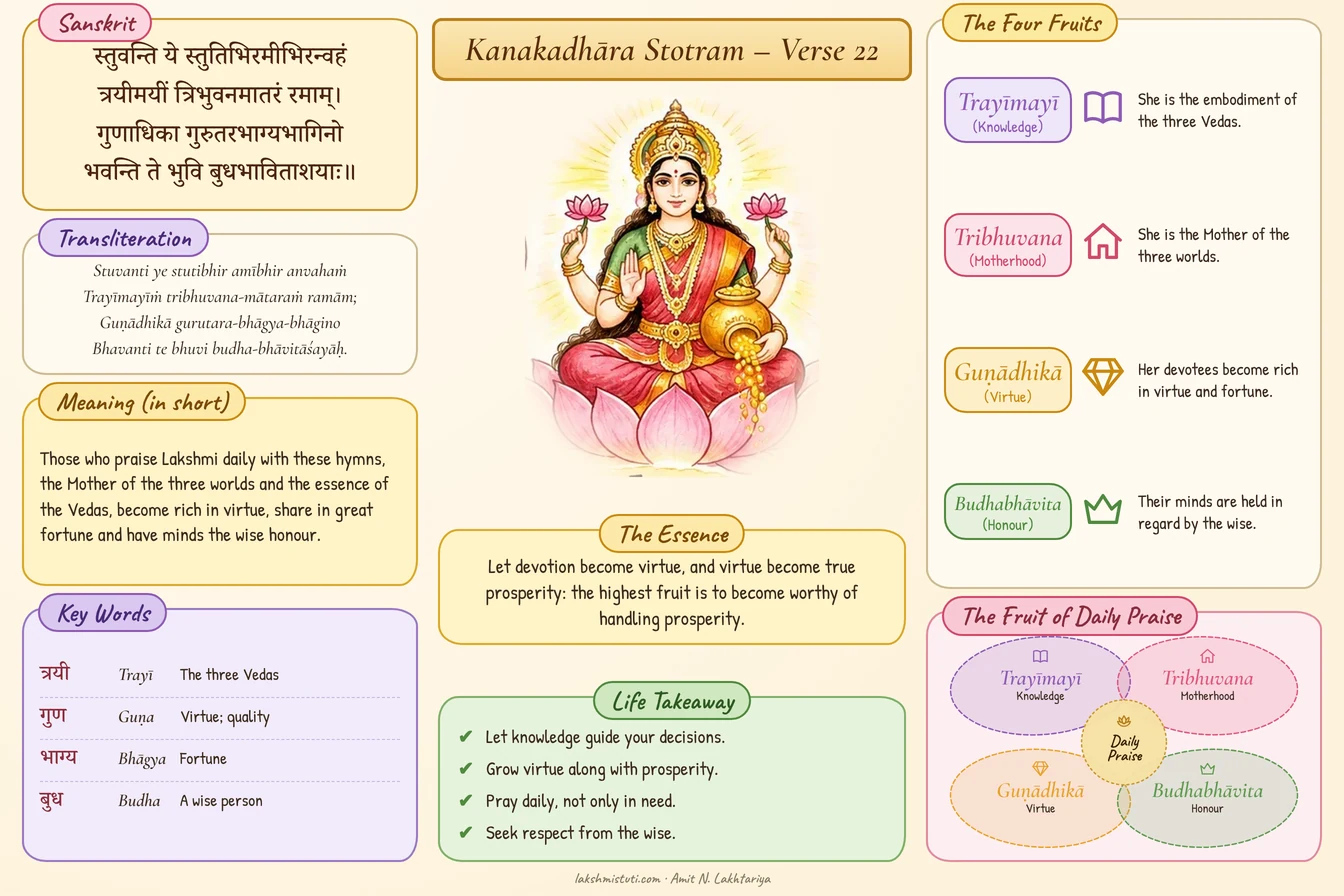
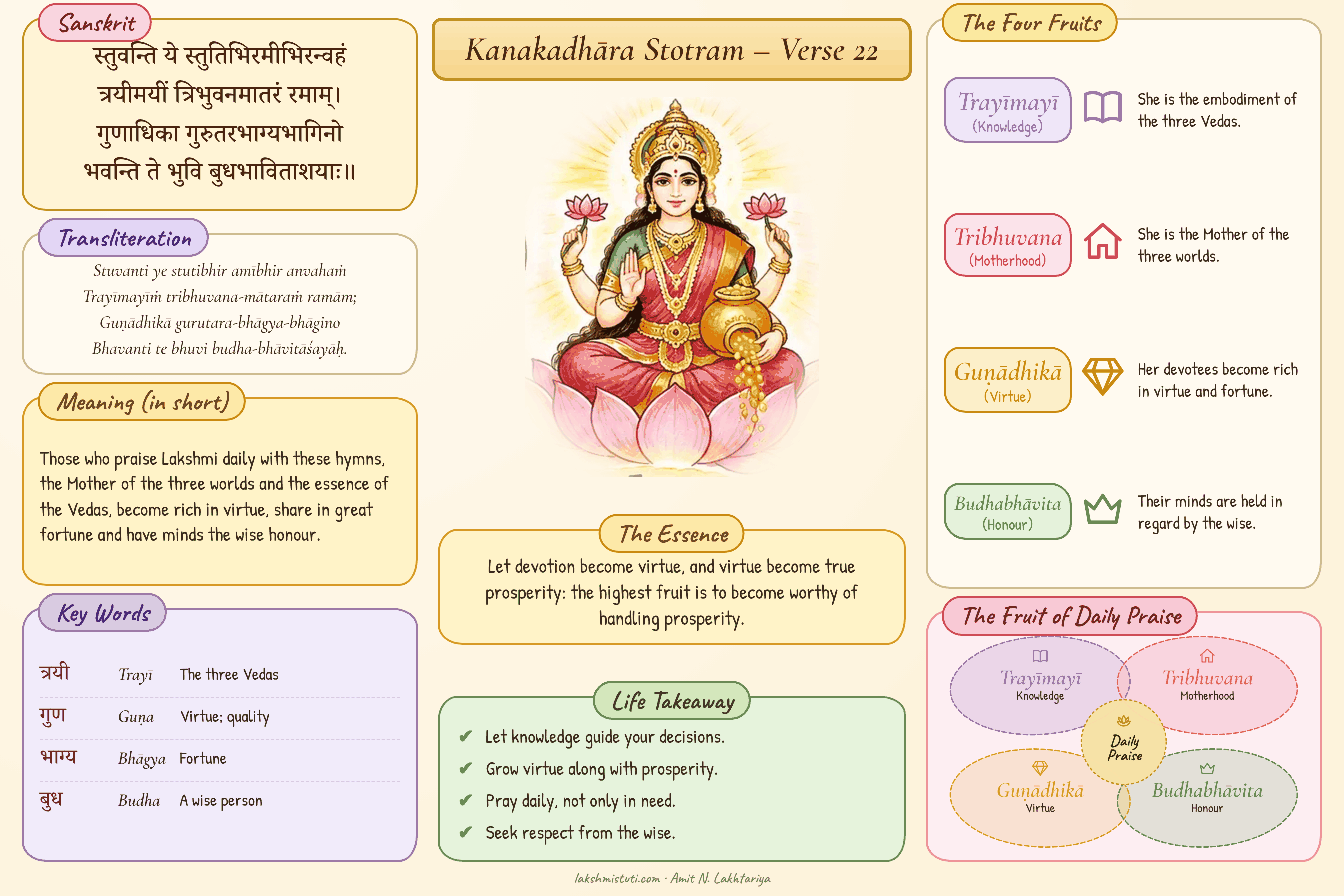
A one-page summary of the verse: Sanskrit, meaning, key ideas, key words and a takeaway. On a phone, open it full screen.
Word-by-word meaning
The literal meaning of each word.
| Sanskrit | Meaning |
|---|---|
| स्तुवन्ति येStuvanti ye | Those who praise |
| स्तुतिभिरमीभिरन्वहम्Stutibhir amībhir anvaham | With these hymns, every day |
| त्रयीमयीम्Trayīmayīm | Her who is made of the three Vedas |
| त्रिभुवनमातरं रमाम्Tribhuvana-mātaraṁ ramām | Ramā, the mother of the three worlds |
| गुणाधिकाःGuṇādhikāḥ | Rich in virtues |
| गुरुतरभाग्यभागिनःGurutara-bhāgya-bhāginaḥ | Sharing in great good fortune |
| भवन्ति ते भुविBhavanti te bhuvi | They become, on earth |
| बुधभाविताशयाःBudha-bhāvitāśayāḥ | With minds the wise honour |
Notes on each word
Stuvanti is “they praise”, from the root stu, from which stuti, a hymn, also comes. Ye is “those who”. The verse opens by naming the people it is about, and will say what becomes of them in the last line with te, “they”.
Stutibhiḥ is “with hymns”, amībhiḥ is “with these”, and anvaham is “day by day”. The visarga of both words turns into r before the vowel that follows. “These hymns” points to the hymn we have just read. Editions differ between amībhiḥ and amūbhiḥ; this site keeps amībhiḥ.
Trayī is the threefold Veda, the Ṛg, Yajus and Sāman. -mayī means “made of, full of”. So she is the Goddess in whom the sacred knowledge of the three Vedas abides.
Tri-bhuvana is the three worlds, mātaram is “mother” and ramā is a name of Lakshmi, “the delightful one”. The words are all in the form of the object: they are what the praising is directed at.
Guṇa is a quality or virtue, and adhika is “more, abundant”. They become people of excellent qualities. Notice that character is named first.
Gurutara is “weightier, greater”, bhāgya is fortune and bhāgin is one who shares in. Fortune follows virtue in the sentence.
Bhavanti is “they become”, the verb of the sentence. Te is “they”, answering the opening ye. Bhuvi is “on the earth, in the world”: the fruit is to be seen in this life.
Budha is a wise person, bhāvita is “held in regard, esteemed” and āśaya is the mind, the inner disposition. Bhāvita and āśaya join into bhāvitāśaya. The last word is about the quality of mind, not about wealth or fame.
Deeper spiritual insights
Interpretation and reflection: ideas that help us read the verse, not part of the text itself.
Before we begin
This is the concluding verse of the Stotram. After twenty-one verses of describing Lakshmi’s beauty, divine power, compassion and auspiciousness, Śaṅkarācārya now speaks about those who praise her through this hymn.
It is a phalaśruti-like concluding benediction, a statement about the fruits associated with the regular recitation and contemplation of the hymn. The closing thought is especially significant: the devotee is not promised only wealth, but virtues, great fortune and a mind respected by the wise.
“Those who praise Lakshmi every day with these hymns, Lakshmi who embodies the three Vedas and is the Mother of the three worlds, become endowed with excellent virtues and share in great good fortune. On earth, their minds and intentions become worthy of the esteem of the wise.”
1A more poetic rendering
Those who daily sing the praise of Ramā, the Mother of the three worlds, the very essence of the Vedas, become rich in virtue and blessed with great fortune; their noble thoughts are honoured by the wise, and their lives become worthy of respect upon this earth.
A grammatical point: ye, “those who”, introduces the people being described; te, “they”, refers back to them. The principal verb is bhavanti: they become.
2The four profound expressions
Image 1 – Trayīmayīm: the embodiment of the three Vedas
Trayī is the threefold Vedic corpus, traditionally referring to Ṛgveda, Yajurveda and Sāmaveda. -Mayī means consisting of, embodying, filled with. Lakshmi is described as trayīmayī, the embodiment of the three Vedas.
This is a significant description. The Goddess is not merely associated with material prosperity; she is connected with sacred knowledge and the Vedic vision of cosmic order. The Vedas are concerned with much more than ritual. They preserve knowledge of dharma, cosmic harmony, sacred duties and the relationship between human beings and the Divine. By calling Lakshmi trayīmayī, Śaṅkarācārya places her within this sacred vision.
Contemplation: Prosperity without knowledge can become arrogance. Prosperity guided by knowledge can become a source of welfare.
Image 2 – Tribhuvanamātaram Ramām: Mother of the three worlds
Tri is three, bhuvana is worlds or realms, mātaram is Mother and ramā is Lakshmi. The three worlds are traditionally understood as Bhūḥ, the earthly realm; Bhuvaḥ, the intermediate or atmospheric realm; and Svaḥ, the celestial realm. Lakshmi is addressed as the Mother of all three.
Notice how this echoes Verse 18, where she was called tribhuvana-bhūti-karī, the giver of prosperity to the three worlds. There is a subtle progression: in Verse 18 she bestows prosperity upon the three worlds; in Verse 22 she is the Mother of the three worlds. The scope of the Stotram has expanded from the individual devotee to the entire universe.
Image 3 – Guṇādhikā, Gurutarabhāgyabhāginaḥ: virtue and great fortune
This is the heart of the promised fruit. Guṇa is virtue, quality, excellence; adhika is abundant, superior; gurutarabhāgya is great or substantial fortune; and bhāginaḥ are those who partake of or share in.
Śaṅkarācārya describes the devotees as becoming rich in qualities and fortunate in life. This is worth noticing: the first expression is about character, and the second is about fortune. The order is meaningful. It would be a mistake to read this verse as saying that recitation is merely a mechanical method for acquiring money. The description of the fruit includes excellence of character as well as good fortune.
Contemplation: A person whose life is shaped by devotion should ideally become more truthful, generous, disciplined, compassionate and wise.
Image 4 – Budhabhāvitāśayāḥ: minds honoured by the wise
Budha is the wise or learned, bhāvita is esteemed, regarded, appreciated, and āśaya is inner disposition, mind, intention. This is a particularly beautiful way to conclude the Stotram.
Śaṅkarācārya does not merely say that the devotees become rich or famous. He says that their inner disposition becomes worthy of the appreciation of wise people. The emphasis is on the quality of the mind. There is a difference between being admired by crowds and being respected by the wise. The first may come from wealth, influence or popularity. The second is more closely connected with character, judgement and wisdom. The verse closes with an aspiration for the latter.
3What does this verse promise?
| Expression | Fruit |
|---|---|
| Guṇādhikāḥ | Excellence of character |
| Gurutarabhāgyabhāginaḥ | A share in great good fortune |
| Bhuvi | A good and meaningful life in this world |
| Budhabhāvitāśayāḥ | An inner disposition respected by the wise |
This is a broad vision of prosperity. The Stotram began with the prayer for the flow of divine grace and material prosperity. It ends by including virtue, fortune and wisdom.
We should also be precise about the nature of the promise: this is a devotional benediction, not a guarantee that reciting the hymn will mechanically produce a particular amount of wealth or remove every difficulty. Its deeper invitation is to let devotion transform the person who recites it.
4Why does Śaṅkarācārya conclude with this verse?
There is a literary and spiritual purpose. Throughout the Stotram, he has used different names for Lakshmi: Kamalā, Ramā, Śrī, Bhūti, Padmā, Hari-vallabhā, Murāri-hṛdayeśvarī, Tribhuvana-mātā. Each name reveals a different dimension of the same Divine Mother.
In Verse 22, he gathers these dimensions into three expressions: trayīmayī, she is connected with sacred knowledge; tribhuvanamātā, she is the Mother of the universe; and ramā, she is Lakshmi, the source of auspiciousness and prosperity. Then he turns towards the devotee and describes the fruits of daily praise. The hymn thus moves from the greatness of the Goddess to the transformation of the worshipper.
5The deeper philosophical message: three lessons
A person may accumulate wealth without developing virtues. But the verse places guṇa alongside bhāgya. Good fortune and good character belong together in an ideal life.
The expression budhabhāvitāśayāḥ is particularly meaningful. The ultimate aspiration is to have a mind and intention that the wise can appreciate, not simply to become famous or powerful.
The word anvaham means daily. Śaṅkarācārya emphasises regularity, not occasional enthusiasm. A daily practice of prayer, reflection and self-examination can help keep one’s thoughts and conduct aligned with one’s values.
6Sanskrit vocabulary to remember
| Word | Meaning |
|---|---|
| Stuvanti (स्तुवन्ति) | They praise |
| Stuti (स्तुति) | Hymn, praise |
| Anvaham (अन्वहम्) | Every day |
| Trayī (त्रयी) | The three Vedas |
| Mayī (मयी) | Consisting of, embodying |
| Tribhuvana (त्रिभुवन) | The three worlds |
| Ramā (रमा) | Lakshmi |
| Guṇa (गुण) | Virtue, quality |
| Bhāgya (भाग्य) | Fortune |
| Bhāgin (भागिन्) | Partaker, recipient |
| Budha (बुध) | Wise person |
| Āśaya (आशय) | Inner disposition, intention |
7The central thought
Let devotion become virtue, and virtue become true prosperity. The concluding verse tells us that those who daily praise Lakshmi, the embodiment of the Vedas and Mother of the three worlds, become endowed with virtues and great fortune. Their inner disposition becomes worthy of the appreciation of the wise.
The highest fruit of devotion is not merely to receive prosperity, but to become worthy of handling prosperity, with wisdom, humility, generosity and good character.
8The complete journey of the Kanakadhāra Stotram
| Movement | Central theme |
|---|---|
| Divine beauty and grace Verses 1–5 | Lakshmi’s glance, compassion and auspiciousness |
| The story of divine grace Verses 6–10 | Her compassion, Vishnu’s grace and the imagery of prosperity |
| Salutations to the Goddess Verses 11–15 | Her many names, forms and divine relationships |
| Personal prayer Verses 16–20 | Prosperity, worship, surrender and compassionate grace |
| Final appeal and benediction Verses 21–22 | Refuge in the Mother and the fruits of daily devotion |
We have now completed the 22 verses of the hymn. Kanakadhārā is not simply a prayer asking Lakshmi to bring gold into our lives. It is also a prayer that divine grace should make our lives worthy of prosperity.
We began with the golden shower. We end with the cultivation of virtues and a mind honoured by the wise. That is a fitting conclusion to our study.
श्रीः प्रसन्ना भवतु। May Śrī Lakshmi’s grace be upon all.
How to pronounce the key words
Stuvanti ye stutibhir amībhir anvaham: stu-van-ti ye stu-ti-bhir a-mee-bhir an-va-ham. Trayīmayīm: tra-yee-ma-yeem. Tribhuvana-mātaram ramām: tri-bhu-va-na-maa-ta-ram ra-maam. Guṇādhikā gurutara-bhāgya-bhāgino: gu-naa-dhi-kaa gu-ru-ta-ra-bhaa-gya-bhaa-gi-no. Bhavanti te bhuvi budha-bhāvitāśayāḥ: bha-van-ti te bhu-vi bu-dha-bhaa-vi-taa-sha-yaah.
Practical meditation
- Trayīmayīm: “May knowledge guide my decisions.”
- Tribhuvanamātaram: “May I remember that the Divine Mother is not only my protector, but the Mother of all beings.”
- Guṇādhikāḥ: “May I develop virtues along with material prosperity.”
- Gurutarabhāgyabhāginaḥ: “May good fortune come with the wisdom to use it properly.”
- Budhabhāvitāśayāḥ: “May my thoughts, intentions and actions become worthy of the respect of the wise.”
Let devotion become virtue, and virtue become true prosperity: the highest fruit of devotion is to become worthy of handling prosperity with wisdom, humility, generosity and good character.
This meditation is a devotional practice for attention and reflection; it does not promise a supernatural result or guarantee material wealth.