Home › Kanakadhāra Stotram › Verse 11
The verse
॥ श्लोक ११ ॥
श्रुत्यै नमोऽस्तु शुभकर्मफलप्रसूत्यै
रत्यै नमोऽस्तु रमणीयगुणार्णवायै।
शक्त्यै नमोऽस्तु शतपत्रनिकेतनायै
पुष्ट्यै नमोऽस्तु पुरुषोत्तमवल्लभायै॥
॥ श्री महालक्ष्म्यै नमः ॥
Śrutyai namo ’stu śubha-karma-phala-prasūtyai
Ratyai namo ’stu ramaṇīya-guṇārṇavāyai;
Śaktyai namo ’stu śata-patra-niketanāyai
Puṣṭyai namo ’stu puruṣottama-vallabhāyai.
Meaning in short
Let there be a bow to her as Śruti, who brings forth the fruit of good deeds. Let there be a bow to her as Rati, the ocean of lovely qualities. Let there be a bow to her as Śakti, whose dwelling is the hundred-petalled lotus. Let there be a bow to her as Puṣṭi, the beloved of Puruṣottama.
The Goddess is praised as wisdom, delight, power and nourishment: four strands of a flourishing life.
Key highlights
- Śruti Wisdom: the sacred knowledge that guides good action
- Rati Delight: love, beauty and lovely qualities
- Śakti Power: the energy that gives strength and the ability to act
- Puṣṭi Nourishment: growth, fullness and flourishing
Explore the four forms
Tap a card to open its meaning and a question to carry with you.
ŚrutiWisdom
Śruti means “what is heard”, the Veda. The line calls her the source from which good deeds yield their fruit. Wisdom comes first because it tells us which deeds are worth doing.
Pause and reflect: Am I deciding with understanding, or only reacting?
RatiDelight
Rati is delight, love and the pleasure of lovely qualities. Śaṅkarācārya calls her an ocean of them. After wisdom, the second bow is to warmth and beauty.
Pause and reflect: Do the people around me feel kindness from the way I act?
ŚaktiPower
Śakti is power, the energy that gives strength and the ability to act. The verse places her in the hundred-petalled lotus, Lakshmi’s own seat.
Pause and reflect: Am I using my abilities for something worthwhile?
PuṣṭiNourishment
Puṣṭi is nourishment, fullness and thriving. The line ends by calling her the beloved of Puruṣottama, Vishnu, which brings us back to Lakshmi herself.
Pause and reflect: Are my family, my office and my community better fed because of what I do?
Sketch note
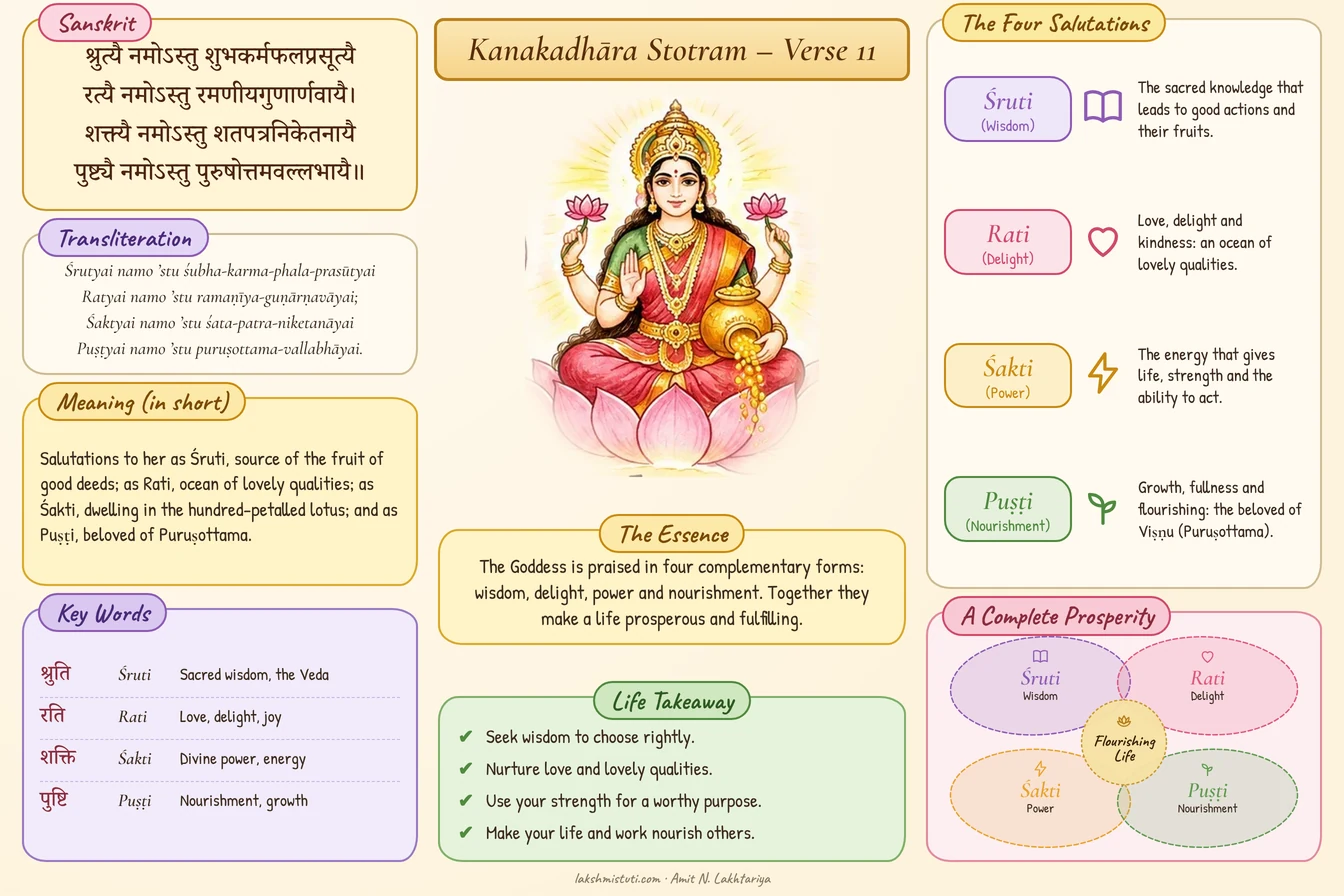
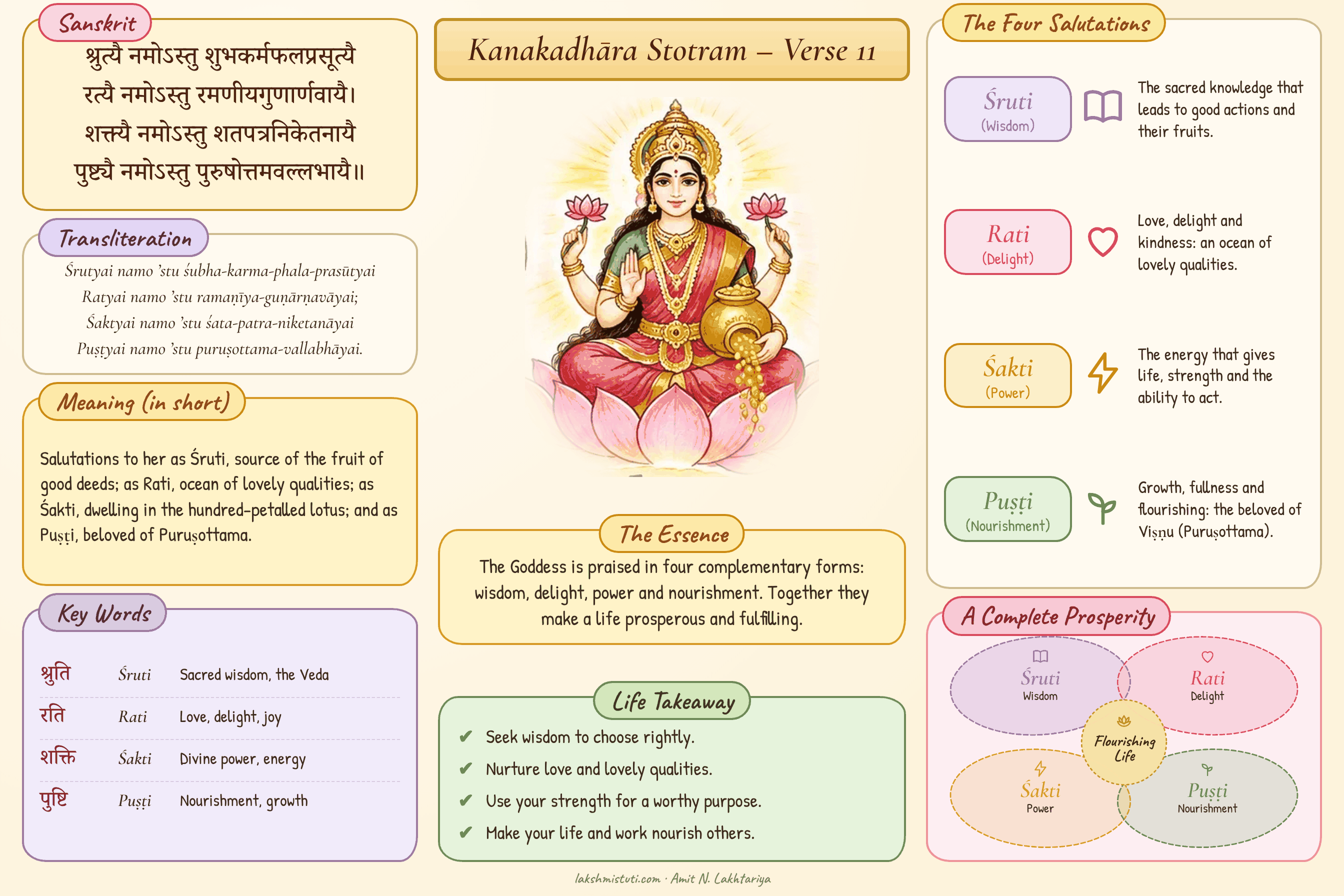
A one-page summary of the verse: Sanskrit, meaning, key ideas, key words and a takeaway. On a phone, open it full screen.
Word-by-word meaning
The literal meaning of each word.
| Sanskrit | Meaning |
|---|---|
| श्रुत्यैŚrutyai | To Śruti; to the Veda |
| नमः अस्तुNamo ’stu | Let there be a bow |
| शुभकर्मफलप्रसूत्यैŚubha-karma-phala-prasūtyai | To her who brings forth the fruit of good deeds |
| रत्यैRatyai | To Rati; to delight |
| रमणीयगुणार्णवायैRamaṇīya-guṇa-arṇavāyai | To her who is an ocean of lovely qualities |
| शक्त्यैŚaktyai | To Śakti; to power |
| शतपत्रनिकेतनायैŚata-patra-niketanāyai | To her whose dwelling is the hundred-petalled lotus |
| पुष्ट्यैPuṣṭyai | To Puṣṭi; to nourishment |
| पुरुषोत्तमवल्लभायैPuruṣottama-vallabhāyai | To the beloved of Puruṣottama |
Notes on each word
Śruti comes from śru, to hear: “that which is heard”. It is the traditional name for the Vedas, the revealed scripture handed down by hearing. The ending -yai means “to” and shows that the Goddess herself is being addressed in this form.
Namaḥ is a bow, a salutation; astu means “let it be”. So the phrase is “let there be a bow to…”. The two words meet as namo ’stu, where the apostrophe marks the lost a of astu. It is repeated four times, once in each line.
Śubha is auspicious, good; karma is action or deed; phala is fruit or result; prasūti is bringing forth, giving birth, a source. So she is the source from which good deeds yield their fruit. The ending means “to”.
Rati means delight, pleasure, love. It is also the name of the goddess of love, wife of Kāma. Here the sense is usually taken to be delight itself, with Lakshmi as its giver.
Ramaṇīya is delightful, charming, from ram, to please; guṇa is a quality, a virtue; arṇava is an ocean. The two a sounds of guṇa and arṇava join into guṇārṇava-. The picture is of virtues as vast and deep as the sea.
Śakti is power, energy, ability. In the Goddess tradition it is also the name of the divine power itself. The ending means “to”.
Śata is a hundred; patra is a petal or leaf; śatapatra is a common Sanskrit name for the lotus. Niketana is a dwelling, a home. So she is the one who lives in the lotus. The number need not be taken literally.
Puṣṭi is nourishment, fullness, thriving. It is the same word asked for in Verse 9. The ending means “to”.
Puruṣa is a person; uttama is the best, the highest; puruṣottama is “the supreme person”, a name of Vishnu. Vallabhā is a beloved, a wife, as in the last verse. The ending means “to”.
Deeper spiritual insights
Interpretation and reflection: ideas that help us read the verse, not part of the text itself.
Before we begin
This verse has a lovely rhythm. Four times, Śaṅkarācārya offers the same reverential expression: namo ’stu, “may my salutations be offered.”
He praises Lakshmi through four profound dimensions: sacred wisdom, divine delight, cosmic power and nourishment.
“Salutations to you as Śruti, the source of the fruits of auspicious actions. Salutations to you as Rati, the ocean of delightful qualities. Salutations to you as Śakti, whose abode is the hundred-petalled lotus. Salutations to you as Puṣṭi, the beloved of Puruṣottama.”
1In simple English
O Mother Lakshmi! You are sacred wisdom, guiding humanity towards righteous action and its fruits.
You are beauty, love and an ocean of virtues. You are the divine energy that resides in the sacred lotus. You are nourishment, abundance and the beloved of Lord Vishnu.
I bow to you in all these forms.
2A small grammatical observation
The endings -yai in words such as Śrutyai, Ratyai, Śaktyai and Puṣṭyai express the sense of “to her”. Śaṅkarācārya is offering salutations to the Goddess in each of these forms.
3The poetry hidden in the verse: four offerings at the feet of the Goddess
The first offering – Śruti: wisdom
Imagine four offerings being placed at the feet of the Goddess. The first is the sacred knowledge that guides human beings towards truth and righteous conduct.
The second offering – Rati: delight
The beauty of love, affection and the qualities that make life worth living.
The third offering – Śakti: power
The invisible energy that gives life, movement and strength to existence.
The fourth offering – Puṣṭi: nourishment
The abundance that sustains the body, mind, family and society.
4Notice the progression
| Offering | What it gives |
|---|---|
| Wisdom (Śruti) | gives direction |
| Love (Rati) | gives sweetness |
| Power (Śakti) | gives strength |
| Nourishment (Puṣṭi) | gives continuity |
Śaṅkarācārya has compressed an entire philosophy of a flourishing life into four salutations.
This sequence is a contemplative reading of the four names; it is not a literal statement of a progression in the Sanskrit.
5Deeper spiritual insights
A. Śruti – prosperity needs wisdom
The first salutation is not to gold, wealth or material possessions. It is to Śruti, sacred wisdom. This is significant.
Wealth without wisdom can become a burden. Knowledge helps us understand how to earn, preserve and use resources responsibly.
The phrase śubha-karma-phala-prasūtyai associates the Goddess with the fruits of auspicious actions. It reminds us that good actions and their consequences matter.
B. Rati – life needs delight
Rati is traditionally the name of the Goddess associated with love and desire, the consort of Kāma. Here, the phrase ramaṇīya-guṇārṇavāyai praises her as an ocean of beautiful and delightful qualities.
There is a lovely lesson in this: a life can be materially successful yet emotionally empty. Affection, beauty, kindness and joy are also forms of richness.
C. Śakti – the power behind existence
The verse calls Lakshmi Śakti and describes her as śata-patra-niketanā, the one whose abode is the hundred-petalled lotus. The lotus is a sacred symbol of spiritual unfolding.
Some later yogic interpretations associate the thousand-petalled lotus with the Sahasrāra chakra. However, this verse itself says śata-patra, hundred-petalled, so we should not automatically equate the two.
The central image is of divine power residing in a sacred lotus.
D. Puṣṭi – prosperity as nourishment
The final salutation is especially meaningful. Puṣṭi is not simply money. It means nourishment, growth, strength and flourishing.
A person who has money but no health, peace, affection or purpose is not truly flourishing. Śaṅkarācārya brings us back to a more complete understanding of prosperity.
6Reflection for today: consider these four questions
Am I making decisions with understanding, or merely reacting to circumstances?
Do the people around me experience warmth and kindness through my actions?
Am I using my abilities for constructive purposes?
Am I creating an environment in which my family, colleagues and community can flourish?
The verse gives us a useful measure of prosperity. It is not only about what we accumulate. It is also about what we cultivate.
Three Sanskrit treasures to remember
- Śruti – that which is heard; the revealed sacred wisdom of the Vedas. Wisdom that guides action
- Arṇava – ocean, vast expanse. In ramaṇīya-guṇārṇavā, it evokes an ocean of beautiful virtues
- Puṣṭi – nourishment, strength, growth and flourishing. A beautiful word for prosperity beyond material wealth
7Essence of the verse
Śaṅkarācārya offers four salutations to the Divine Mother:
- As Śruti, she is wisdom.
- As Rati, she is delight and beauty.
- As Śakti, she is power.
- As Puṣṭi, she is nourishment and abundance.
The deeper message is that a complete life requires all four. Wisdom without love can become cold. Love without strength can become helpless. Strength without nourishment cannot endure. And wealth without wisdom may lose its purpose.
A question to carry into Verse 12
A glimpse of Verse 12: the next verse returns to the beautiful divine appearance of Lakshmi. It praises her lotus-like face, her birth from the Ocean of Milk, her association with the nectar of the moon, and her eternal relationship with Nārāyaṇa.
We will move from the four dimensions of her divine nature to the beauty of her celestial form.
Practical meditation
- Theme: four dimensions of a flourishing life. Minute 1, wisdom: visualize a lotus and silently repeat, Śrutyai namaḥ. May my understanding guide my actions.
- Minute 2LoveRepeat, Ratyai namaḥ. May my relationships be filled with affection and beautiful qualities.
- Minute 3PowerRepeat, Śaktyai namaḥ. May I have the strength to fulfil my responsibilities.
- Minute 4NourishmentRepeat, Puṣṭyai namaḥ. May my life, family and work flourish.
- Minute 5GratitudeBring all four together. Offer gratitude for the wisdom, love, strength and nourishment already present in your life.
May Mother Lakshmi bless us with the wisdom to choose rightly, the love to live beautifully, the strength to act courageously and the prosperity to flourish.
This meditation is a devotional practice for attention and reflection; it does not promise a supernatural result or guarantee material wealth.