Home › Kanakadhāra Stotram › Verse 13
The verse
॥ श्लोक १३ ॥
नमोऽस्तु हेमाम्बुजपीठिकायै
नमोऽस्तु भूमण्डलनायिकायै।
नमोऽस्तु देवादिदयापरायै
नमोऽस्तु शार्ङ्गायुधवल्लभायै॥
॥ श्री महालक्ष्म्यै नमः ॥
Namo ’stu hemāmbuja-pīṭhikāyai
Namo ’stu bhūmaṇḍala-nāyikāyai;
Namo ’stu devādi-dayāparāyai
Namo ’stu śārṅgāyudha-vallabhāyai.
Meaning in short
Salutations to the Goddess who is seated upon a golden lotus. Salutations to the sovereign Lady of the entire earthly world. Salutations to her whose compassion extends to the gods and all beings. Salutations to the beloved consort of Lord Vishnu, the wielder of the divine bow Śārṅga.
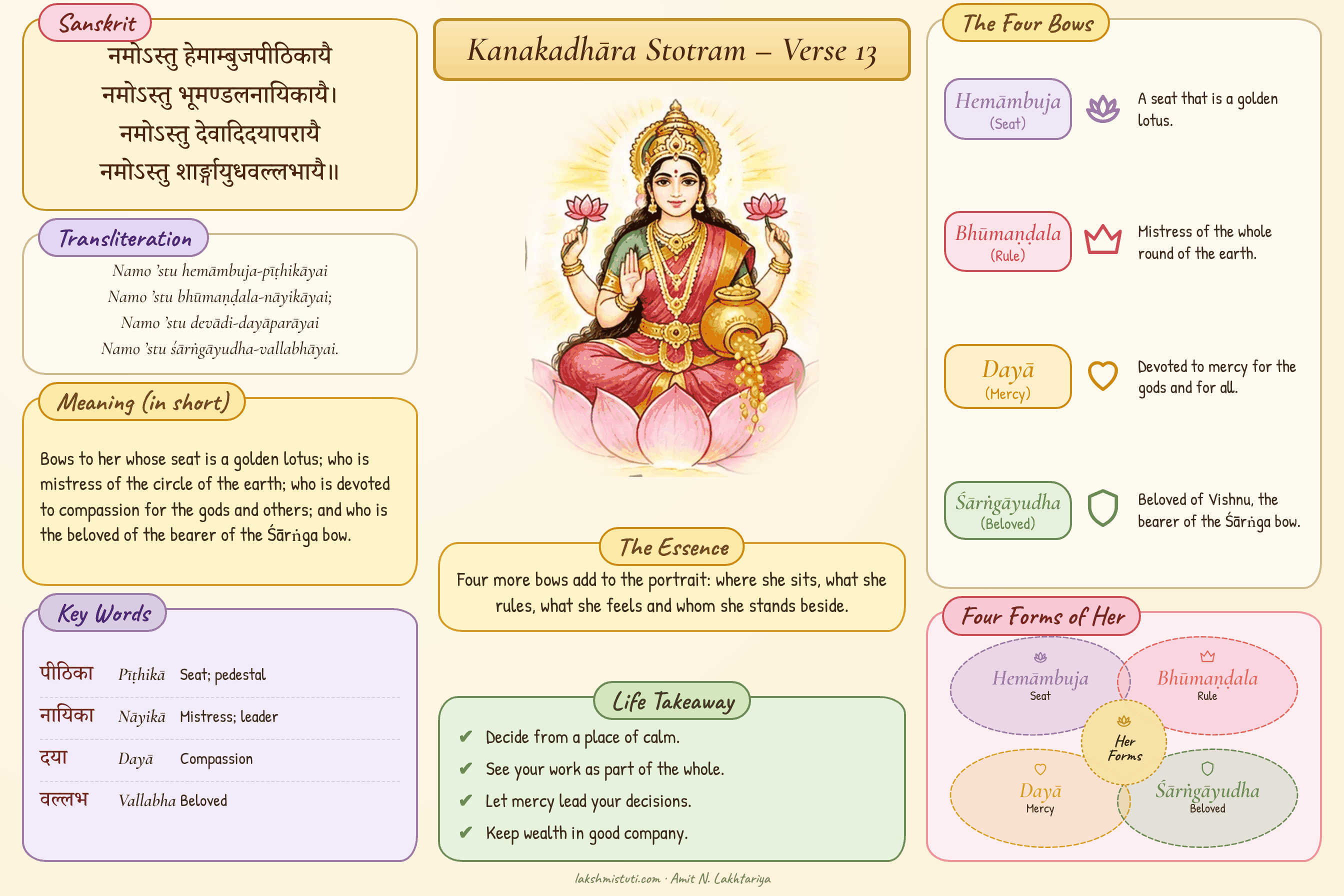
Four bows to four forms of the Goddess: the golden lotus seat, the rule of the earth, mercy for all and the beloved of the bowman.
Key highlights
- Hemāmbuja Seat: she sits on a golden lotus
- Bhūmaṇḍala Rule: mistress of the whole earth
- Dayā Mercy: compassion for the gods and all
- Śārṅgāyudha Beloved: of the bearer of the Śārṅga bow
Explore the four bows
Tap a card to open its meaning and a question to carry with you.
HemāmbujaSeat
Hemāmbuja is a golden lotus and pīṭhikā is a seat. The first bow is to the place where she sits. A lotus rises clean from mud, and gold adds wealth. A reflection: she sits on a flower, not on a throne of stone, and Śaṅkarācārya notices that first.
Pause and reflect: Where do I sit when I make big decisions, in calm or in hurry?
BhūmaṇḍalaRule
Bhūmaṇḍala is the whole round of the earth and nāyikā is a mistress or leader. The second bow is to her rule over it. A reflection: prosperity here belongs to the world as a whole, and is not only a private matter.
Pause and reflect: What part of the wider world does my work look after?
DayāMercy
Dayā is compassion, and parā says her attention is fixed on it. Devādi means the gods and the rest, so her mercy begins with the highest and spreads to everyone. A reflection: she gives from compassion, not from calculation.
Pause and reflect: Whom could I be kinder to this week?
ŚārṅgāyudhaBeloved
Śārṅga is Vishnu’s bow and vallabhā is a beloved. The fourth bow names Vishnu in his warrior form. Each of Verses 11 to 15 ends with a different name for her beloved, while she stays the same.
Pause and reflect: Is what I earn kept in the company of what is right?
Sketch note
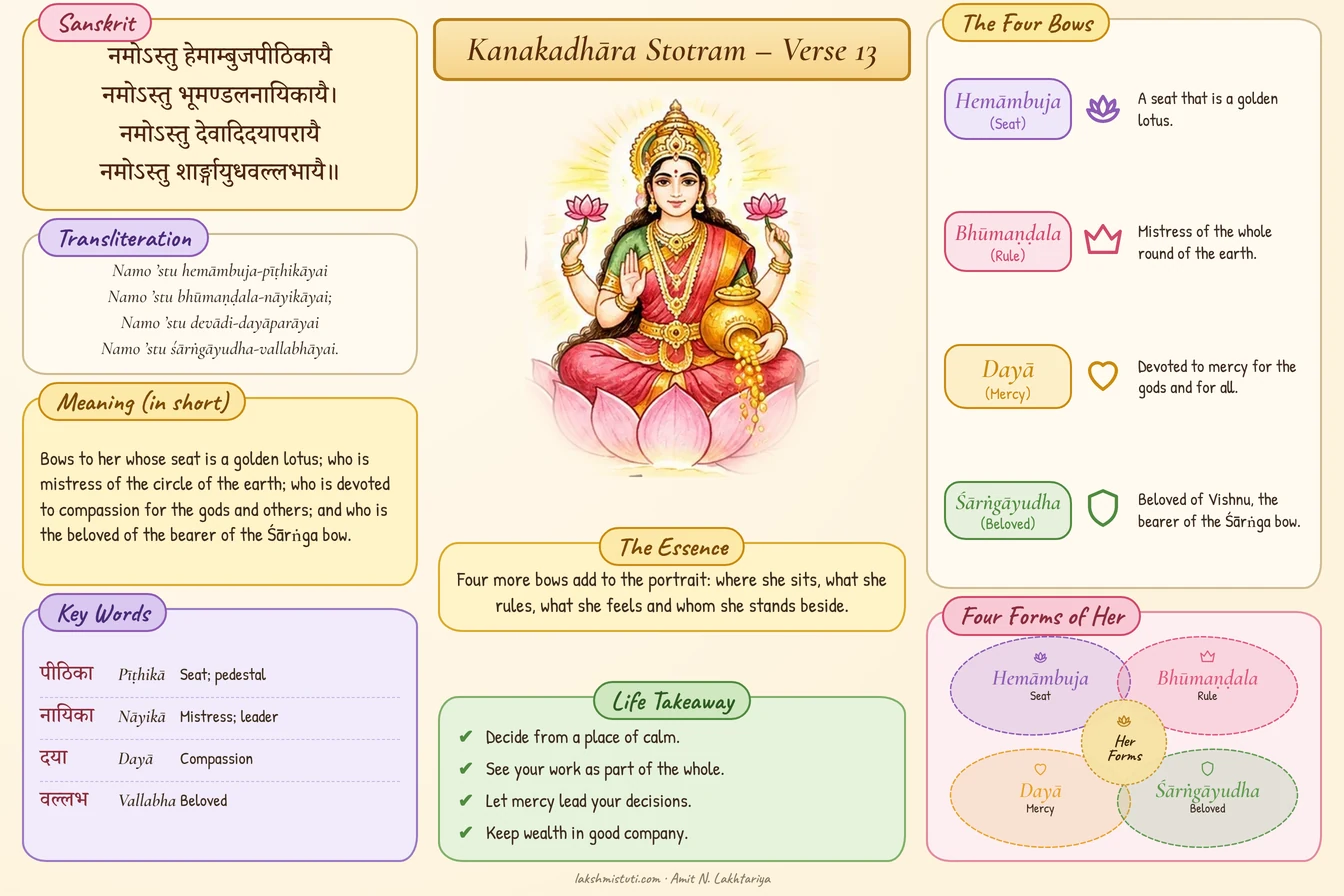
A one-page summary of the verse: Sanskrit, meaning, key ideas, key words and a takeaway. On a phone, open it full screen.
Word-by-word meaning
The literal meaning of each word.
| Sanskrit | Meaning |
|---|---|
| नमः अस्तुNamo ’stu | Salutations be offered; may there be reverence |
| हेमHema | Gold |
| अम्बुजAmbuja | Lotus; literally, born in water |
| पीठिकाPīṭhikā | Seat, pedestal or throne |
| हेमाम्बुजपीठिकायैHemāmbuja-pīṭhikāyai | To Her who has a golden lotus as Her seat |
| भूमण्डलBhū-maṇḍala | The sphere of the Earth; the world |
| नायिकाNāyikā | Lady, leader, sovereign or presiding goddess |
| भूमण्डलनायिकायैBhūmaṇḍala-nāyikāyai | To the sovereign Lady of the world |
| देवादिDeva-ādi | The gods and others; beginning with the gods |
| दयाDayā | Compassion, mercy |
| पराParā | Supreme, foremost, devoted to |
| देवादिदयापरायैDevādi-dayā-parāyai | To Her whose compassion extends to the gods and others |
| शार्ङ्गŚārṅga | The name of Vishnu’s divine bow |
| आयुधĀyudha | Weapon |
| वल्लभाVallabhā | Beloved, consort |
| शार्ङ्गायुधवल्लभायैŚārṅgāyudha-vallabhāyai | To the beloved consort of the wielder of the Śārṅga bow, Vishnu |
Notes on each word
Namaḥ is a salutation and astu is “let it be”. Through sandhi namaḥ astu becomes namo ’stu, where the apostrophe marks the dropped a. It begins every line of the verse, as it did in Verse 11 and Verse 12.
The metal of wealth and splendour. Here it makes the lotus golden.
Ambu is water and ja is “born”. A lotus is “water-born”.
A seat on which a deity or a ruler sits.
The two a sounds of hema and ambuja join into ā. The ending -āyai is the feminine “to” form, so the whole word is a salutation addressed to the Goddess.
Bhū is the earth and maṇḍala is a circle, a disc or a realm. Together they give the whole round of the earth.
From the root nī, “to lead”. A nāyikā is a woman who leads, a mistress.
Again the ending -āyai: “to” the Goddess who presides over the earthly sphere.
Deva is a god and ādi is “and so on, beginning with”. So her compassion begins with the gods and goes out to all the rest.
Tender care for another’s suffering or need.
On its own parā can mean supreme or foremost. At the end of a compound, as here, it also has the sense “intent on, wholly devoted to”: she whose first concern is compassion.
The visible chain is deva + ādi + dayā + parā, with a + ā joining into ā in devādi. A salutation to her whose attention rests on mercy.
In the tradition the bow of Vishnu is called Śārṅga.
Anything used to fight with. Śārṅgāyudha is therefore “he whose weapon is the Śārṅga bow”, a name of Vishnu.
The same word that ended Verse 11 and Verse 12. Here the beloved is of Vishnu the bowman.
The last bow names her through her beloved. The a of śārṅga and the ā of āyudha join into ā.
Deeper spiritual insights
Interpretation and reflection: ideas that help us read the verse, not part of the text itself.
Before we begin
We now move from Verse 12, which praised Lakshmi’s divine origin and her relationship with Nārāyaṇa, to a verse that presents her in four powerful dimensions: divine splendour, universal sovereignty, boundless compassion and inseparable union with Vishnu.
“Salutations to the Goddess who is seated upon a golden lotus. Salutations to the sovereign Lady of the entire earthly world. Salutations to her whose compassion extends to the gods and all beings. Salutations to the beloved consort of Lord Vishnu, the wielder of the divine bow Śārṅga.”
1The simple translation
This is the straightforward meaning of the four lines. Notice the repeated feminine ending -āyai: each expression is addressed to the Goddess, “salutations to her who is…”.
2The deeper meaning of the four images
First image – Hemāmbuja-pīṭhikā: the golden lotus throne
The lotus is a familiar symbol of purity: it grows in water and mud, yet its beauty is not diminished by the environment in which it grows.
The golden lotus adds another dimension: splendour, auspiciousness and divine abundance.
Lakshmi is not merely surrounded by gold; she is seated upon a lotus made golden. The image brings together purity and prosperity.
Contemplation: Wealth is most auspicious when it rests upon purity of conduct.
Second image – Bhūmaṇḍala-nāyikā: sovereign of the world
Here Śaṅkarācārya moves beyond the image of a beautiful Goddess seated on a lotus. She is the presiding Lady of the entire earthly sphere.
Think about the significance: Lakshmi is not being praised merely as the giver of individual wealth, jewellery or gold. Her presence is associated with the prosperity and well-being of the world itself.
This is a much wider understanding of Lakshmi: agriculture, food, resources, trade, learning, institutions, relationships and the conditions that allow life to flourish.
Third image – Devādi-dayā-parā: the embodiment of compassion
This is perhaps the most important expression in the verse. Deva-ādi is the gods and others, dayā is compassion and parā is supreme, foremost. She is praised as one whose compassion extends to the gods and others.
Notice the sequence: Śaṅkarācārya has just described her as the sovereign of the world. But immediately after describing her authority, he describes her compassion. That is a profound pairing.
Contemplation: Power without compassion can become domination. Power guided by compassion becomes protection.
Fourth image – Śārṅgāyudha-vallabhā: the beloved of Vishnu
Śārṅga is the divine bow of Lord Vishnu. Āyudha means weapon, and vallabhā means beloved or consort. Śaṅkarācārya identifies Lakshmi through her intimate relationship with Vishnu.
Vishnu represents the sustaining and protecting principle of the universe. Lakshmi, as his inseparable divine consort, represents auspiciousness, abundance and grace.
The image is not simply about a divine marriage. It expresses the inseparability of preservation and prosperity, protection and grace.
3Why has Śaṅkarācārya arranged these four descriptions in this order?
| Order | Description | Central idea |
|---|---|---|
| 1 | Golden lotus seat | Divine purity and splendour |
| 2 | Sovereign of the world | Universal authority |
| 3 | Supreme compassion | Kindness and protection |
| 4 | Beloved of Vishnu | Divine unity and preservation |
This is a reading of the sequence; the verse itself does not explain its order. There is a movement from the Goddess’s appearance, to her authority, to her character, and finally to her divine relationship.
And there is something worth noticing: when Śaṅkarācārya speaks of her sovereignty, he does not stop there. He immediately reminds us of her compassion. It is almost as if he is teaching us what true greatness should look like. A person may possess wealth, authority and influence. But without compassion, these qualities remain incomplete.
4The philosophical interpretation: Lakshmi beyond money
Let prosperity come into your life, but do not allow it to corrupt your values.
The greater your resources and authority, the greater your responsibility towards others.
The measure of prosperity is not only what you accumulate, but also what becomes better because you are there.
In the traditional Vaishnava understanding, Lakshmi and Narayana are inseparable. Prosperity should remain connected with preservation, righteousness and responsibility.
This is a contemplative interpretation of the imagery, rather than a literal translation of the Sanskrit.
5A poetic observation: why four times namo ’stu?
Namaḥ is salutation and astu is “let it be”. The repetition is deliberate. Each line offers a fresh salutation, as though Śaṅkarācārya refuses to let even one dimension of the Goddess pass without reverence. It is also a poetic device called anaphora: repeating the same expression at the beginning of successive lines.
But there is a devotional dimension too. Śaṅkarācārya does not merely say, “Lakshmi is beautiful, powerful and compassionate.” He bows separately to each quality. That is the beauty of stuti: praise becomes an act of worship.
Three Sanskrit words to keep
- Pīṭhikā – a seat, a pedestal
- Nāyikā – a mistress, a leader
- Dayā – compassion
A question to carry into Verse 14
Verse 13 describes Lakshmi as the sovereign of the world and the beloved of Vishnu. Verse 14 takes us closer to her personal and divine identity: as Bhṛgu’s daughter, as the one who resides on Vishnu’s chest, and as the beloved of Dāmodara.
The next verse will help us explore why Lakshmi is described both as a universal cosmic power and as the intimate companion of Vishnu.
Practical meditation
- Pause after each line and contemplate it. First line, namo ’stu hemāmbuja-pīṭhikāyai: “May purity and auspicious prosperity find a seat in my life.”
- Second line, namo ’stu bhūmaṇḍala-nāyikāyai: “May I understand that resources and authority come with responsibility.”
- Third line, namo ’stu devādi-dayā-parāyai: “May compassion become the foundation of my thoughts and actions.”
- Fourth line, namo ’stu śārṅgāyudha-vallabhāyai: “May my prosperity remain aligned with dharma and the sustaining principle of life.”
True Lakshmi is not merely the presence of gold in one’s home; it is the presence of purity, responsibility, compassion and dharma in one’s life.
This meditation is a devotional practice for attention and reflection; it does not promise a supernatural result or guarantee material wealth.