Home › Kanakadhāra Stotram › Verse 4
The verse
॥ श्लोक ४ ॥
आमीलिताक्षमधिगम्य मुदा मुकुन्दम्
आनन्दकन्दमनिमेषमनङ्गतन्त्रम्।
आकेकरस्थितकनीनिकपक्ष्मनेत्रम्
भूत्यै भवेन्मम भुजङ्गशयाङ्गनायाः॥
॥ श्री महालक्ष्म्यै नमः ॥
Āmīlitākṣam adhigamya mudā Mukundam,
Ānanda-kandam animeṣam anaṅga-tantram;
Ākekara-sthita-kanīnika-pakṣma-netram,
Bhūtyai bhaven mama bhujaṅga-śayāṅganāyāḥ.
Meaning in short
May the eye of the consort of Vishnu, who rests on the serpent, become a source of prosperity for me: the eye that, having come upon Mukunda with joy, the root of bliss, gazes at him unblinking and ruled by love, half-closed, with its pupil and lashes held in a narrowed, sidelong look.
Not her crown or jewels but the smallest movement of her eye shows how deep the love is. Then comes the wish.
Key highlights
- Āmīlita Eyes: the half-closed eyes of deep joy
- Ānanda-kanda Bliss: Mukunda, the root of bliss
- Animeṣa Attention: an unblinking, loving gaze
- Bhūti Flourishing: the prayer for prosperity
Explore the four images
Tap a card to open its meaning and a question to carry with you.
ĀmīlitaEyes
Āmīlita-akṣam means with half-closed eyes. The lids are lowered in joy and the pupil and lashes are held in a narrowed, sidelong look. Śaṅkarācārya shows love through the smallest movement.
Pause and reflect: What small gesture of mine shows what I feel?
Ānanda-kandaBliss
Mukunda is ānanda-kanda, the root of bliss. Śaṅkarācārya turns our eyes toward the source of joy, not toward the things we hope will make us happy.
Pause and reflect: Do I wait for a future event to be happy, or look for the source of joy now?
AnimeṣaAttention
Animeṣam is unblinking: she does not look away. We may reflect, beyond the verse, on how rarely we give anything that kind of undivided attention.
Pause and reflect: What would I notice if I gave one thing my full attention today?
BhūtiFlourishing
The wish arrives only in the last line: bhūtyai bhavet mama, may it be for my prosperity. Bhūti is flourishing: income and security, and also sound judgement and healthy relations.
Pause and reflect: What does a flourishing life look like for me?
Sketch note
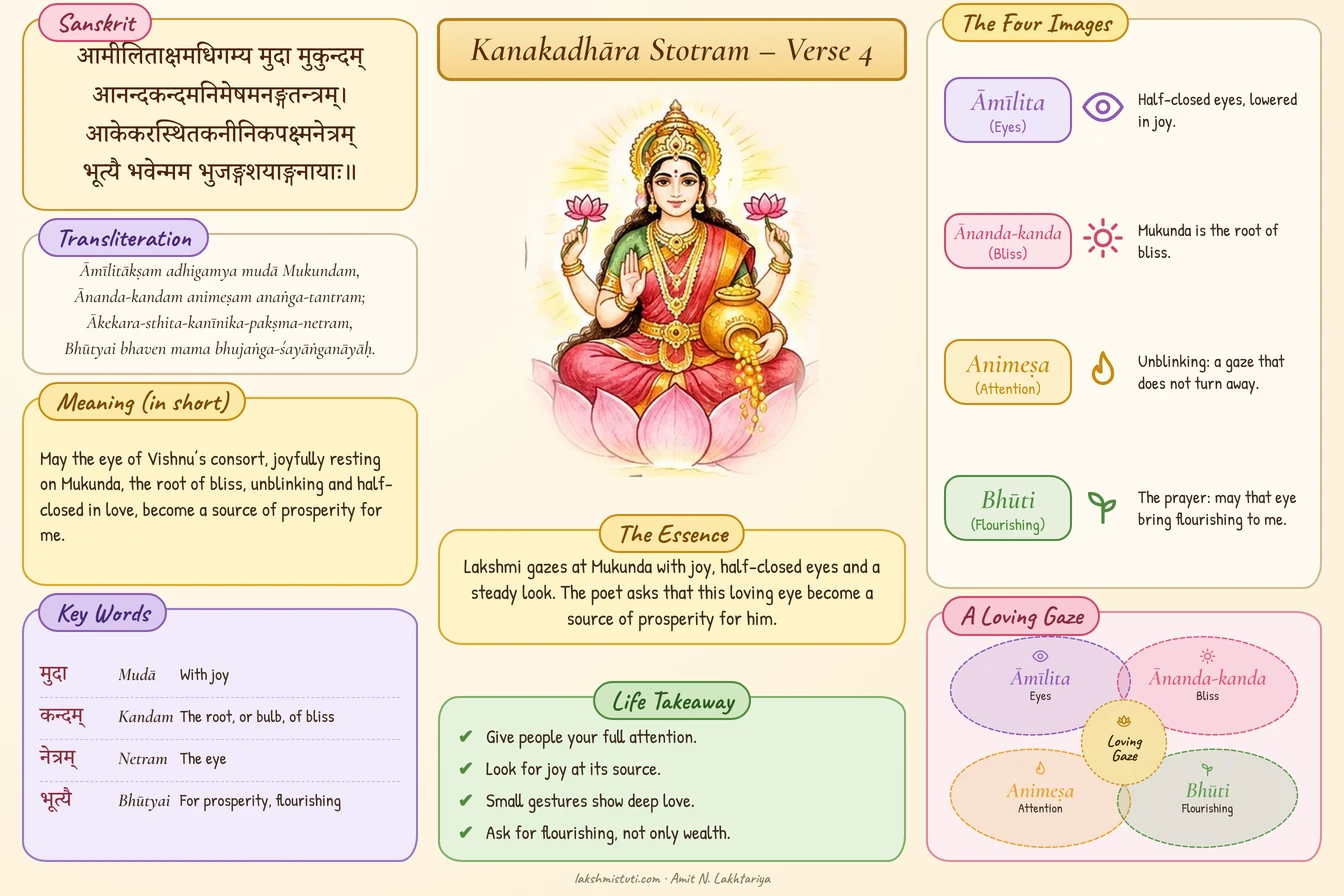
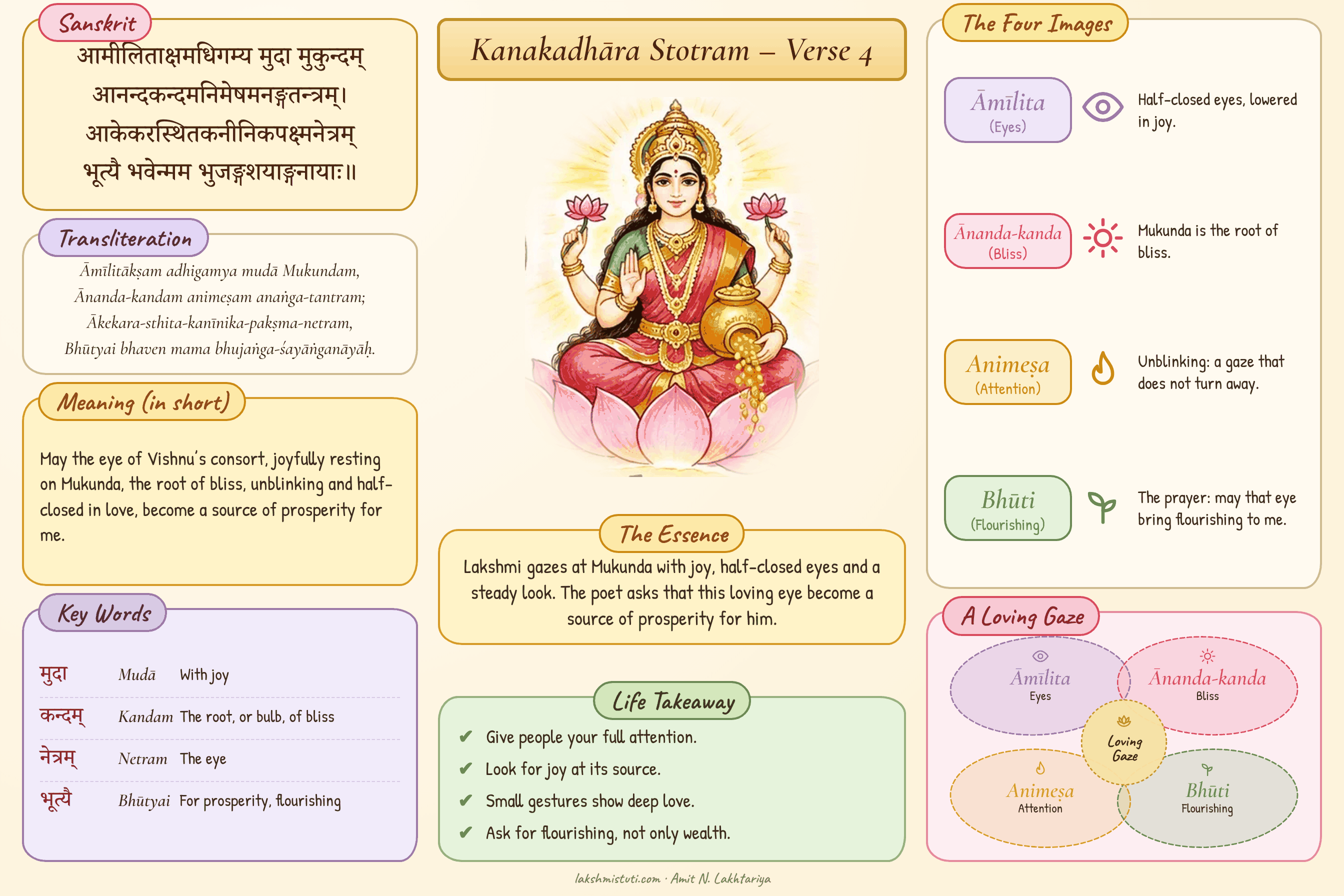
A one-page summary of the verse: Sanskrit, meaning, key ideas, key words and a takeaway. On a phone, open it full screen.
Word-by-word meaning
The literal meaning of each word.
| Sanskrit | Meaning |
|---|---|
| आमीलिताक्षम्Āmīlita-akṣam | With half-closed eyes |
| अधिगम्यAdhigamya | Having come to; having come upon |
| मुदाMudā | With joy, gladly |
| मुकुन्दम्Mukundam | Mukunda, the one who is looked upon |
| आनन्दकन्दम्Ānanda-kandam | The root, or bulb, of bliss |
| अनिमेषम्Animeṣam | Unblinking, without a pause |
| अनङ्गतन्त्रम्Anaṅga-tantram | Ruled by Anaṅga (Kāma, Love) |
| आकेकरस्थितकनीनिकपक्ष्मनेत्रम्Ākekara-sthita-kanīnika-pakṣma-netram | The eye whose pupil and lashes rest in a narrowed, sidelong look |
| भूत्यैBhūtyai | For prosperity, for flourishing |
| भवेत् ममBhavet mama | May it be; for me |
| भुजङ्गशयाङ्गनायाःBhujaṅga-śayāṅganāyāḥ | Of the consort of him who rests on the serpent |
Notes on each word
Mīlita is closed; the prefix ā softens it to “a little, partly”, so āmīlita is half-shut. Akṣa is the eye. The lids are lowered but not closed: the look of someone taking in something dear.
From adhi (towards) and gam (to go): to approach, to reach, to come upon. The ending -ya means “having done”, so the arrival is complete before the next thing happens.
Mud is delight. The ending means “by, with”, so the coming upon is done with gladness.
A name of Vishnu. Tradition explains it as “giver of mukti” (liberation). The final m marks him as the one the glance goes towards.
Ānanda is bliss; kanda is a bulb or tuber, the underground root from which a plant springs. So Mukunda is not simply happy: he is the source from which bliss grows.
Nimeṣa is a blink, a closing of the eyes; a- negates it. The word sits in the same case as Mukundam, so strictly it goes with him, but translators commonly carry it over to her gaze, which does not turn away. Both readings give the same scene: one steady, absorbed look.
Anaṅga means “without a body”, the name of Kāma, the god of love, who lives on without form after Shiva burned his body. Tantra here is rule or sway, so the compound reads “governed by Love”. Commentators handle this compound in slightly different ways; the plain sense is the look of someone held by love.
Ākekara means slightly squinting, a narrowed and sidelong glance (from kekara, squinting); some translators render it as “at the corner of the eye”, and the picture is much the same. Sthita is standing, staying; kanīnikā is the pupil; pakṣma is the eyelash; netra is the eye. The long compound is one picture: the eye in which pupil and lashes stay held in that soft, narrowed pose.
Bhūti comes from bhū, to be or to become: growth, well-being, prosperity. The ending means “for the sake of”.
Bhavet is the wishing form of bhū: “may it be, may it become”. Mama is “of me, mine”. Together with bhūtyai: “may it become, for my prosperity”. The two join as bhūtyai bhaven mama.
Bhujaṅga is a serpent; śaya is resting or lying, so “he who rests on the serpent” is Vishnu on Śeṣa. Aṅganā is a woman, a lady, here his consort, Lakshmi. When the two words join, śaya and aṅganā become śayāṅganā. The ending marks “of”.
Deeper spiritual insights
Interpretation and reflection: ideas that help us read the verse, not part of the text itself.
Before we begin
In the first three verses, Śaṅkarācārya followed the glance of Mahalakshmi: its sidelong approach, its repeated going and returning, and its great power.
In Verse 4, he comes close and looks at the eye itself: the lowered lids, the lashes, the pupil, and the love behind them. After the power of the glance, we see its tenderness. Only at the very end does the wish arrive.
“May the eye of the consort of him who rests on the serpent become a source of prosperity for me: the eye that, having come upon Mukunda with joy, the root of bliss, gazes at him unblinking and ruled by love, half-closed, with its pupil and lashes held in a narrowed, sidelong look.”
1In simple words
“O Mother, I see how you look at Vishnu: with a joy so deep that your eyes are half-closed and your gaze does not move away from him. May that same loving look turn towards me and help my life flourish.”
The first three lines paint a picture of love. The last line is the quiet request.
2What the verse actually says
The subject of the verse is her eye. Everything before the last line describes it: the half-closed lids, the steady look, the pupil and lashes in their narrowed pose.
Only in the last line does the wish arrive: bhūtyai bhavet mama, “may it be for my prosperity”. The glance of her eye is what Śaṅkarācārya hopes will come to him.
3The four images in the verse
First – Āmīlita-akṣam: the half-closed eyes
Mīlita is closed; the prefix ā softens it to “a little, partly”, so āmīlita is half-shut. Akṣa is the eye. The lids are lowered but not closed: the look of someone taking in something dear.
The long compound ākekara-sthita-kanīnika-pakṣma-netram completes the picture: the eye in which the pupil (kanīnikā) and the lashes (pakṣma) stay held in a soft, narrowed, sidelong pose.
Contemplation: What small gesture of mine shows what I feel?
Second – Ānanda-kandam: the root of bliss
Ānanda is bliss; kanda is a bulb or tuber, the underground root from which a plant springs. So Mukunda is not simply happy: he is the source from which bliss grows.
Mukunda is a name of Vishnu, which tradition explains as “giver of mukti” (liberation). She comes upon him mudā, with joy.
Contemplation: Do I wait for a future event to be happy, or look for the source of joy now?
Third – Animeṣam, Anaṅga-tantram: the unblinking gaze, ruled by Love
Nimeṣa is a blink; a- negates it. Strictly, the word sits in the same case as Mukundam, but translators commonly carry it over to her gaze, which does not turn away. Both readings give the same scene: one steady, absorbed look.
Anaṅga means “without a body”, the name of Kāma, the god of love. Tantra here is rule or sway, so the compound reads “governed by Love”. Commentators handle this compound in slightly different ways; the plain sense is the look of someone held by love.
Contemplation: What would I notice if I gave one thing my full attention today?
Fourth – Bhūtyai bhavet mama: the prayer for flourishing
Bhūti comes from bhū, to be or to become: growth, well-being, prosperity. Bhavet is the wishing form of bhū, “may it be, may it become”. Together: “may it become, for my prosperity.”
The one whose eye this is, is named last: bhujaṅga-śayāṅganā, the consort of him who rests on the serpent, that is, of Vishnu on Śeṣa.
Contemplation: What does a flourishing life look like for me?
4The poetry hidden in the verse
Look at what Śaṅkarācārya chooses to show. Not Vishnu’s crown, not the splendour of his heaven, not the ornaments she wears. He shows the smallest movement of her eye: the lowered lids, the lashes, the pupil held to one side.
Deep affection is often shown this way, not in words but in how we look at someone. Animeṣam, “unblinking”, makes the look feel continuous; mudā, “with joy”, gives it warmth. A tiny physical detail carries a whole world of feeling.
5Reading the compounds
The first two lines are a chain of describing words in one case: āmīlitākṣam, ānanda-kandam, animeṣam, anaṅga-tantram. Sanskrit can pile up such words so that they flavour one another without a single verb between them.
Translators differ on which word describes her and which describes him, and the difference is noted in the word list. The picture is the same either way: a gaze that rests, steady and glad, on the source of joy.
6The beauty of attention
The verse says she looks at Mukunda with joy and without turning away. What we may reflect on, beyond the verse, is how rarely we give anything that kind of attention. We divide ourselves between work, worry and the next task.
This is a reflection inspired by the verse, not a line in it: could our work, or a conversation with someone we love, be better for even five minutes of whole attention?
7Bliss as a source, not a prize
Mukunda is ānanda-kanda, the root of bliss. Śaṅkarācārya turns our eyes towards the source of joy, not towards the things we hope will make us happy.
We often think, “When I earn more or solve this problem, then I will be happy.” The verse suggests a different question: while I work for what I need, can I also notice the sources of peace already in my life? This does not ask us to give up ambition. It asks us not to hang all our happiness on the next achievement.
8What bhūti can mean
The verse asks for bhūti: prosperity, flourishing, well-being. For a householder this certainly includes a steady income, the means to support a family and freedom from want.
As a wider reflection it may also include sound judgement, healthy relationships, peace of mind and the wisdom to use what we have. These wider meanings are reflections on the word; the Sanskrit itself says only prosperity and flourishing.
9Why ask after describing love?
Śaṅkarācārya does not first call her a giver of wealth. He first shows her in a moment of loving absorption, and only then asks.
One way to read the order is that prosperity is sought in the presence of grace and joy, not as a possession cut off from them. The verse does not promise that reciting it brings wealth. It offers a devotional ideal: ask for well-being while keeping the heart turned towards something deeper than possessions.
10How this verse follows Verses 1 to 3
| Verse | What we see of the glance |
|---|---|
| 1 | Its sidelong approach |
| 2 | Its repeated going and returning |
| 3 | Its great power |
| 4 | Its tenderness: the eye itself, and the love behind it |
After the power of the glance, we see its tenderness. This is a reading of the progression, not something the verse states.
Three Sanskrit words to keep
- Mudā – joy; doing a thing with a glad heart
- Ānanda-kanda – the root of bliss, the source from which joy springs
- Bhūti – flourishing: life that grows and prospers
How to pronounce the key words
Āmīlitākṣam: aa-mee-li-taak-sham. Adhigamya: a-dhi-gam-ya. Mudā: mu-daa. Mukundam: mu-kun-dam. Ānanda-kandam: aa-nan-da-kan-dam. Animeṣam: a-ni-me-sham. Anaṅga-tantram: a-nang-ga-tan-tram. Ākekara: aa-ke-ka-ra. Kanīnika: ka-nee-ni-ka. Pakṣma: paksh-ma. Bhūtyai: bhoot-yai. Bhujaṅga: bhu-jan-ga. Read slowly and let each line settle.
A question to carry into Verse 5
From the eye itself, Verse 5 moves to what the glances become. Śaṅkarācārya imagines Lakshmi’s repeated loving glances as a necklace resting on Vishnu’s chest, beside the Kaustubha jewel, and then asks that this garland of grace bring auspiciousness into his own life.
Practical meditation
- Minute 1ReciteSay the verse gently and without hurry, giving each line its own breath.
- Minute 2Picture the sceneImagine Vishnu resting on the great serpent and Lakshmi beside him, looking at him with quiet delight. You need not force a vision; let it come as it will.
- Minute 3Look at the eyesRest your attention on her lowered lids and the stillness of her look. Notice how still a loving attention can be.
- Minute 4ReflectAsk yourself, “What deserves my whole attention today? What am I pursuing, and why?”
- Minute 5Offer a prayer. Say silently“O Mother Lakshmi, may my life flourish. Give me the wisdom to recognise true happiness, the discernment to use prosperity well and the steadiness to stay grateful as I work for my goals.”
The verse opens with Lakshmi’s eye resting lovingly on Mukunda, the root of bliss, and ends with a humble prayer that her grace may bring flourishing to the devotee; perhaps the lesson is to seek not prosperity alone but a life in which prosperity, joy, attention and gratitude can live together.
This meditation is a devotional practice for attention and reflection; it does not promise a supernatural result or guarantee material wealth.