Home › Kanakadhāra Stotram › Verse 16
The verse
॥ श्लोक १६ ॥
सम्पत्कराणि सकलेन्द्रियनन्दनानि
साम्राज्यदानविभवानि सरोरुहाक्षि।
त्वद्वन्दनानि दुरिताहरणोद्यतानि
मामेव मातरनिशं कलयन्तु मान्ये॥
॥ श्री महालक्ष्म्यै नमः ॥
Sampat-karāṇi sakalendriya-nandanāni
Sāmrājya-dāna-vibhavāni saroruhākṣi;
Tvad-vandanāni duritāharaṇodyatāni
Mām eva mātar aniśaṁ kalayantu mānye.
Meaning in short
O lotus-eyed Mother, worthy of honour! May my salutations to you, which bring prosperity, delight all the senses, have the power to bestow sovereignty and are always ready to remove misfortune, attend me alone, without pause.
Four fruits of homage: prosperity, delight, sovereignty and release from misfortune, and a prayer that the homage never stops.
Key highlights
- Sampat Prosperity: homage that brings good fortune
- Nandana Delight: it gladdens all the senses
- Sāmrājya Sovereignty: it can bestow rule and mastery
- Durita Release: it is ready to remove misfortune
Explore the four fruits
Tap a card to open its meaning and a question to carry with you.
SampatProsperity
Sampat is wealth, good fortune, flourishing. The verse says Śaṅkarācārya’s own salutations are sampat-kara, “makers of prosperity”. Notice that it is the homage that is said to bring it. A reflection: prosperity here is wider than money; it includes work, health and steadiness.
Pause and reflect: What already supports my life that I have stopped noticing?
NandanaDelight
Nandana is delighting, and sakala-indriya is all the senses. Śaṅkarācārya claims that homage does not dull the senses but gladdens them. A reflection: a thankful mind can notice more beauty, a sound, a taste, a sight, and enjoy it with less hurry.
Pause and reflect: When did I last enjoy something simple without hurry?
SāmrājyaSovereignty
Sāmrājya is sovereignty, rule over a great realm, and dāna is giving. The salutations are said to have the might to bestow it. As a reflection, many readers take sovereignty also as mastery of oneself: of habit, temper and spending.
Pause and reflect: Which one habit would I like to govern first?
DuritaRelease
Durita is what has gone wrong, misfortune or fault, and udyata means ready or intent. The homage is “ready to remove” it. A reflection: prayer does not take the place of action, but it can steady us enough to put right what we can.
Pause and reflect: Which fault or worry will I take one step to set right this week?
Sketch note
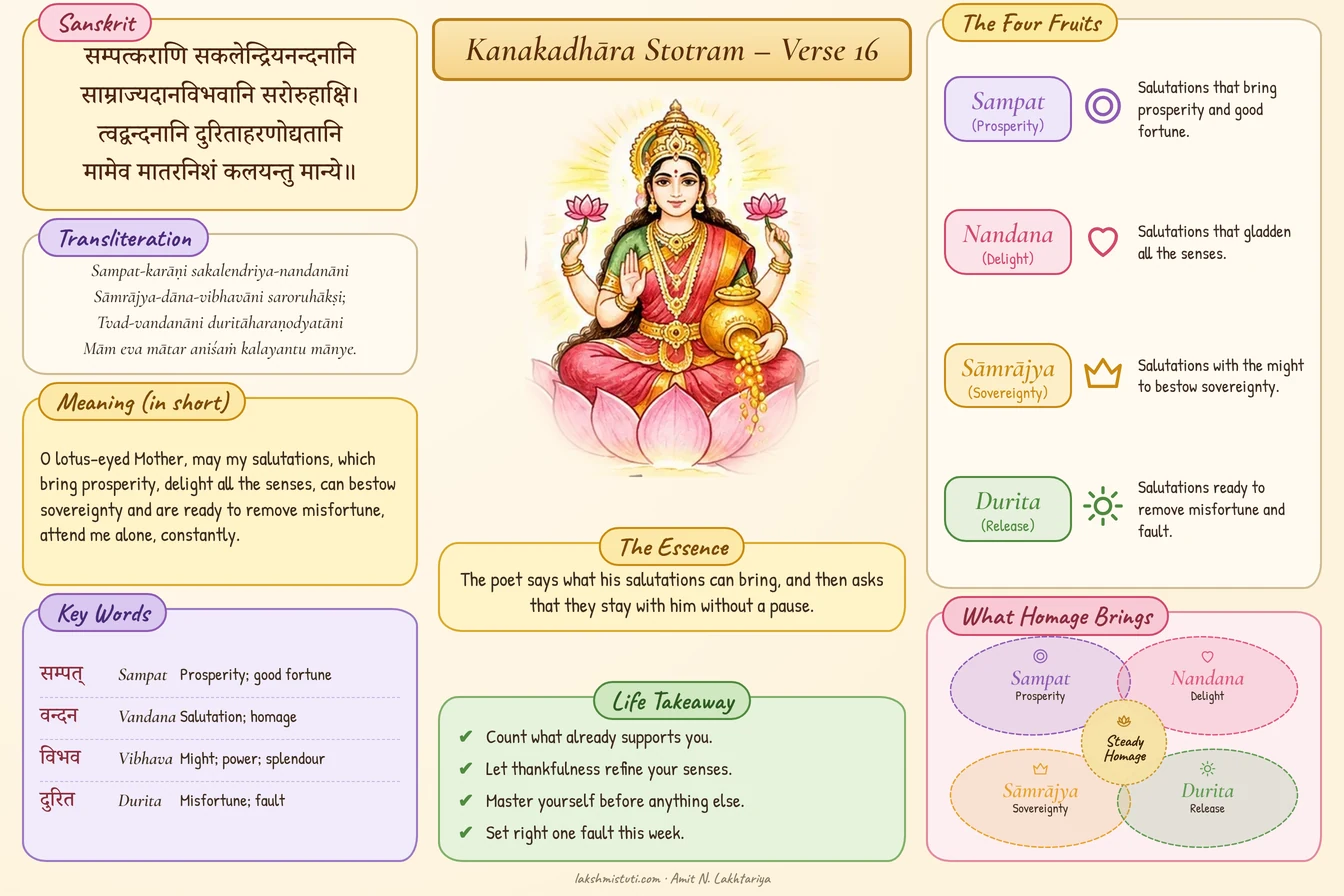
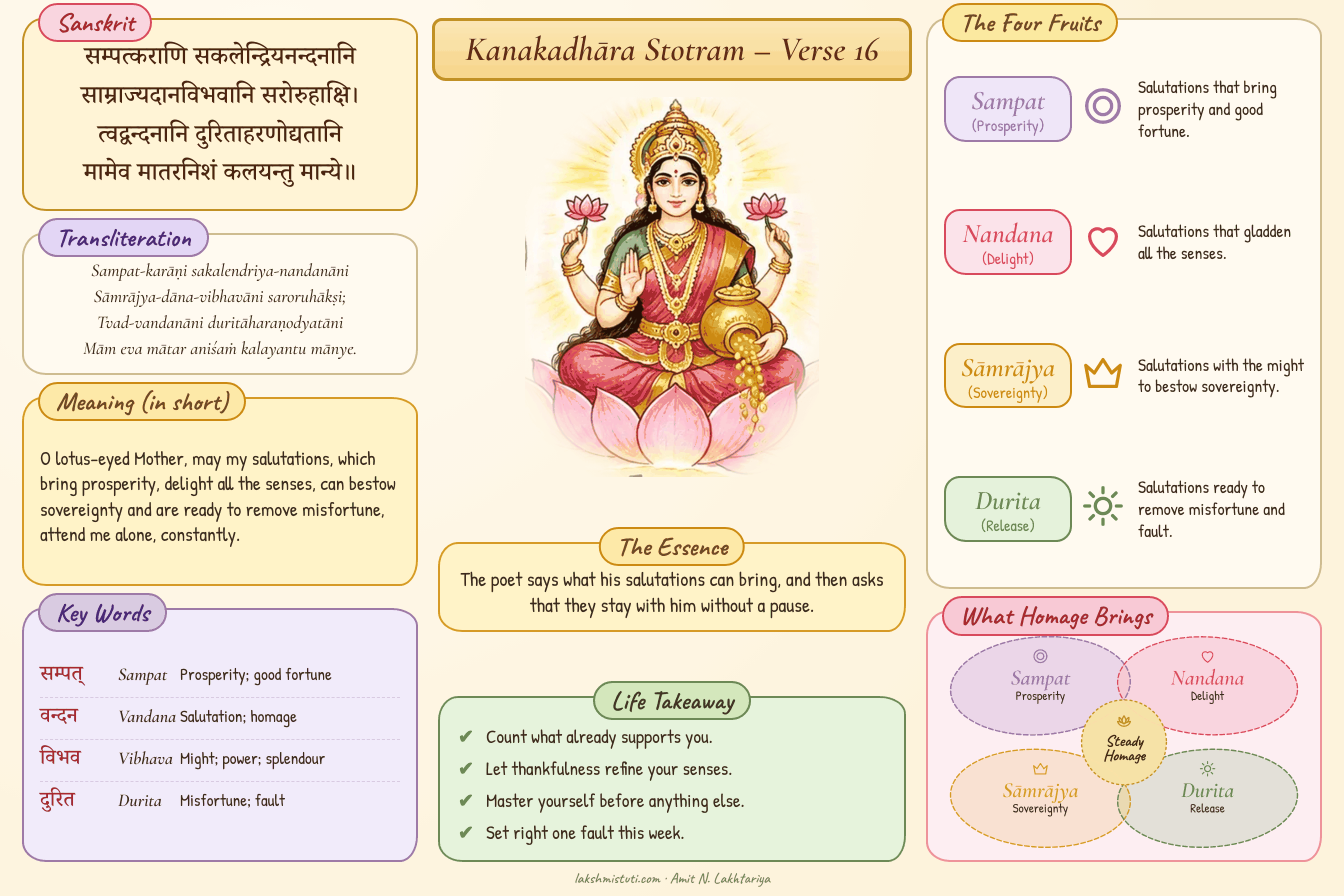
A one-page summary of the verse: Sanskrit, meaning, key ideas, key words and a takeaway. On a phone, open it full screen.
Word-by-word meaning
The literal meaning of each word.
| Sanskrit | Meaning |
|---|---|
| सम्पत्कराणिSampat-karāṇi | Bringing prosperity |
| सकलेन्द्रियनन्दनानिSakala-indriya-nandanāni | Delighting all the senses |
| साम्राज्यदानविभवानिSāmrājya-dāna-vibhavāni | Having the power to bestow sovereignty |
| सरोरुहाक्षिSaroruha-akṣi | O lotus-eyed one |
| त्वद्वन्दनानिTvad-vandanāni | My salutations to you |
| दुरिताहरणोद्यतानिDurita-āharaṇa-udyatāni | Ready to remove misfortune |
| माम् एवMām eva | Me alone |
| मातर्Mātar | O Mother |
| अनिशम्Aniśam | Without pause, constantly |
| कलयन्तुKalayantu | May they attend; may they come to |
| मान्येMānye | O worthy of honour |
Notes on each word
Sampat is wealth, good fortune, flourishing; kara, from the root kṛ, “to make”, means making or doing. So sampat-kara is “maker of prosperity”. The ending -āṇi is neuter plural, which tells us the word describes the salutations (vandanāni), not the Goddess. She is only addressed later in the verse.
Sakala is all, whole; indriya is a sense, such as sight or hearing; nandana is delighting, gladdening. The a of sakala and the i of indriya join into e, giving sakalendriya. Śaṅkarācārya says that homage does not dull the senses; it gladdens them.
Sāmrājya is sovereignty, rule over a great realm; dāna is giving; vibhava is might, power, splendour. Together: salutations whose might lies in giving sovereignty. A few printed editions read dhana, “wealth”, in place of dāna; this site follows dāna, the reading in the text we checked.
Saroruha is a lotus, literally “growing in a lake” (saras, lake; ruh, to grow); akṣi is the eye. The two a sounds join into ā. This is a call to the Goddess. In Verse 12 her face was like a lotus; here her eyes are.
Tvad is the form of “you” used inside compounds; vandana is a salutation, an act of honouring. Vandanāni is the plural, and it is the subject of the whole verse: all four descriptions and the verb belong to it. So the verse is about the power of Śaṅkarācārya’s own acts of homage.
Durita is what has gone wrong: misfortune, fault, sin. Āharaṇa is taking away, removal. Udyata means raised, ready, intent upon. So the salutations are “intent on taking away what has gone wrong”. Some editions read duritoddharaṇa, “lifting out of misfortune”; the sense is close.
Mām is “me”, in the form used for the object; eva means only, alone, indeed. In writing they run together: मामेव. Śaṅkarācārya is speaking for himself, as he did in Verse 8 when he called himself a young bird with nothing.
Mātṛ is mother, and this is the call form. In the Devanagari it runs into the next word: मातरनिशं. The call comes from Śaṅkarācārya’s own affection: after calling her lotus-eyed, he now calls her simply Mother.
Aniśam is an adverb meaning without pause, continually. It goes with the verb kalayantu. It is the word that turns the last line into a prayer for steadiness, not for a single event.
Kalayantu is a command in the “let it be” mood (the imperative), third person plural: “let them…”. Its subject is vandanāni. The root kal has several shades: to bring, to bear, to hold, to attend. Translators render it in different ways, for example “may they always remain with me”; this site keeps the wider sense, “may they attend me”.
Mānyā means to be honoured, worthy of respect, from the root mān, “to honour”. The call form for a woman is mānye. The verse ends on a note of respect: Śaṅkarācārya has asked for much and finishes by calling her worthy of honour.
Deeper spiritual insights
Interpretation and reflection: ideas that help us read the verse, not part of the text itself.
Before we begin
This verse marks a beautiful change in the Stotram.
In Verses 12–15, Adi Śaṅkarācārya offered repeated salutations to Mahalakshmi, praising her divine beauty, origin, compassion, sovereignty and relationship with Nārāyaṇa. Now, in Verse 16, Śaṅkarācārya makes a direct and personal prayer. He asks the Mother to make her salutations, and by implication her grace, a constant source of prosperity and the remover of suffering in his own life.
There is an important distinction here: the earlier verses praise who Lakshmi is; this verse describes what her grace can bring into a devotee’s life.
“O lotus-eyed Mother, worthy of honour: my salutations to you bring prosperity, gladden the senses, can bestow sovereignty and are always ready to remove misfortune. Let them be with me, and with me alone, without a break.”
1A small grammatical point
Vandanāni is neuter plural. It is the subject of the final prayer, and kalayantu is the plural imperative: “May they bring about, may they bestow.” Śaṅkarācārya is asking that his salutations to Lakshmi may continuously bring about these blessings.
2Understanding the verse line by line
First line – Sampat-karāṇi sakalendriya-nandanāni
That which creates prosperity and delights all the senses. Śaṅkarācārya begins by describing the fruits of worshipping Lakshmi. Sampat is prosperity and abundance, karāṇi means that which produces or brings about, and sakalendriya-nandanāni means that which delights all the sense faculties.
Here, prosperity is not presented as money alone. It is an abundance that makes life wholesome and joyful. Think of a home where there is sufficient food, good health, peace, affection and dignity. Such a home experiences prosperity in a much wider sense than its bank balance.
Contemplation: May prosperity enrich every dimension of life, not merely the possessions we accumulate.
Second line – Sāmrājya-dāna-vibhavāni saroruhākṣi
O lotus-eyed Goddess, your salutations possess the power to bestow sovereignty and great prosperity. Sāmrājya means sovereignty, empire or supreme dominion, dāna means giving, and vibhava means wealth, power, greatness and splendour.
Śaṅkarācārya is not asking merely for enough to survive. He invokes a form of divine abundance associated with greatness and flourishing. But there is a deeper way to contemplate sāmrājya. Outer sovereignty is the ability to govern a kingdom. Inner sovereignty is the ability to govern oneself: one’s desires, senses, thoughts and decisions. The latter is a valuable philosophical reflection, although the literal word here refers to sovereignty and royal prosperity.
Contemplation: May I gain the capacity to govern my life wisely before seeking to govern anything beyond it.
Third line – Tvad-vandanāni duritāharaṇodyatāni
Your salutations are intent upon removing misfortune and adversity. This is the heart of the verse. Tvat means your, vandanāni means salutations, durita refers to wrongdoing, sin, misfortune or adversity, haraṇa means removal and udyata means ready, prepared or actively engaged.
Śaṅkarācārya is saying that worship of the Goddess is not merely a means of obtaining prosperity. It is also directed towards removing durita. Notice the balance: he asks for prosperity, but also for the removal of what obstructs a righteous and harmonious life.
We should not interpret this as a mechanical guarantee that recitation automatically erases every consequence of our actions. A deeper devotional understanding is that worship can inspire repentance, clarity, right conduct and the strength to overcome adversity.
Contemplation: May I not only ask for blessings, but also develop the wisdom to correct what is wrong in my life.
Fourth line – Mām eva mātar aniśaṁ kalayantu mānye
O revered Mother, may they always bring their blessings to me. This line changes the tone of the entire verse. Mām eva means “me indeed”, mātar is “O Mother”, aniśam is “always, constantly”, kalayantu is “may they bestow upon me or bring about for me” and mānye is “O revered one”.
There is something very human here. Śaṅkarācārya has praised the universal Goddess, the sovereign of the worlds. Yet, at the end, he approaches her as a child approaches its mother.
Contemplation: After all our efforts, ambitions and responsibilities, there is a place in the heart that simply seeks the protection of the Divine Mother.
3The most important philosophical idea: what is real prosperity?
| Dimension | Meaning in life |
|---|---|
| Material prosperity | Resources, wealth and financial stability |
| Sensory well-being | Health, comfort and the ability to enjoy life |
| Sovereignty | Freedom, dignity, independence and the capacity to govern one’s affairs |
| Spiritual prosperity | Clarity, contentment and freedom from destructive tendencies |
Śaṅkarācārya uses three important expressions: sampat (prosperity), indriya-nandana (delight of the senses) and sāmrājya (sovereignty and greatness). The table is my reading of how they widen into a broad vision of abundance.
The verse does not ask us to reject material prosperity. Quite the opposite: it openly acknowledges wealth and sovereignty as legitimate blessings. But it places them within a devotional framework. Wealth is a blessing; wisdom is the ability to use that blessing well.
For a householder, this is a particularly meaningful distinction. Earning, building, providing for one’s family and creating opportunities are not opposed to spiritual life. The question is whether these pursuits remain connected with dharma.
4A closer look at the word Durita
It is easy to translate this word too narrowly as simply “sin”. Durita can convey several related meanings: wrongdoing or sinful conduct, misfortune and suffering, harmful consequences of past actions, and obstacles that disturb one’s well-being.
This makes the third line much richer. The devotee is not asking only for external difficulties to disappear. He is also seeking freedom from the causes of suffering. There are two dimensions to this prayer: external, may adversity and misfortune be removed; and internal, may ignorance, harmful tendencies and wrongful conduct be overcome.
That second dimension is particularly important. Otherwise, a person may receive wealth but continue creating suffering through their own decisions.
5Is this verse a prayer for material wealth?
Yes, it includes a clear prayer for material prosperity. We should not dilute that meaning. The words sampat and sāmrājya-dāna-vibhava are quite explicit.
But it would also be incomplete to interpret the verse as a promise that chanting will automatically produce riches, political power or an empire. The verse is a devotional prayer. Its deeper significance lies in the relationship between prosperity, well-being, the removal of adversity and divine grace.
The traditional Hindu understanding of Lakshmi is not limited to currency or possessions. She is also associated with auspiciousness, fertility, abundance, beauty, dignity and flourishing.
6A note on the wording of the third line
Our adopted reading is duritāharaṇodyatāni: durita, adversity or wrongdoing; haraṇa, removal; udyata, ready or intent upon. Some printed and online versions read this compound a little differently. Their nuances differ slightly, but the central idea remains the removal or overcoming of adversity.
7Why does Śaṅkarācārya suddenly say mām eva, “me indeed”?
This is a lovely change in the Stotram. Until now, Śaṅkarācārya has been offering repeated salutations: namo ’stu… namo ’stu… namo ’stu… But in this verse, he moves into a direct personal prayer. In Verses 12–15: I bow to your divine qualities. In Verse 16: may the blessings of worshipping you always reach me, O Mother.
The words mām eva bring the devotee into the prayer. And mātar is especially tender. He does not address her merely as the Goddess, the sovereign or the consort of Vishnu. He calls her Mother. This is the emotional centre of the verse.
8The larger journey of the Stotram
| Verses | Main theme |
|---|---|
| 1–4 | The beauty, compassion and divine glance of Lakshmi |
| 5–8 | The power of her grace and the transformation it can bring |
| 9–11 | Her divine attributes and relationship with Nārāyaṇa |
| 12–15 | Her cosmic identity, sovereignty, motherhood and divine companionship |
| 16 | The devotee’s direct prayer for prosperity and removal of adversity |
This is a useful thematic map rather than a claim that every recension or commentary divides the Stotram in precisely this way.
How to pronounce the key words
Sampat-karāṇi: sam-pat-ka-raa-ni. Sakalendriya-nandanāni: sa-ka-len-dri-ya-nan-da-naa-ni. Saroruhākṣi: sa-ro-ru-haak-shi. Duritāharaṇodyatāni: du-ri-taa-ha-ra-no-dya-taa-ni. Mām eva mātar aniśam: maam e-va maa-tar a-ni-sham.
A question to carry into Verse 17
Śaṅkarācārya asks for wealth, but he also asks for the removal of durita. He understands that prosperity without the removal of harmful tendencies can become another source of suffering. May Lakshmi not only enter our homes, but may her grace also improve the way we live.
In Verse 17, Śaṅkarācārya takes this thought further. He speaks about the power of Lakshmi’s kaṭākṣa, her gracious glance, and how its contemplation can bring all forms of prosperity to the devotee.
Practical meditation
- Contemplate this verse in four stages. Sampat-karāṇi: “May I receive prosperity through honest effort and divine grace.”
- Sakalendriya-nandanāni: “May my prosperity bring health, peace, happiness and well-being to all my senses.”
- Duritāharaṇodyatāni: “May I find the strength to overcome adversity, correct my mistakes and walk the path of righteousness.”
- Mām eva mātar aniśaṁ kalayantu mānye: “O Divine Mother, may your grace remain with me always.”
O Mother, may my worship of You bring prosperity, well-being, dignity and the strength to overcome adversity. May Your grace remain with me always.
This meditation is a devotional practice for attention and reflection; it does not promise a supernatural result or guarantee material wealth.