Home › Kanakadhāra Stotram › Verse 18
The verse
॥ श्लोक १८ ॥
सरसिजनिलये सरोजहस्ते धवलतमांशुकगन्धमाल्यशोभे।
भगवति हरिवल्लभे मनोज्ञे त्रिभुवनभूतिकरि प्रसीद मह्यम्॥
॥ श्री महालक्ष्म्यै नमः ॥
Sarasija-nilaye saroja-haste dhavalatamāṁśuka-gandha-mālya-śobhe,
Bhagavati hari-vallabhe manojñe tribhuvana-bhūtikari prasīda mahyam.
Meaning in short
O you who dwell in the lotus, who hold a lotus in your hand, who shine with the whitest garments, perfume and garlands. O revered one, beloved of Hari, delight of the mind, maker of the well-being of the three worlds: be gracious to me.
A portrait of the lotus-seated Goddess in white, ending on a request of two words.
Key highlights
- Sarasija Home: she dwells in the lotus
- Saroja-haste Hand: a lotus in her hand
- Śobhā Adornment: white garments, scent, garlands
- Prasīda Request: be gracious to me
Explore the four parts of the picture
Tap a card to open its meaning and a question to carry with you.
SarasijaHome
Sarasija means lake-born, the lotus, and nilaya is a home. She lives in the lotus, as Verse 14 bowed to her whose home is the lotus. A reflection: the lotus grows from mud and stays clean, a fitting seat for grace.
Pause and reflect: Where do I feel steady?
Saroja-hasteHand
Saroja-haste gives her a lotus in her hand, a second lotus beside the one she sits in. Hasta is the hand. A reflection: a hand holding a flower is open and unhurried, the opposite of a grasp.
Pause and reflect: What am I holding that I could put down?
ŚobhāAdornment
Dhavalatama means the whitest, aṁśuka a cloth, gandha perfume and mālya a garland. A reflection: the image links prosperity with cleanliness and care; the verse does not name gold.
Pause and reflect: What small thing can I put in order today?
PrasīdaRequest
Prasīda comes from a root meaning to settle. It means to be calmly pleased, gracious. Nothing else is asked for: no sum, no outcome. A reflection: asking only for grace leaves the rest to her.
Pause and reflect: If I asked only for grace, what would I ask?
Sketch note
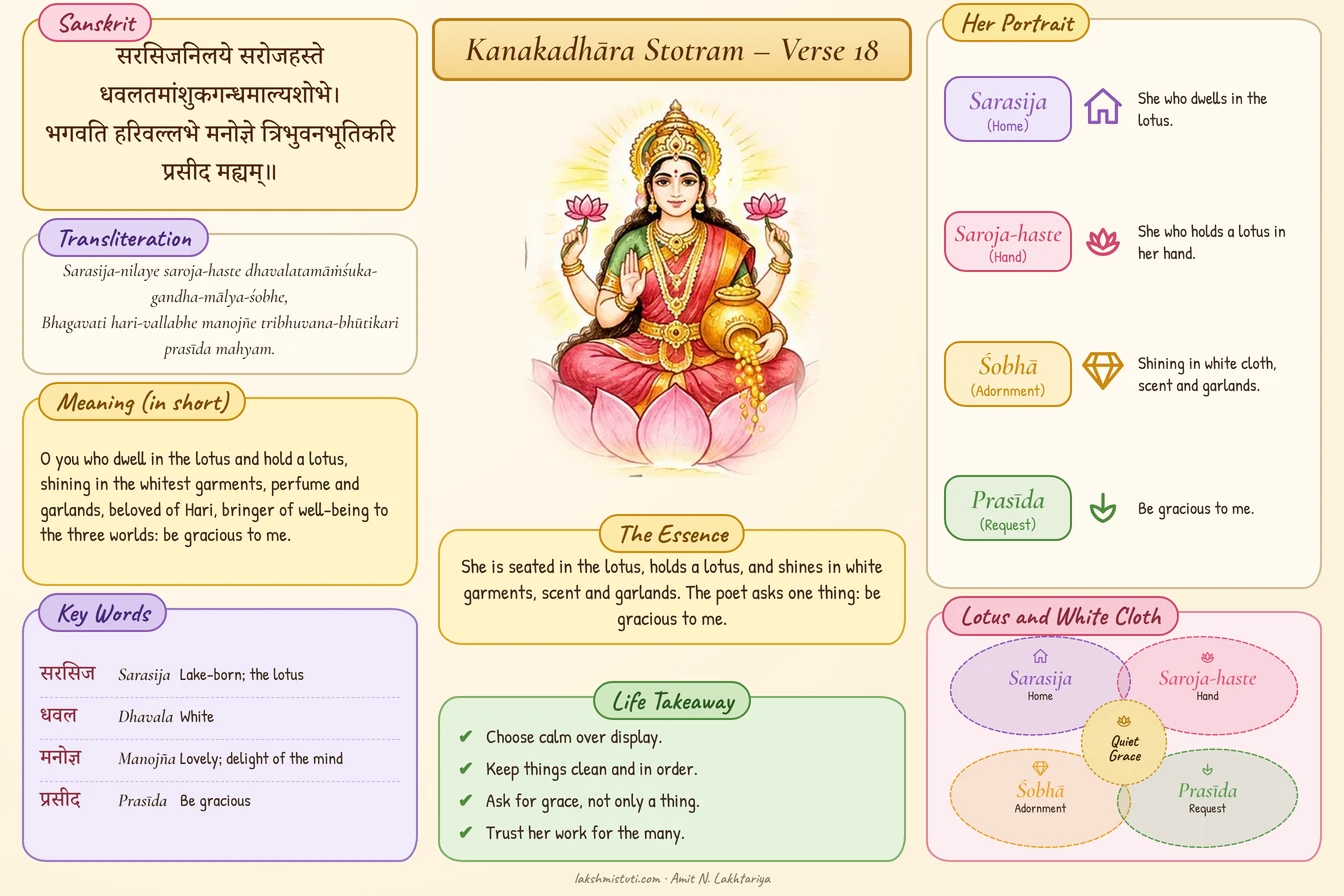
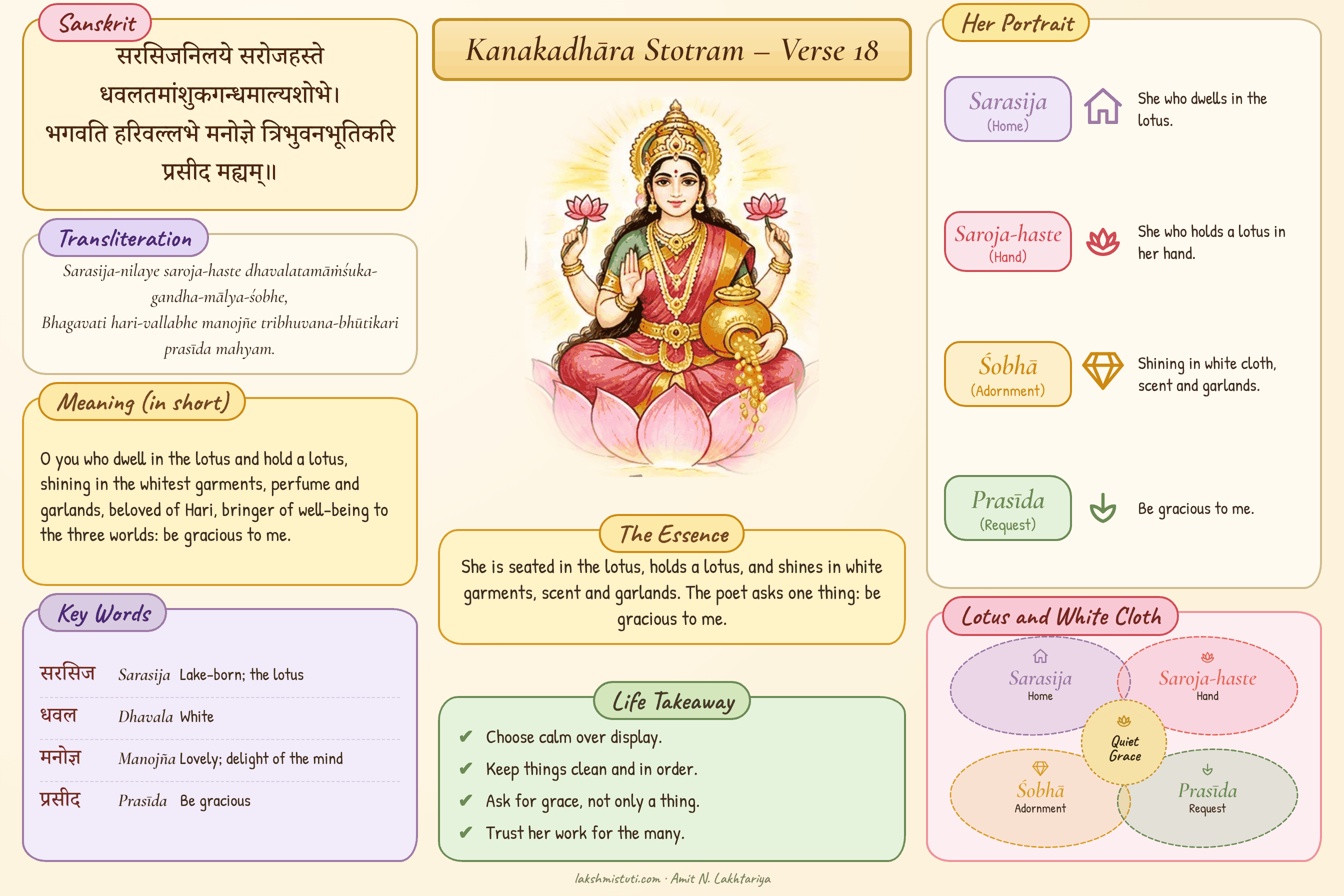
A one-page summary of the verse: Sanskrit, meaning, key ideas, key words and a takeaway. On a phone, open it full screen.
Word-by-word meaning
The literal meaning of each word.
| Sanskrit | Meaning |
|---|---|
| सरसिजनिलयेSarasija-nilaye | O you who dwell in the lotus |
| सरोजहस्तेSaroja-haste | O you with a lotus in your hand |
| धवलतमांशुकगन्धमाल्यशोभेDhavalatamāṁśuka-gandha-mālya-śobhe | O you who shine with the whitest garments, perfume and garlands |
| भगवतिBhagavati | O revered Goddess |
| हरिवल्लभेHari-vallabhe | O beloved of Hari |
| मनोज्ञेManojñe | O lovely one, O delight of the mind |
| त्रिभुवनभूतिकरिTribhuvana-bhūti-kari | O you who bring prosperity to the three worlds |
| प्रसीदPrasīda | Be gracious, be pleased |
| मह्यम्Mahyam | To me, for me |
Notes on each word
Sarasija means “born in a lake”: saras, a lake, and ja, born. It is a lotus. Nilaya is a dwelling, a home. The ending -e is the calling form: “O you whose home is the lotus”.
Saroja is again “lake-born”, the lotus. Hasta is the hand. So she holds a lotus in her hand. The two words for the lotus in the first two descriptions are a pair, one for her seat and one for her hand.
Dhavala is white; -tama makes it “the most white”. Aṁśuka is a fine cloth, a garment. Gandha is perfume. Mālya is a garland. Śobhā is splendour, so śobhe is “O you who are made radiant by” these. The a of tama and the a of aṁśuka join into ā.
Bhagavatī is the feminine of bhagavat, “possessing bhaga”, that is fortune, glory, majesty. It is a title of honour for a goddess. In the calling form the long ī becomes a short i: bhagavati.
Hari is Vishnu and vallabhā is a beloved. The calling form is vallabhe.
Manojña is built from manas, the mind, and jña, “known, pleasing”. So she is pleasing to the mind, charming. The calling form is manojñe.
Tribhuvana is the three worlds. Bhūti is well-being, prosperity. -Karī is “she who makes”. In the calling form, the long ī becomes short: -kari. She is the maker of the well-being of the three worlds.
The command form of pra and the root sad, “to sit, to settle”. The sense is “be calmly pleased, be gracious”. It is the single request of the verse.
The “to, for” form of “I”. The request ends on Śaṅkarācārya himself: be gracious to me.
Deeper spiritual insights
Interpretation and reflection: ideas that help us read the verse, not part of the text itself.
Before we begin
Verse 17 ended with a beautiful declaration: “I worship You, the sovereign of Murāri’s heart.”
Now, in Verse 18, Śaṅkarācārya returns to the divine form of Mahalakshmi. He describes her lotus abode, the lotus in her hand, her radiant attire and ornaments, and finally makes a direct appeal: “O Bhagavati, beloved of Hari, bestower of prosperity upon the three worlds, be gracious to me.”
This verse is especially rich in visual imagery. Let us explore both its devotional beauty and its deeper symbolism.
“O Goddess who dwell in the lotus and hold a lotus in your hand, radiant with the whitest garments, fragrance and garlands; O Bhagavati, beloved of Hari, charming one, bestower of prosperity on the three worlds: be gracious to me.”
1A grammatical observation
Almost the entire verse is composed of feminine vocative expressions. Śaṅkarācārya is directly addressing Lakshmi: O lotus-dwelling Goddess, O lotus-handed one, O beloved of Hari… The final words, prasīda mahyam, turn all these descriptions into a personal prayer: “Please be gracious to me.”
2The four images in the verse
First – Sarasija-nilaye: she who dwells in the lotus
Lakshmi is traditionally depicted seated upon a lotus. Why the lotus? The lotus grows in water and mud, yet its flower rises above the surface, beautiful and relatively untouched by the muddy surroundings. It has become a powerful symbol of purity amidst worldly life, beauty without attachment, spiritual elevation, and auspiciousness and divine presence.
There is a distinction worth noticing: in Verse 13, Śaṅkarācārya described her as seated upon a golden lotus. Here, he simply calls her the dweller in the lotus. The emphasis is now on the lotus as her divine abode, rather than its material splendour.
Contemplation: Live fully in the world, but do not allow the world to diminish the purity of your character.
Second – Saroja-haste: she who holds a lotus in her hand
The lotus appears again, but this time it is in her hand. Why does Śaṅkarācārya repeat the lotus image? The first lotus is her seat; the second is her attribute. In traditional iconography, the lotus held by Lakshmi represents purity, auspiciousness, fertility and spiritual unfolding.
There is also a beautiful symbolic distinction: the lotus beneath her represents the foundation of her divine presence, and the lotus in her hand represents the qualities she offers and embodies.
Contemplation: Let purity be both the foundation of your life and the quality you carry into your actions.
Third – Dhavala-tamāṁśuka-gandha-mālya-śobhe: radiant in pure white garments, fragrance and garlands
This is a particularly beautiful visual description. Śaṅkarācārya brings together three elements: aṁśuka, garments; gandha, fragrance, traditionally associated with sandalwood and perfume; and mālya, flower garlands. Together, they create an image of an exquisitely adorned Goddess. The word dhavala means white or pure. White is traditionally associated with purity, serenity and auspiciousness.
An important distinction: Lakshmi is depicted in different colours and forms in different traditions. This verse specifically describes her in radiant white garments; it should not be taken as a claim that all Lakshmi iconography uses white clothing.
Contemplation: True beauty is not merely decoration. It is the harmony of purity, grace and refinement.
Fourth – Bhagavati Hari-vallabhe Manojñe Tri-bhuvana-bhūti-karī: the Divine Goddess, beloved of Hari, giver of prosperity to the three worlds
Śaṅkarācārya now moves from her physical beauty to her divine status. Bhagavati is the glorious Divine Goddess; hari-vallabhā is the beloved of Vishnu; manojñā is the one who delights the mind; tri-bhuvana-bhūti-karī is the giver of prosperity to the three worlds.
Lakshmi’s abundance is therefore not restricted to one household, one kingdom or one individual. Her auspicious power is celebrated as extending throughout the universe.
Contemplation: May the prosperity I seek be beneficial not only to myself, but also to the wider world around me.
3A special observation: why does Śaṅkarācārya repeat the lotus?
| Earlier verse | Lotus imagery |
|---|---|
| Verse 12 | Lotus-like face |
| Verse 13 | Golden lotus seat |
| Verse 14 | Lotus as her abode |
| Verse 15 | Lotus-like eyes |
| Verse 18 | Lotus as abode and as an attribute in her hand |
The verse uses two closely related words, sarasija and saroja. Both refer to the same flower, but Śaṅkarācārya uses them in two different expressions: sarasija-nilaye, she who dwells in the lotus, and saroja-haste, she who holds a lotus in her hand. I would not regard this as unnecessary repetition. It creates a complete visual image: the Goddess is surrounded by the lotus, seated upon it and holding it.
The lotus is almost a visual thread running through the Stotram, the recurring symbol through which Śaṅkarācārya communicates purity and divine auspiciousness.
4The central concept: Tri-bhuvana-bhūti-karī
Tri-bhuvana means the three worlds. In traditional Hindu cosmology, these are often understood as Bhū-loka, the earthly realm; Bhuvar-loka, the intermediate or atmospheric realm; and Svar-loka, the heavenly realm. Bhūti-karī means the one who brings about prosperity, splendour or well-being. Thus Śaṅkarācārya praises Lakshmi as the one who brings prosperity to all three worlds.
Now compare this with Verse 13: there, bhūmaṇḍala-nāyikā, sovereign of the earthly world; here, tri-bhuvana-bhūti-karī, bestower of prosperity upon the three worlds. There is an expansion in scale. In Verse 13, her sovereignty is emphasised. In Verse 18, the extent of her auspicious influence is emphasised. This is a useful example of how Śaṅkarācārya revisits an idea but gives it a new dimension.
5Why does the verse end with prasīda mahyam?
This is perhaps the most emotionally important part. After describing her lotus abode, the lotus in her hand, her pure garments, fragrant adornments, divine beauty, relationship with Hari and power over the three worlds, Śaṅkarācārya finally says: prasīda mahyam, “be gracious to me”.
Notice the contrast. The Goddess is praised as the bestower of prosperity upon the three worlds. Yet Śaṅkarācārya approaches her with a very personal request. He does not ask for an empire in this line. He simply asks her to look upon him with grace.
There is humility in this prayer. The devotee recognises the vastness of the Divine and the smallness of the individual before that vastness. And yet, he approaches her without hesitation, as a child approaches a mother.
6Philosophical interpretation: what does this verse teach us?
| Divine image | Reflection for daily life |
|---|---|
| Lotus abode | Remain pure amidst worldly responsibilities |
| Lotus in hand | Carry good qualities into your actions |
| White garments and fragrance | Cultivate refinement, serenity and good conduct |
| Prosperity of three worlds | Let your success benefit others too |
The verse does not reject material prosperity. It celebrates prosperity as a divine blessing. But it also places prosperity within a larger vision, one that includes purity, beauty, harmony and universal well-being. The highest form of prosperity is not merely having more; it is becoming a source of well-being.
Sanskrit words to keep
- Sarasija / Saroja – a lotus
- Nilaya – an abode
- Dhavala – white, pure
- Aṁśuka – a garment
- Manojña – delightful, charming
- Prasīda – be gracious
7The progression from Verse 16 to Verse 18
| Verse | Central movement |
|---|---|
| 16 | The devotee asks for prosperity and the removal of adversity |
| 17 | The devotee worships Lakshmi’s gracious glance |
| 18 | The devotee beholds her divine form and asks for her grace |
There is a gradual movement from asking for blessings, to contemplating grace, to standing before the divine form in devotion. And the final words of Verse 18 are worth remembering: prasīda mahyam, be gracious to me.
A question to carry into Verse 19
Next is Verse 19: digghastibhiḥ kanaka-kumbha-mukhāvasṛṣṭa…
It presents one of the most magnificent visual scenes in the Stotram: the celestial elephants pouring sacred water from golden vessels over the Goddess. It is a powerful image of royal consecration, abundance and divine motherhood.
Practical meditation
- Recite the verse slowly, contemplating each image. Sarasija-nilaye: “O Mother, may I remain pure and steady amidst the challenges of worldly life.”
- Saroja-haste: “May my hands perform actions that bring goodness and prosperity.”
- Dhavalatamāṁśuka-gandha-mālya-śobhe: “May my thoughts, conduct and character become as pure and refined as Your divine adornment.”
- Bhagavati hari-vallabhe manojñe: “O beloved of Hari, may devotion and grace bring peace to my mind.”
- Tri-bhuvana-bhūti-kari prasīda mahyam: “O Mother, bestower of prosperity upon the three worlds, please be gracious to me.”
O Divine Mother, embodiment of purity and beauty, beloved of Hari and source of prosperity in all the worlds, please shower Your grace upon me.
This meditation is a devotional practice for attention and reflection; it does not promise a supernatural result or guarantee material wealth.