Home › Mahālakṣmī Aṣṭakam › Phalaśruti (9–11)
The verse
॥ फलश्रुति ॥
महालक्ष्म्यष्टकं स्तोत्रं यः पठेद्भक्तिमान्नरः।
सर्वसिद्धिमवाप्नोति राज्यं प्राप्नोति सर्वदा॥
एककाले पठेन्नित्यं महापापविनाशनम्।
द्विकालं यः पठेन्नित्यं धनधान्यसमन्वितः॥
त्रिकालं यः पठेन्नित्यं महाशत्रुविनाशनम्।
महालक्ष्मीर्भवेन्नित्यं प्रसन्ना वरदा शुभा॥
॥ श्री महालक्ष्म्यै नमः ॥
Mahālakṣmy-aṣṭakaṁ stotraṁ yaḥ paṭhed bhaktimān naraḥ,
Sarva-siddhim avāpnoti rājyaṁ prāpnoti sarvadā.
Eka-kāle paṭhen nityaṁ mahā-pāpa-vināśanam,
Dvi-kālaṁ yaḥ paṭhen nityaṁ dhana-dhānya-samanvitaḥ.
Tri-kālaṁ yaḥ paṭhen nityaṁ mahā-śatru-vināśanam,
Mahālakṣmīr bhaven nityaṁ prasannā varadā śubhā.
Meaning in short
Whoever recites this eight-verse hymn to Mahalakshmi with devotion is said to attain every accomplishment and lasting authority. Recited once daily, it destroys great sins; twice daily, it brings wealth and grain; three times daily, it destroys great enemies, and Mahalakshmi becomes ever pleased, boon-giving and auspicious.
The closing verses say what tradition associates with steady recitation, rising from once a day to three times.
Key highlights
- With devotion Bhakti: the reciter is described as devoted
- Once a day Faults: the text links it with great sins destroyed
- Twice a day Wealth: the text links it with wealth and grain
- Three times Opposition: great enemies destroyed, and she is pleased
Explore the four lines
Tap a card to open its meaning and a question to carry with you.
With devotionBhakti
The first line describes the reciter as bhaktimān, one who has devotion. The text places devotion before any fruit. A reader may take this as the condition that gives the rest its meaning.
Pause and reflect: What would it mean to practise out of care instead of for a result?
Once a dayFaults
Recited once a day, the text says, it destroys great sins. Read as encouragement, this is a promise of a lighter conscience through a small, regular act.
Pause and reflect: What small daily habit could make me feel lighter?
Twice a dayWealth
Recited twice a day, the text links it with wealth and grain. This site reads such lines as what tradition says, not as a guarantee. Some readers take them literally and others as inner growth.
Pause and reflect: What would I count as real abundance in my own life?
Three timesOpposition
Recited three times, it is said to destroy great enemies, and Mahalakshmi becomes ever pleased, boon-giving and auspicious. Some read the enemies as inner ones such as fear and doubt.
Pause and reflect: Which inner enemy would I most like to see weakened?
Sketch note
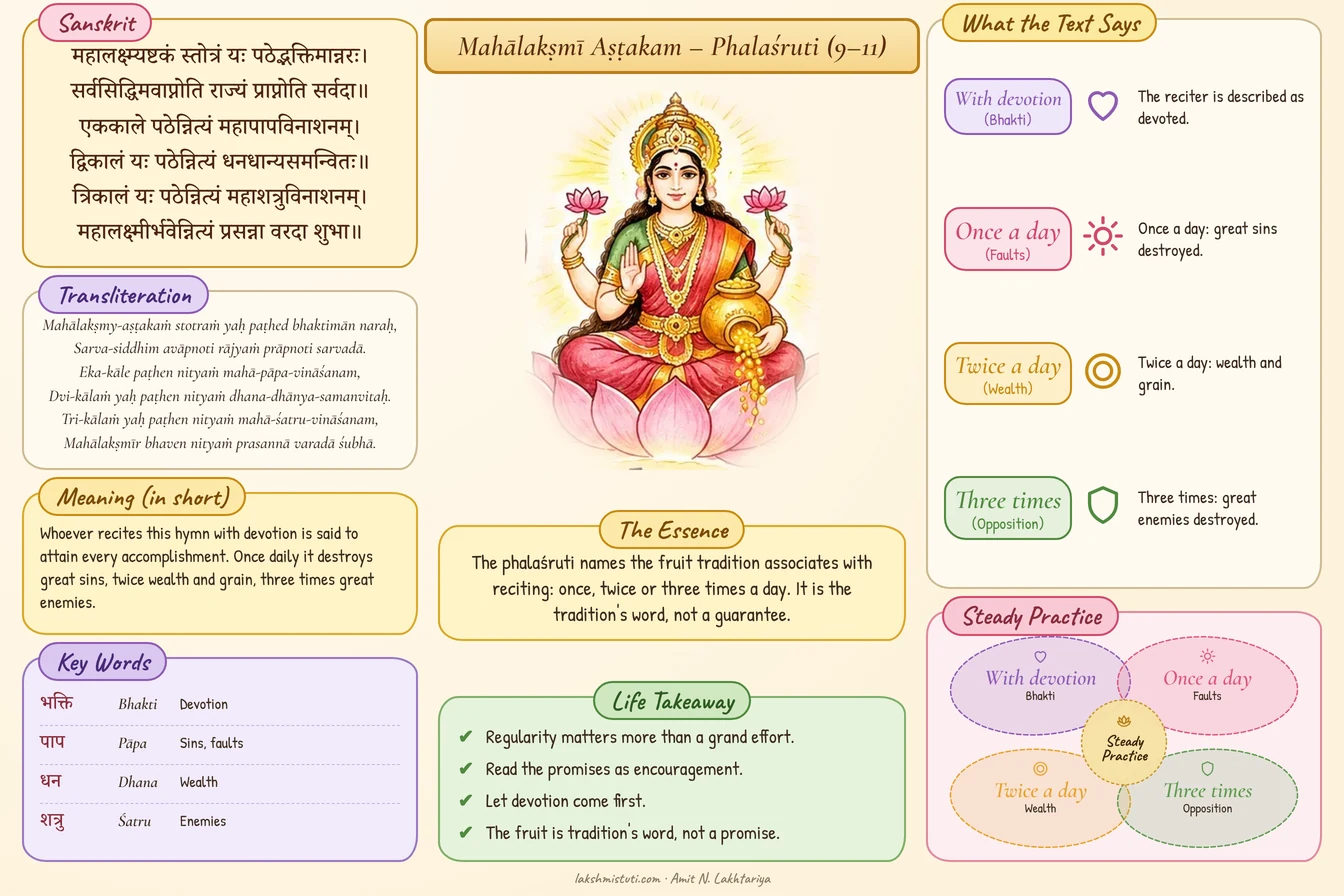
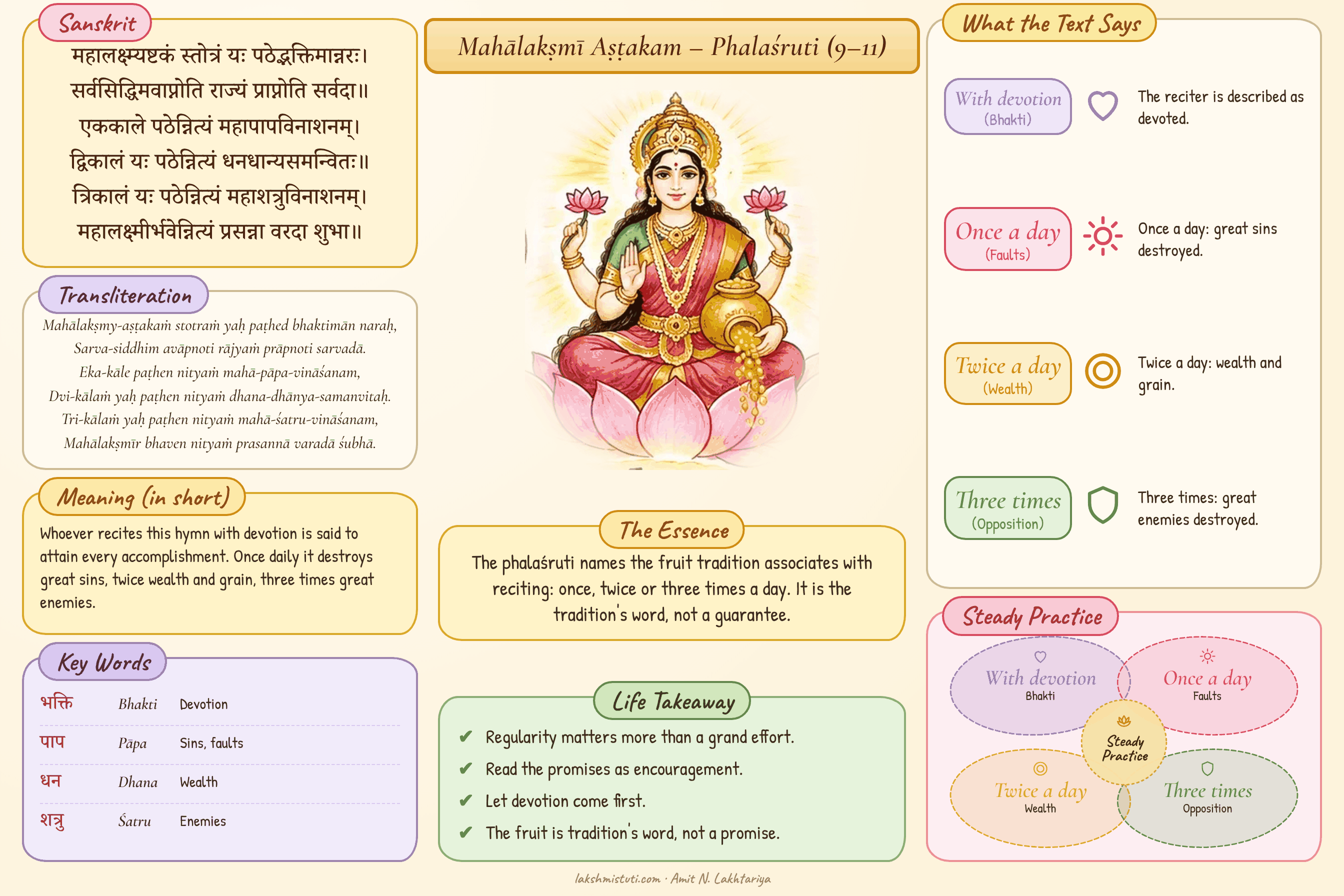
A one-page summary of the verse: Sanskrit, meaning, key ideas, key words and a takeaway. On a phone, open it full screen.
Word-by-word meaning
The literal meaning of each word.
| Sanskrit | Meaning |
|---|---|
| महालक्ष्म्यष्टकं स्तोत्रम्Mahālakṣmy-aṣṭakaṁ stotram | The eight-verse hymn to Mahalakshmi |
| यः पठेत् भक्तिमान् नरःYaḥ paṭhet bhaktimān naraḥ | The person who recites it with devotion |
| सर्वसिद्धिम् अवाप्नोतिSarva-siddhim avāpnoti | Attains all accomplishments |
| राज्यं प्राप्नोतिRājyaṁ prāpnoti | Obtains sovereignty or a kingdom |
| एककालेEka-kāle | Once a day |
| द्विकालम् / त्रिकालम्Dvi-kālam / Tri-kālam | Twice a day / three times a day |
| धनधान्यसमन्वितःDhana-dhānya-samanvitaḥ | Endowed with wealth and grain |
| प्रसन्ना वरदा शुभाPrasannā varadā śubhā | Pleased, boon-giving and auspicious |
Notes on each word
Aṣṭaka is a set of eight; stotra is a hymn of praise.
Bhaktimān is one who has devotion.
Siddhi is accomplishment; avāpnoti is attains.
Classical language for authority and prosperity; many readers take it figuratively.
Kāla is time or period.
Morning and evening, or morning, noon and evening.
Dhana is wealth; dhānya is grain; samanvita is endowed with.
Three words describing Mahalakshmi as she becomes favourable.
Deeper spiritual insights
Interpretation and reflection: ideas that help us read the verse, not part of the text itself.
In simple words
Like many Sanskrit hymns, this one ends with a phalaśruti, a statement of the fruit that tradition associates with reciting it. Three more verses are added to the eight, so the hymn is often printed with eleven verses. Here the three are taken together as the ninth entry.
Once, twice, three times
The verses raise the benefit as the practice grows: once a day for forgiveness of faults, twice for prosperity, three times for strength against what opposes us. The pattern encourages regularity rather than a single grand effort.
How to read these promises
A phalaśruti states what tradition says, not what anyone can guarantee. Readers differ: some take the fruits literally, others as inner growth such as steadiness, clarity and courage. This site reads it as encouragement to practise, and does not promise an outcome.
Practical meditation
- Minute 1Sit and breathe.
- Minute 2Recite one verse of the hymn that you remember.
- Minute 3Choose a realistic rhythm for yourself: once a day, or once a week.
- Minute 4End with a bow.
Reflection for today
What would a gentle, sustainable practice look like for me: a few minutes once a day, rather than a promise I cannot keep?
The hymn closes by turning from praise to practice. Whatever fruit one expects, the steady habit of attention is the part within our own hands.
This meditation is a devotional practice for attention and reflection; it does not promise a supernatural result or guarantee material wealth.