Home › Mahālakṣmī Aṣṭakam › Verse 1
The verse
॥ श्लोक १ ॥
नमस्तेऽस्तु महामाये श्रीपीठे सुरपूजिते।
शङ्खचक्रगदाहस्ते महालक्ष्मि नमोऽस्तु ते॥
॥ श्री महालक्ष्म्यै नमः ॥
Namas te 'stu mahāmāye śrīpīṭhe sura-pūjite,
Śaṅkha-cakra-gadā-haste mahālakṣmi namo 'stu te.
Meaning in short
Salutations to you, O Mahāmāyā, great divine power, seated at Śrīpīṭha and worshipped by the gods; you who hold the conch, discus and mace in your hands. O Mahalakshmi, I bow to you.
The hymn opens with a bow to the Goddess in her seat, honoured by the gods and holding her emblems.
Key highlights
- Mahāmāyā Divine power: the great creative power by which the world appears
- Śrīpīṭha Her seat: the seat of Śrī, linked by tradition with Kolhapur
- Surapūjitā Worshipped: honoured by the gods
- Her emblems Emblems: the conch, discus and mace in her hands
Explore the four images
Tap a card to open its meaning and a question to carry with you.
MahāmāyāDivine power
Māyā is the creative power by which the world appears. Here it is a title of honour, not a charge of deception. The hymn begins by naming her as the great power behind the world.
Pause and reflect: Do I see the world as only things, or also as the power that holds them together?
ŚrīpīṭhaHer seat
Pīṭha means a seat or sacred centre. Tradition links her seat with Kolhapur, and the phrase can also be read simply as the seat of prosperity. The first image is of a place where she is honoured.
Pause and reflect: Where in my life is there a place set aside for gratitude?
SurapūjitāWorshipped
The gods themselves worship her. The hymn shows that even the powerful bow before what they depend on, so the bow of the reader is in good company.
Pause and reflect: Whom or what do I depend on without ever saying thank you?
Her emblemsEmblems
The conch, discus and mace are emblems she shares with Vishnu: the call, the wheel of order and the strength to protect. The tradition reads them as signs of purpose, not only of power.
Pause and reflect: Which of my strengths am I using for something larger than myself?
Sketch note
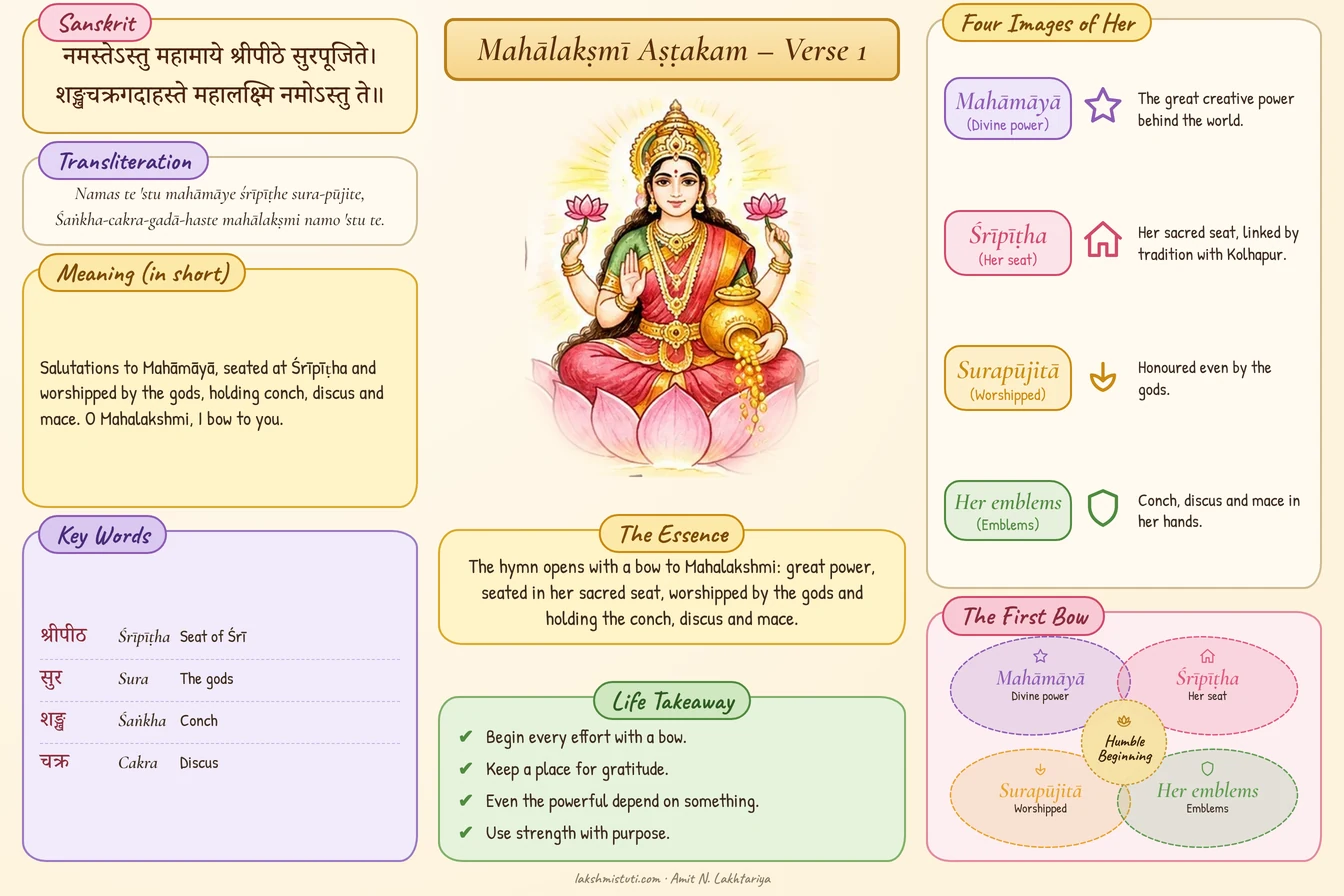
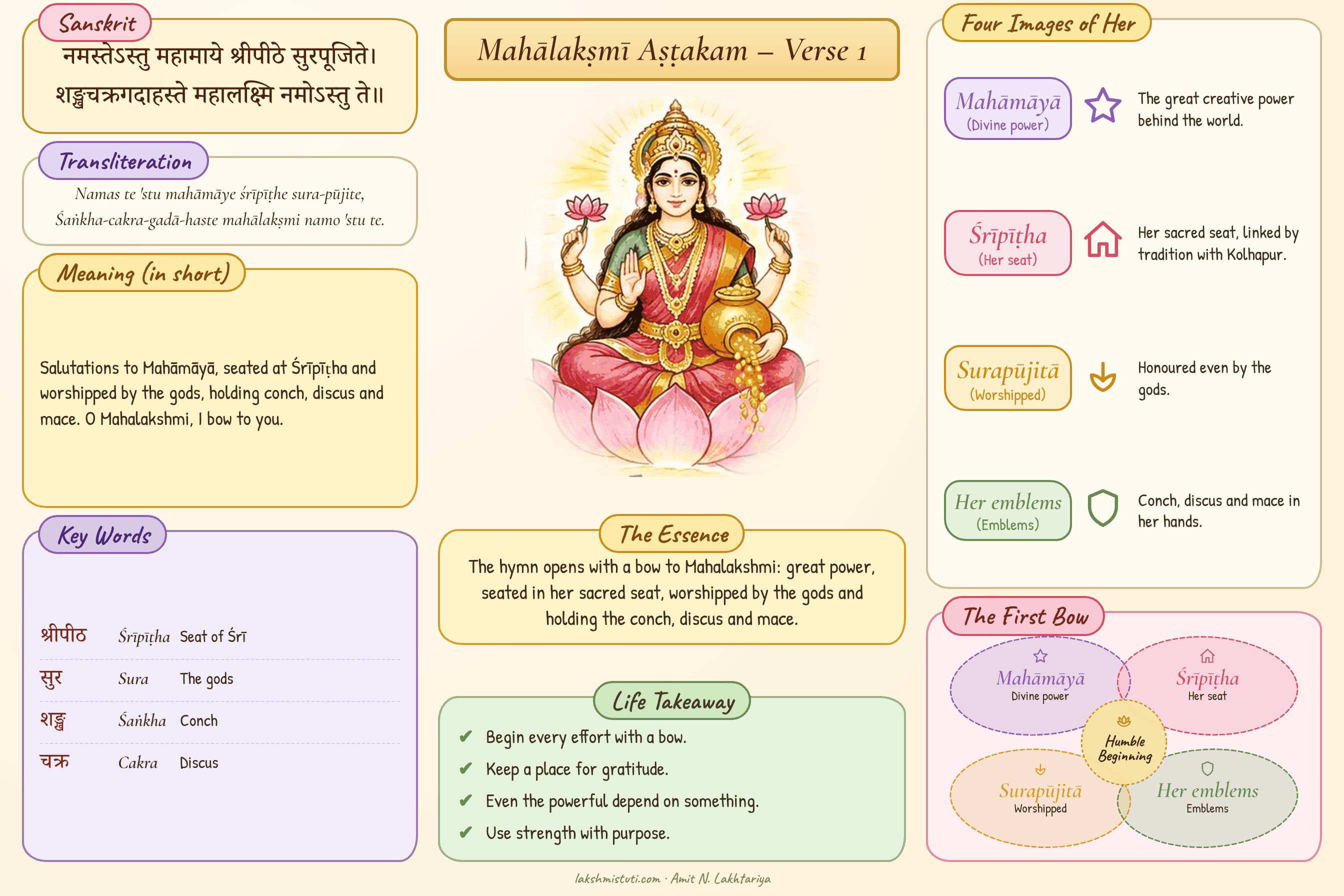
A one-page summary of the verse: Sanskrit, meaning, key ideas, key words and a takeaway. On a phone, open it full screen.
Word-by-word meaning
The literal meaning of each word.
| Sanskrit | Meaning |
|---|---|
| नमः ते अस्तुNamaḥ te astu | Salutation to you; may there be a bow to you |
| महामायेMahāmāye | O Great Māyā, great divine power |
| श्रीपीठेŚrīpīṭhe | O you who are seated at Śrīpīṭha, the seat of Śrī |
| सुरपूजितेSura-pūjite | Worshipped by the gods |
| शङ्खचक्रगदाहस्तेŚaṅkha-cakra-gadā-haste | Holding conch, discus and mace in her hands |
| महालक्ष्मिMahālakṣmi | O Mahalakshmi |
| नमः अस्तु तेNamo ’stu te | My salutations to you |
Notes on each word
Namaḥ is a bow or salutation; te is “to you”; astu is “let it be”.
Māyā is the creative power by which the world appears. Here it is a title of honour, not a charge of deception.
Pīṭha is a seat or sacred centre. Tradition links this seat with Kolhapur; the phrase can also be read simply as “seat of prosperity”.
Sura is a god; pūjita is worshipped.
Śaṅkha is the conch, cakra the discus, gadā the mace, hasta the hand.
The vocative of Mahālakṣmī, “the Great Lakshmi”.
The refrain that closes every verse of the hymn.
Deeper spiritual insights
Interpretation and reflection: ideas that help us read the verse, not part of the text itself.
In simple words
The hymn opens with a plain bow. Before asking for anything, the poet greets the Goddess with three titles: the great creative power, the one seated at the sacred seat of Śrī, and the one whom even the gods worship. Reverence comes first; everything else follows from it.
Who is speaking
Tradition ascribes this hymn to Indra, king of the gods, and places it in the Padma Purāṇa. Accounts of the occasion differ, so it is safer to hold only the broad idea: even a king of the gods approaches Lakshmi with a bow.
Conch, discus and mace
These are the familiar emblems of Lord Vishnu. Here the Goddess carries them herself. The picture is of a Lakshmi who is not only gentle and generous but also powerful. That is a useful balance to keep in mind through the rest of the hymn.
Mahāmāyā is not “illusion” only
In popular speech māyā often means illusion. In devotional Sanskrit it also means the creative power through which the world is manifest. Read that way, mahāmāyā addresses Lakshmi as the great power behind creation.
Practical meditation
- Minute 1Sit quietly and let the breath settle.
- Minute 2Recite the first line slowly, feeling the bow in namaḥ.
- Minute 3Picture the Goddess holding the conch, discus and mace, calm and capable.
- Minute 4Offer one silent thanks for something you already have.
Reflection for today
Before I ask for anything today, can I begin by acknowledging what I have already received? What would change in my day if I started with a bow instead of a request?
The first verse is a salutation and nothing more, and that is its strength. A hymn that begins with reverence trains the mind to receive before it asks.
This meditation is a devotional practice for attention and reflection; it does not promise a supernatural result or guarantee material wealth.