Home › Mahālakṣmī Aṣṭakam › Verse 2
The verse
॥ श्लोक २ ॥
नमस्ते गरुडारूढे कोलासुरभयङ्करि।
सर्वपापहरे देवि महालक्ष्मि नमोऽस्तु ते॥
॥ श्री महालक्ष्म्यै नमः ॥
Namas te garuḍārūḍhe kolāsura-bhayaṅkari,
Sarva-pāpa-hare devi mahālakṣmi namo 'stu te.
Meaning in short
Salutations to you, O Goddess who ride on Garuḍa and are the terror of the demon Kolāsura, remover of all sins. O Mahalakshmi, I bow to you.
The second bow salutes the Goddess who rides Garuḍa, frightens Kolāsura and removes all faults.
Key highlights
- Garuḍa Her mount: she rides Garuḍa, the king of birds
- Kolāsura Fearless: the demon Kolāsura is said to fear her
- Sarva-pāpa Remover: she takes away all sins and faults
Explore the three images
Tap a card to open its meaning and a question to carry with you.
GaruḍaHer mount
Garuḍa is the king of birds and the traditional mount of Vishnu. To ride him is to move with ease and speed above the ground. The first image is of grace in motion.
Pause and reflect: What helps me rise above a problem instead of getting stuck in it?
KolāsuraFearless
Kolāsura is the demon of the Kolhapur tradition. The verse says the Goddess is his terror. A reader may take him as a figure of fear itself, and her as the strength that stands before it. This is a reflection, not part of the text.
Pause and reflect: What fear in me needs a steadier ally?
Sarva-pāpaRemover
Sarva-pāpa-hare means the remover of all sins, mistakes and faults. The hymn does not stop at power over enemies. It also asks for the quieter work of cleansing.
Pause and reflect: Is there a mistake I can set down and begin again from?
Sketch note
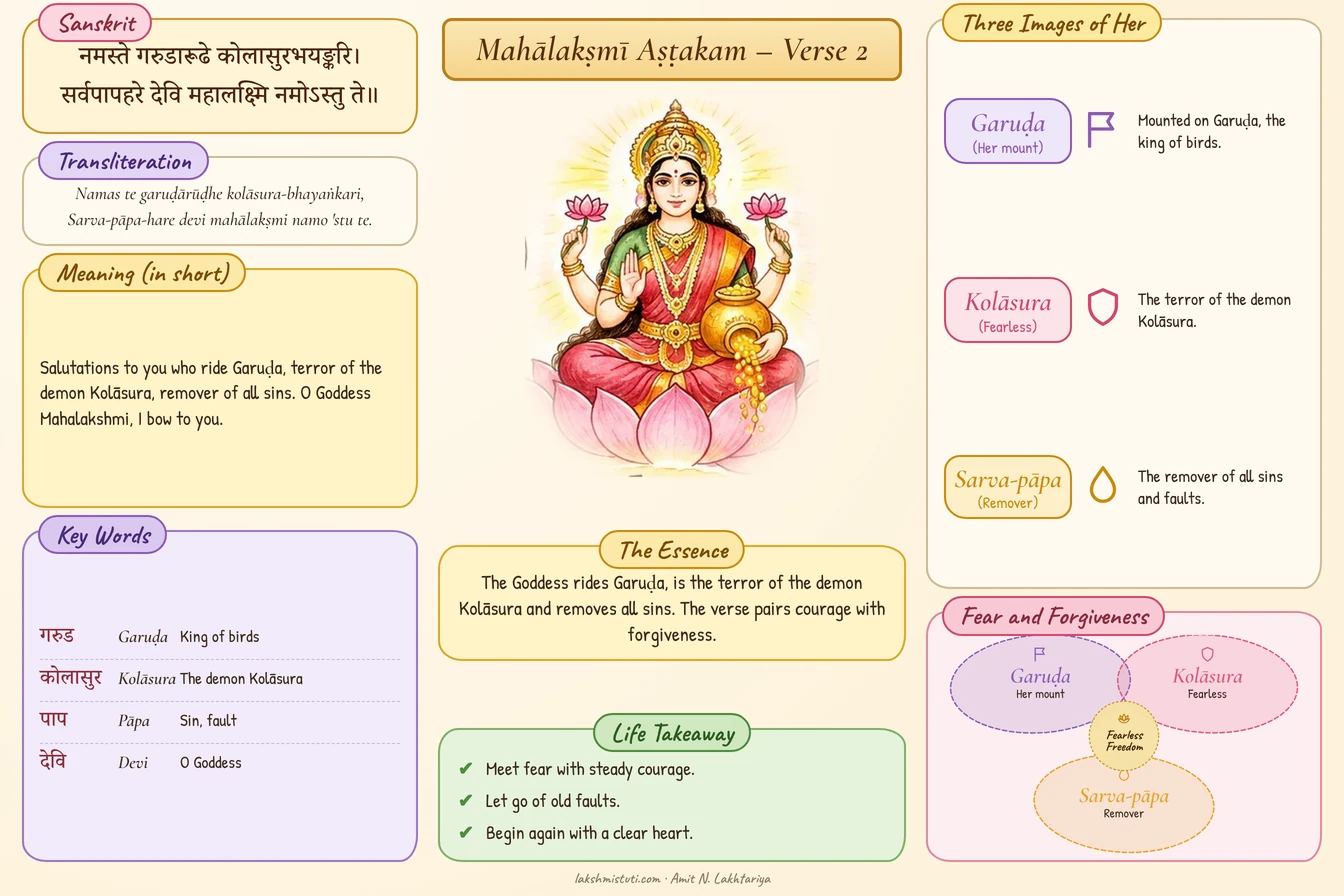
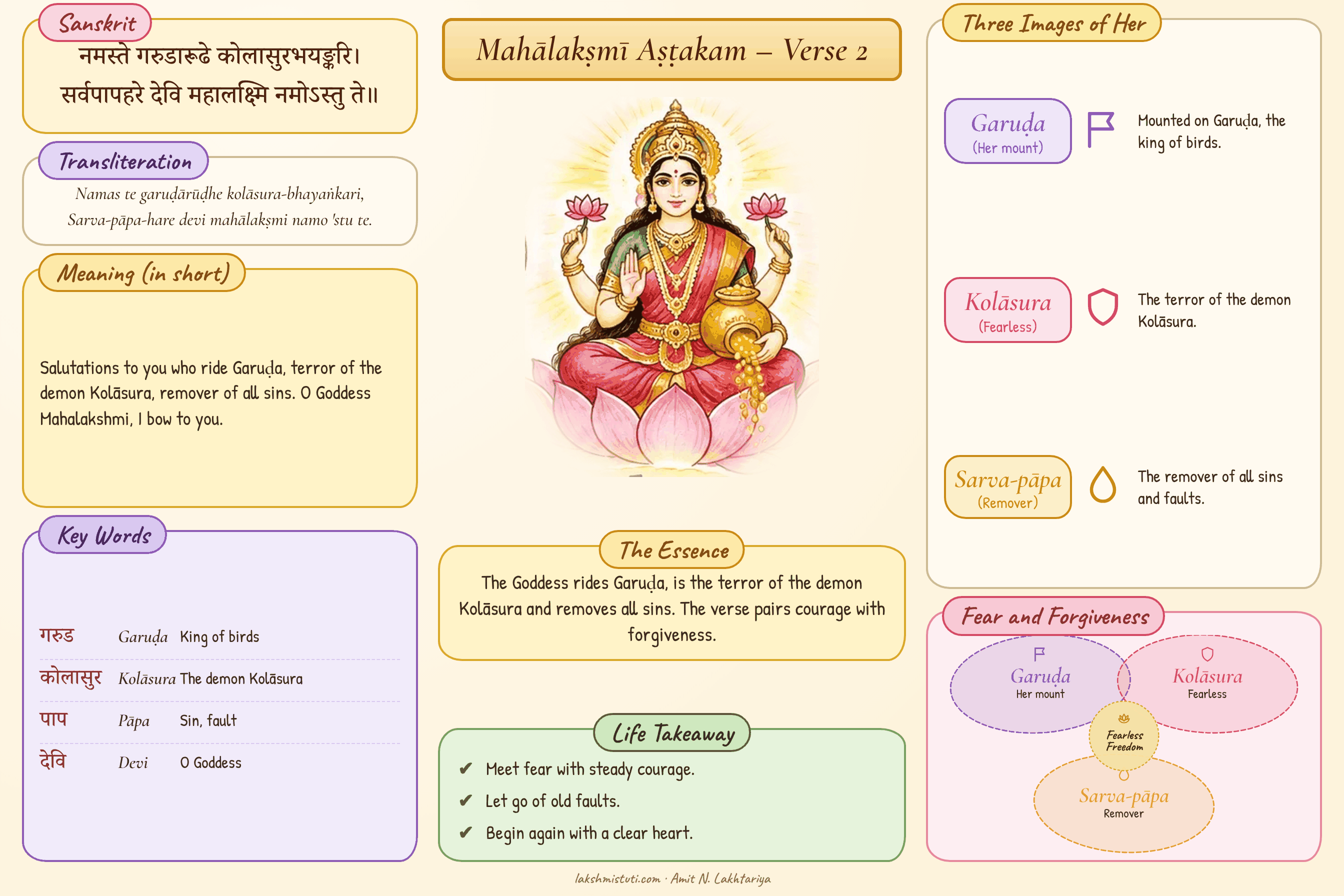
A one-page summary of the verse: Sanskrit, meaning, key ideas, key words and a takeaway. On a phone, open it full screen.
Word-by-word meaning
The literal meaning of each word.
| Sanskrit | Meaning |
|---|---|
| नमः तेNamaḥ te | Salutation to you |
| गरुडारूढेGaruḍārūḍhe | O you who are mounted on Garuḍa |
| कोलासुरभयङ्करिKolāsura-bhayaṅkari | O terror of the demon Kolāsura |
| सर्वपापहरेSarva-pāpa-hare | O remover of all sins and faults |
| देविDevi | O Goddess |
| महालक्ष्मिMahālakṣmi | O Mahalakshmi |
Notes on each word
As in the first verse.
Garuḍa is the eagle-like king of birds, the traditional mount of Lord Vishnu; ārūḍha is mounted or seated.
Kolāsura is the demon Kola of the Kolhapur tradition; bhayaṅkari is she who causes fear.
Sarva is all; pāpa is sin or fault; harā is one who takes away.
A respectful vocative.
The refrain name.
Deeper spiritual insights
Interpretation and reflection: ideas that help us read the verse, not part of the text itself.
In simple words
The second verse shows two sides of the Goddess: she is mounted on Garuḍa and strikes fear into a demon, yet she is also the one who removes the faults of her devotees. Power and compassion are named in the same breath.
Kolāsura and Kolhapur
Local tradition tells that Mahalakshmi destroyed the demon Kolāsura at Kolhapur, and the city’s great Mahalakshmi temple is linked with this legend. Different tellings vary in detail, so treat the story as tradition rather than record.
A reflection on inner “demons”
Many readers take the demon as a symbol of whatever overwhelms us from inside: fear, greed or carelessness. That is a reading we bring to the verse, not something the verse states. It is a helpful way to make an old legend speak to daily life.
Practical meditation
- Minute 1Breathe slowly and settle.
- Minute 2Recite the verse once, paying attention to the rhythm of garuḍārūḍhe.
- Minute 3Name one fear or fault you would like to be freed from, without judging yourself.
- Minute 4Take one small, practical step toward it today.
Reflection for today
What is the one fear or habit that most holds back my prosperity, in the widest sense of that word? What small step could I take toward it today?
Fear and fault are two of the quiet drains on any life. This verse asks the Goddess to deal with both.
This meditation is a devotional practice for attention and reflection; it does not promise a supernatural result or guarantee material wealth.