Home › Mahālakṣmī Aṣṭakam › Verse 4
The verse
॥ श्लोक ४ ॥
सिद्धिबुद्धिप्रदे देवि भुक्तिमुक्तिप्रदायिनि।
मन्त्रमूर्ते सदा देवि महालक्ष्मि नमोऽस्तु ते॥
॥ श्री महालक्ष्म्यै नमः ॥
Siddhi-buddhi-prade devi bhukti-mukti-pradāyini,
Mantra-mūrte sadā devi mahālakṣmi namo 'stu te.
Meaning in short
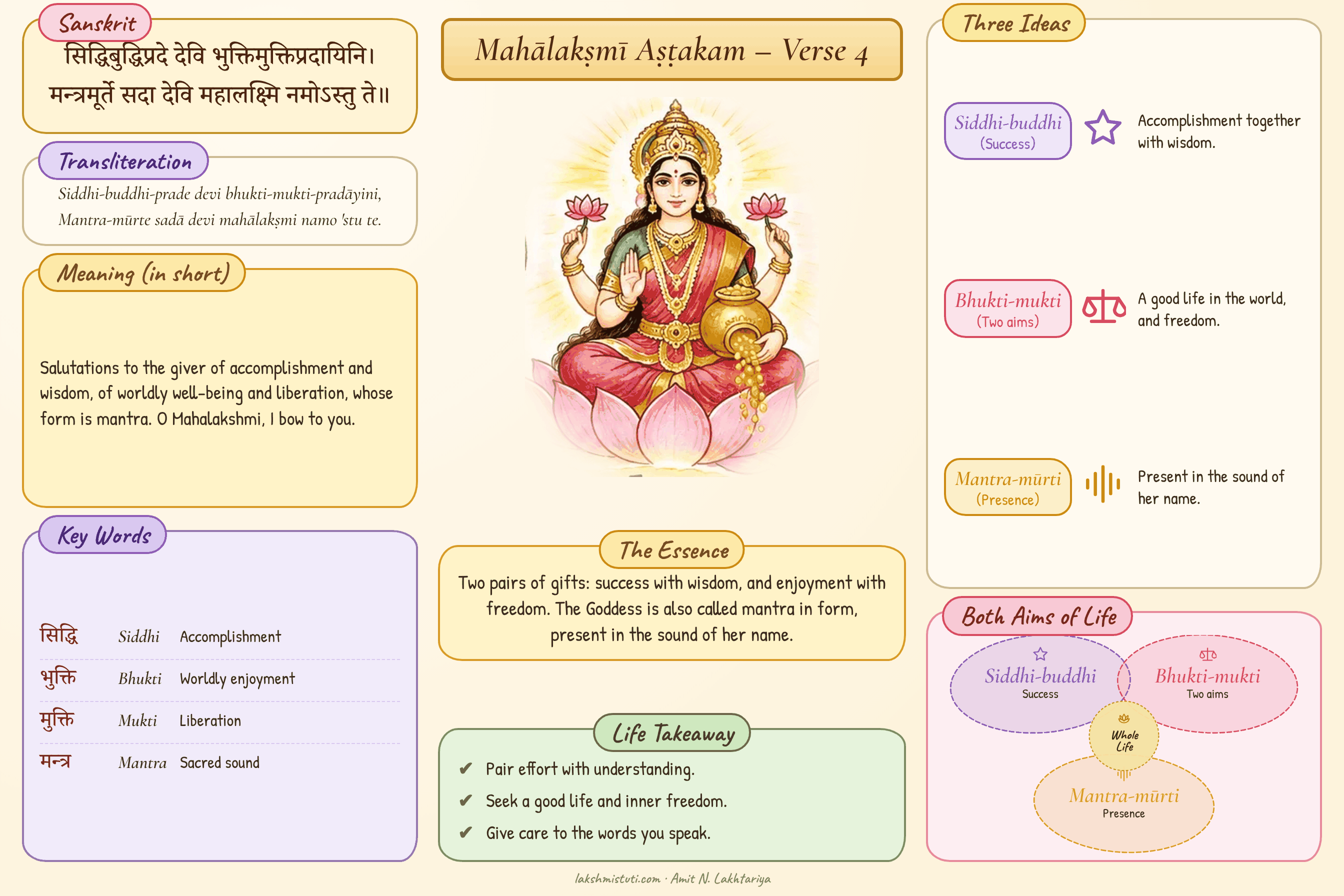
Salutations to you, O Goddess, giver of accomplishment and wisdom, giver of worldly well-being and of liberation, whose very form is mantra. O Mahalakshmi, I bow to you.
Success with wisdom, enjoyment with freedom, and a form made of sound: the verse holds the two aims of life together.
Key highlights
- Siddhi-buddhi Success: accomplishment paired with wisdom
- Bhukti-mukti Two aims: worldly well-being and liberation
- Mantra-mūrti Presence: her very form is mantra
Explore the three ideas
Tap a card to open its meaning and a question to carry with you.
Siddhi-buddhiSuccess
Siddhi is accomplishment and buddhi is wisdom. The verse pairs them. Success without understanding can go wrong, and understanding without action can stay unused.
Pause and reflect: Where in my work am I succeeding without stopping to understand?
Bhukti-muktiTwo aims
Indian thought speaks of bhukti, a good life in the world, and mukti, freedom from what binds us. The Goddess gives both. Material well-being is not despised, and it is not the final goal.
Pause and reflect: What would a good life look like if it also felt free?
Mantra-mūrtiPresence
To call her form mantra is to say that when her name or verse is recited, she is present in the sound. This is the devotional logic behind chanting, and a reason many readers value pronouncing the verses with care.
Pause and reflect: Can I give one minute of slow, careful attention to a single word today?
Sketch note
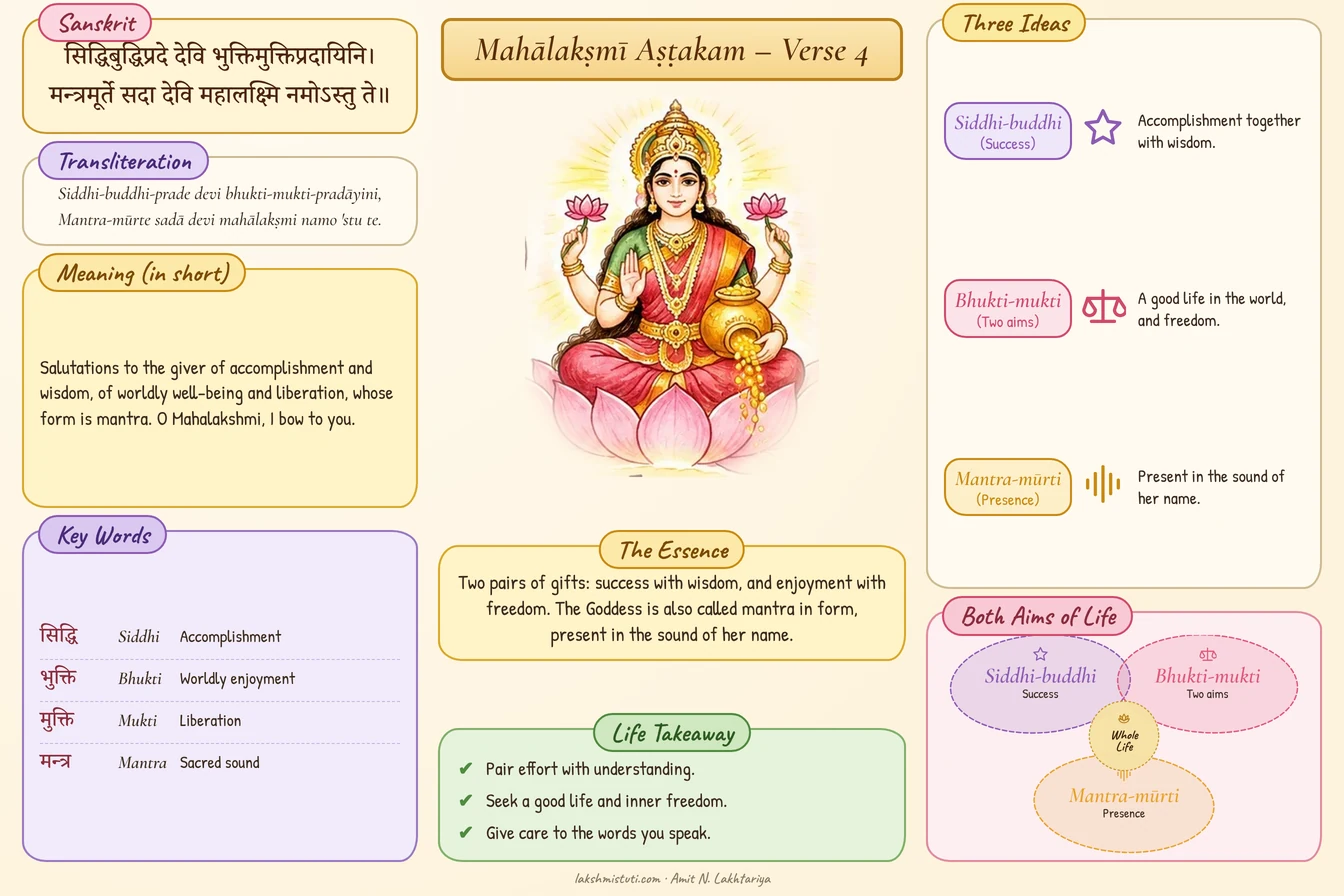
A one-page summary of the verse: Sanskrit, meaning, key ideas, key words and a takeaway. On a phone, open it full screen.
Word-by-word meaning
The literal meaning of each word.
| Sanskrit | Meaning |
|---|---|
| सिद्धिबुद्धिप्रदेSiddhi-buddhi-prade | O giver of accomplishment and wisdom |
| देविDevi | O Goddess |
| भुक्तिमुक्तिप्रदायिनिBhukti-mukti-pradāyini | O giver of worldly enjoyment and liberation |
| मन्त्रमूर्तेMantra-mūrte | O you whose form is mantra |
| सदाSadā | Always |
| महालक्ष्मिMahālakṣmi | O Mahalakshmi |
Notes on each word
Siddhi is accomplishment or success; buddhi is intellect, discernment; prada is giver.
Vocative.
Bhukti is enjoyment of the world, material well-being; mukti is liberation; pradāyinī is giver.
Mūrti is form or embodiment. The Goddess is seen as present in sacred sound.
At all times.
The refrain.
Deeper spiritual insights
Interpretation and reflection: ideas that help us read the verse, not part of the text itself.
In simple words
Two pairs of gifts are named: success with wisdom, and enjoyment with liberation. Notice that success is paired with wisdom, and enjoyment with freedom. The verse does not set one pair against the other.
Both aims of life
Indian thought speaks of bhukti, a good life in the world, and mukti, freedom from what binds us. Here the Goddess gives both. It is a quietly balanced view: material well-being is not despised, and it is not the final goal.
Mantra-mūrti: sound as presence
To call the Goddess “whose form is mantra” is to say that when her name or verse is recited, she is present in the sound. This is the devotional logic behind chanting, and it explains why many readers value pronouncing the verses with care.
Practical meditation
- Minute 1Settle your posture and breath.
- Minute 2Recite the verse once, slowly and clearly.
- Minute 3Think of one area where you want success and ask what wisdom it needs.
- Minute 4Sit quietly with the sound of the verse still in your mind.
Reflection for today
Where am I asking for success without asking for wisdom? What would a good life, not only a successful one, look like for me?
The verse pairs every gift with its companion. That is perhaps its best advice: look for success that comes with wisdom, and enjoyment that does not forget freedom.
This meditation is a devotional practice for attention and reflection; it does not promise a supernatural result or guarantee material wealth.