Home › Mahālakṣmī Aṣṭakam › Verse 7
The verse
॥ श्लोक ७ ॥
पद्मासनस्थिते देवि परब्रह्मस्वरूपिणि।
परमेशि जगन्मातर्महालक्ष्मि नमोऽस्तु ते॥
॥ श्री महालक्ष्म्यै नमः ॥
Padmāsana-sthite devi para-brahma-svarūpiṇi,
Parameśi jagan-mātar mahālakṣmi namo 'stu te.
Meaning in short
Salutations to you, O Goddess seated on the lotus, whose very nature is the Supreme Brahman, supreme sovereign and mother of the world. O Mahalakshmi, I bow to you.
Seated on the lotus, supreme in nature and mother of the world: the verse joins the highest idea with the closest one.
Key highlights
- Padmāsana Lotus seat: she sits on a lotus
- Para-brahma Supreme: her nature is the Supreme Brahman
- Parameśī Sovereign: the supreme ruler
- Jagan-mātā Mother: the mother of the world
Explore the four images
Tap a card to open its meaning and a question to carry with you.
PadmāsanaLotus seat
The lotus grows from mud and stays unstained by water. The tradition uses it as a seat of purity and calm. She sits where beauty rises from ordinary soil.
Pause and reflect: Where in my own life has something good grown from difficult ground?
Para-brahmaSupreme
Para-brahma is the Supreme Brahman, the ultimate reality. The verse says her very nature is this. The same Lakshmi shown with coins and flowers is, in this line, praised as the highest truth.
Pause and reflect: Do I look for the highest in ordinary things, or only far away?
ParameśīSovereign
Parameśī is the supreme sovereign, and it follows the line on Brahman. The title is about being at the head of all, not about displaying power.
Pause and reflect: What would it mean to lead from calm instead of pressure?
Jagan-mātāMother
The verse ends with the closest image of all: the mother of the world. After the highest idea, the hymn speaks in the most familiar voice, that of a child to a mother.
Pause and reflect: Whose care for me have I never properly thanked?
Sketch note
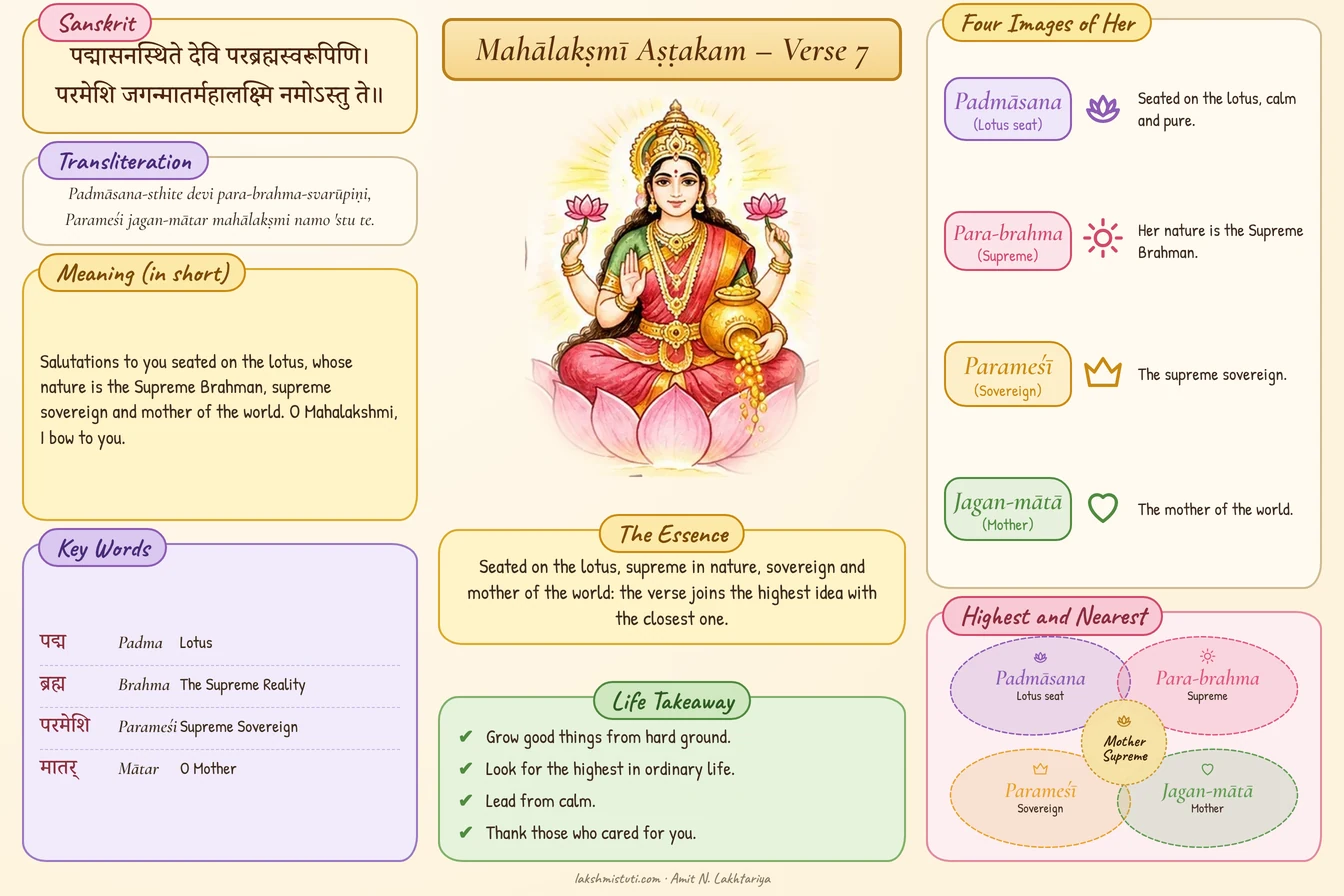
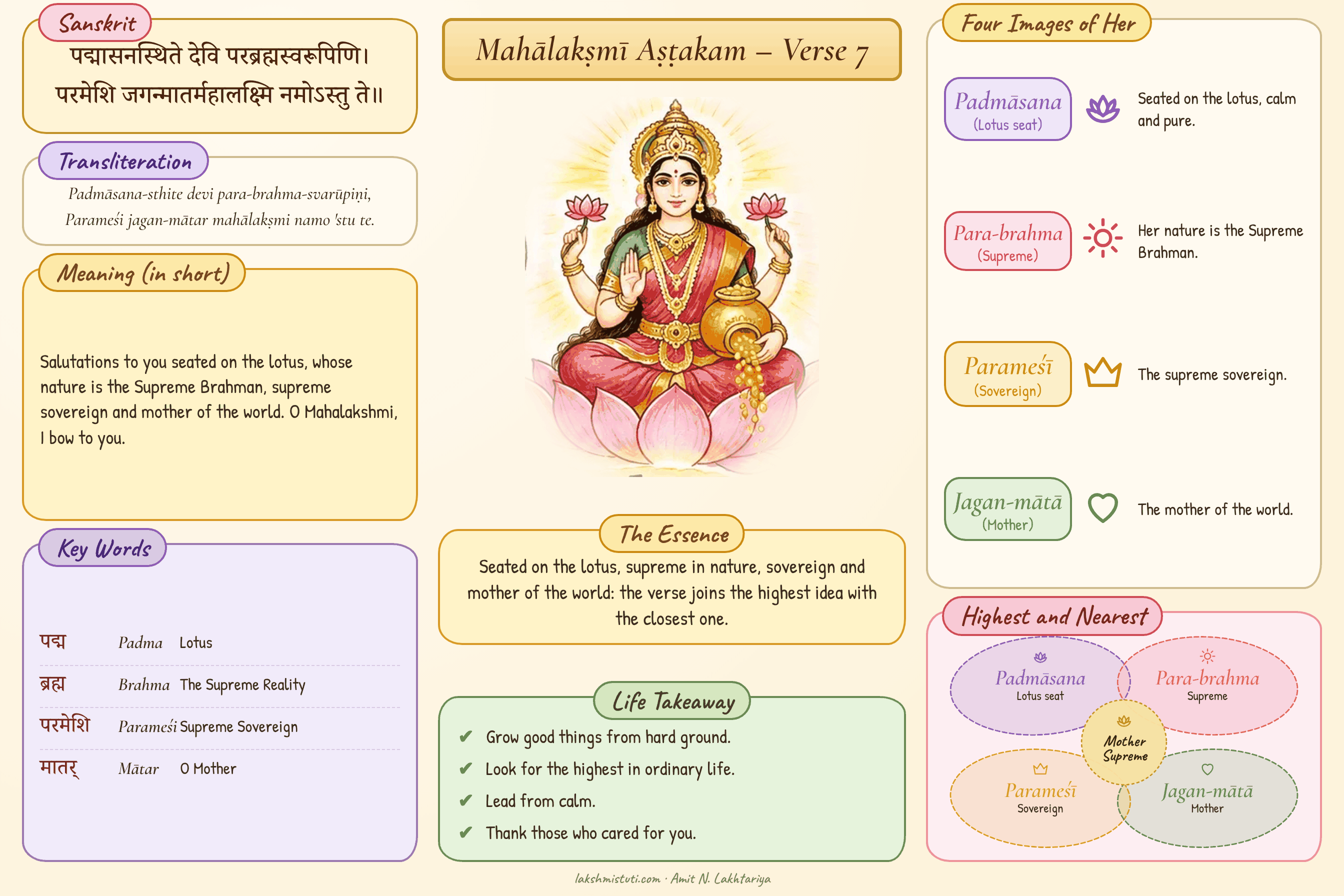
A one-page summary of the verse: Sanskrit, meaning, key ideas, key words and a takeaway. On a phone, open it full screen.
Word-by-word meaning
The literal meaning of each word.
| Sanskrit | Meaning |
|---|---|
| पद्मासनस्थितेPadmāsana-sthite | O you who are seated on a lotus seat |
| परब्रह्मस्वरूपिणिPara-brahma-svarūpiṇi | O you whose nature is the Supreme Brahman |
| परमेशिParameśi | O Supreme Sovereign |
| जगन्मातःJagan-mātaḥ | O Mother of the world |
| महालक्ष्मिMahālakṣmi | O Mahalakshmi |
Notes on each word
Padma is lotus; āsana is seat; sthita is seated.
Para-brahma is the Supreme Reality; svarūpa is own form or nature.
Parama is supreme; īśī is a ruler, a feminine form.
Jagat is the world; mātṛ is mother.
The refrain.
Deeper spiritual insights
Interpretation and reflection: ideas that help us read the verse, not part of the text itself.
In simple words
Two images come together: the Goddess on her lotus seat, and the Goddess as the Supreme Reality itself. Lakshmi is not only a figure in a story; here she is named as the ultimate.
The lotus seat
The lotus grows in mud yet stays clean, which is why it has long stood for purity and for being at ease in the world. To place the Goddess on a lotus is to say that prosperity and purity belong together.
Mother of the world
Jagan-mātā is a warm title. It means that the Supreme is also a mother: someone from whom we are not separate and to whom we can speak directly. Many devotees find this the most approachable image in the hymn.
Practical meditation
- Minute 1Sit and settle.
- Minute 2Picture a lotus resting on still water.
- Minute 3Recite the verse and let the word “mother” soften the recitation.
- Minute 4Rest quietly.
Reflection for today
What would it mean to approach prosperity the way a lotus approaches water: at home in it, but not stained by it?
The seventh verse joins the highest philosophy with the warmest title: Supreme Brahman, and mother. Both are meant to be held together.
This meditation is a devotional practice for attention and reflection; it does not promise a supernatural result or guarantee material wealth.