Home › Śrī Sūktam › Verse 8
The verse
॥ ऋचा ८ ॥
क्षुत्पिपासामलां ज्येष्ठामलक्ष्मीं नाशयाम्यहम्।
अभूतिमसमृद्धिं च सर्वां निर्णुद मे गृहात्॥
॥ श्री महालक्ष्म्यै नमः ॥
Kṣut-pipāsā-malāṁ jyeṣṭhām alakṣmīṁ nāśayāmy aham,
Abhūtim asamṛddhiṁ ca sarvāṁ nirṇuda me gṛhāt.
Meaning in short
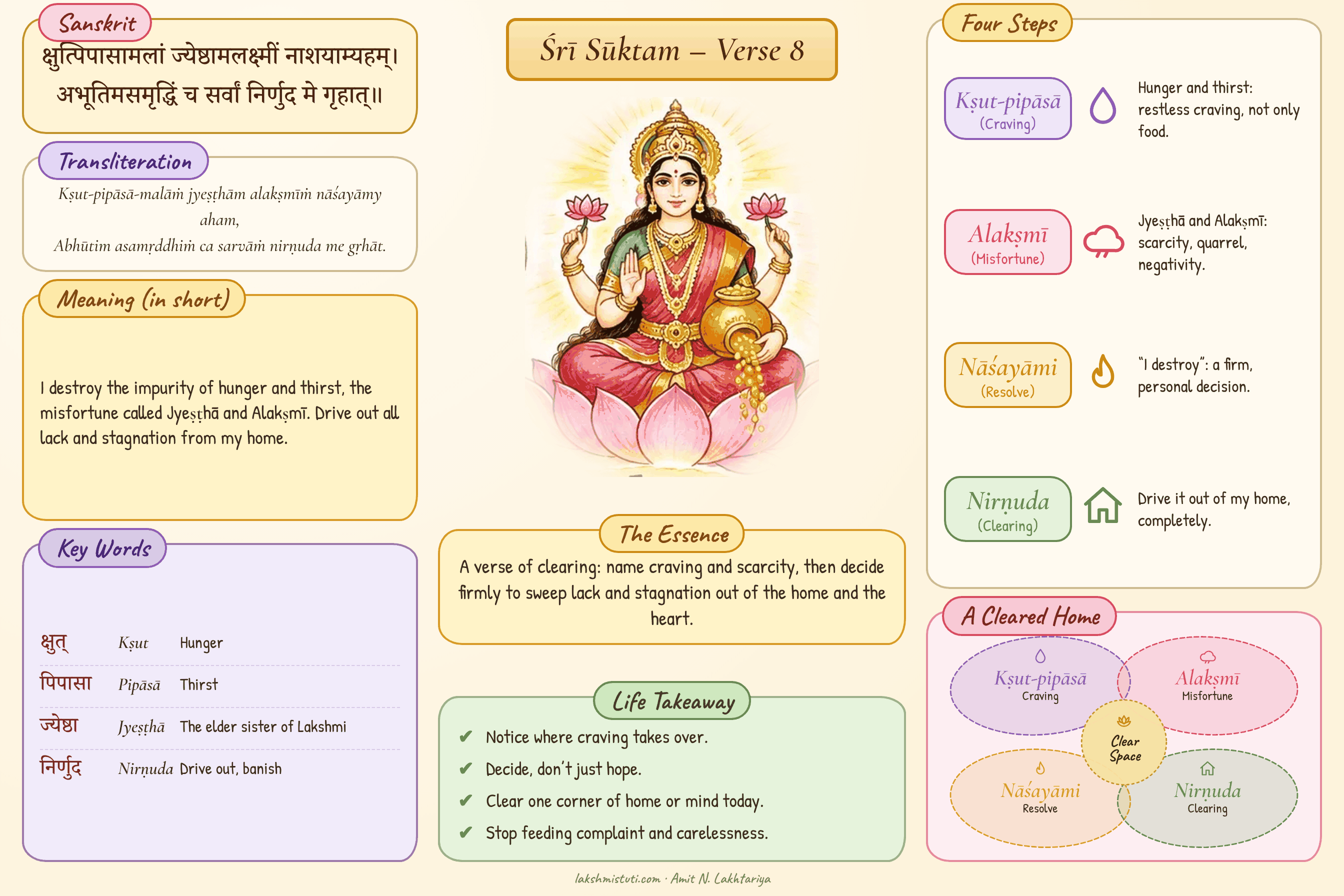
I remove and destroy all impurity born of hunger, thirst, craving and dissatisfaction, the misfortune represented by Jyeṣṭhā and Alakṣmī. I drive out all poverty, stagnation and failure from my home and my life, completely.
A verse of clearing: name craving and scarcity, then decide firmly to sweep them out of home and heart.
Key highlights
- Kṣut-pipāsā Craving: hunger and thirst of restless wanting
- Alakṣmī Misfortune: scarcity and quarrel, the opposite of Śrī
- Nāśayāmi Resolve: “I destroy”, a firm personal decision
- Nirṇuda Clearing: drive it out of home and life
Explore the four steps
Tap a card to open its meaning and a question to carry with you.
Kṣut-pipāsāCraving
Kṣut-pipāsā is hunger and thirst. The commentary reads them as more than physical: greed, dissatisfaction and endless wanting. Where the mind keeps saying “not enough”, prosperity is said not to stay.
Pause and reflect: Where does “not enough” keep speaking in my mind?
AlakṣmīMisfortune
Jyeṣṭhā, the elder sister, and Alakṣmī stand for scarcity, quarrels, dirt and negativity, the opposite of Lakshmi. The commentary says they take root where there is constant complaint, discontent or carelessness.
Pause and reflect: What habit of complaint or carelessness could I stop feeding?
NāśayāmiResolve
Nāśayāmy aham means “I destroy”. It is first person and firm, not “I hope”. You are not asking someone else to clean your space; the decision is your own.
Pause and reflect: What am I ready to decide today, rather than hope for?
NirṇudaClearing
Nirṇuda is a command to drive out, and me gṛhāt means from my home. Abhūti and asamṛddhi, lack and stagnation, are included. The commentary reads it as no longer tolerating scarcity thinking, doubt and fear.
Pause and reflect: Which corner of my home or mind needs clearing first?
Sketch note
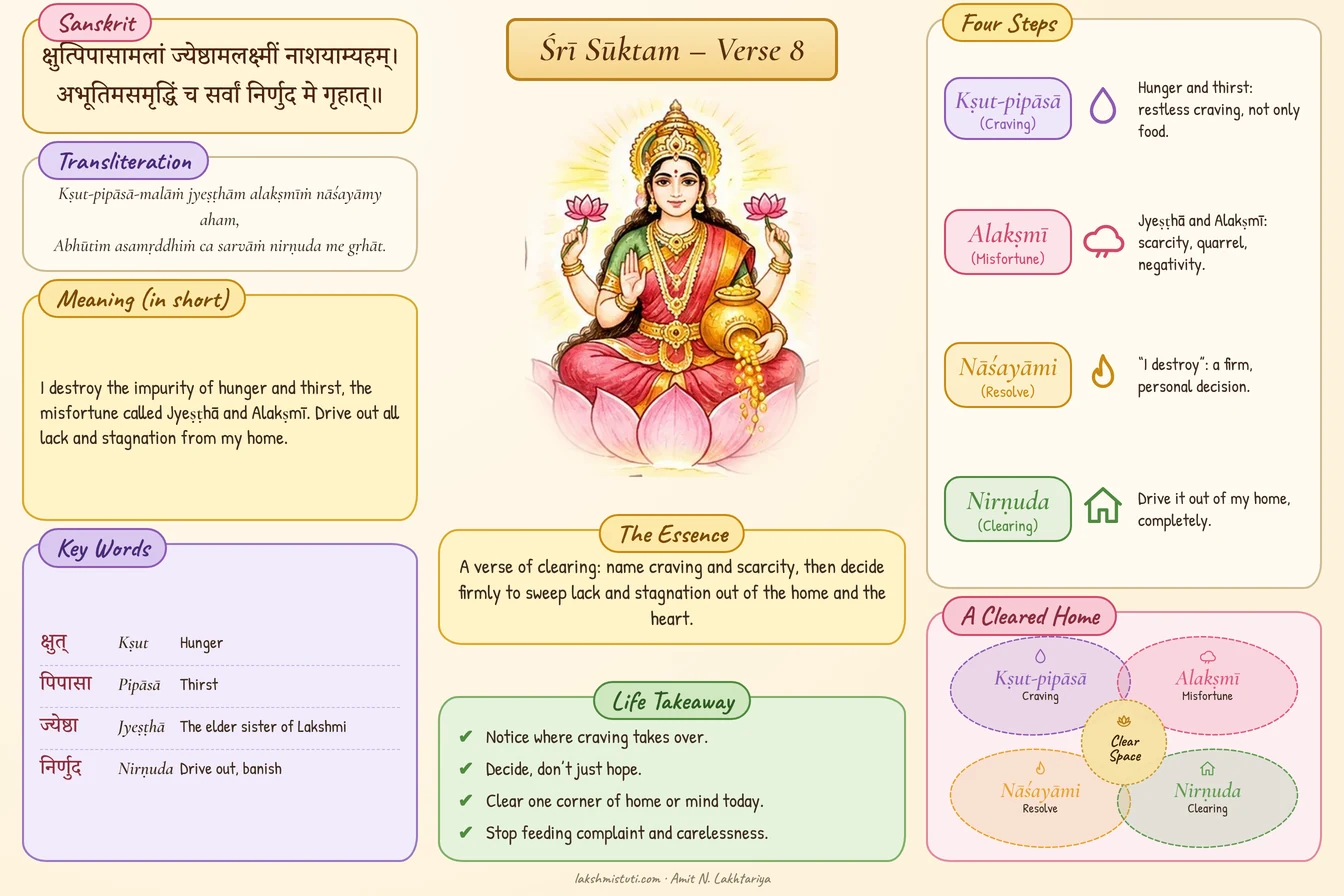
A one-page summary of the verse: Sanskrit, meaning, key ideas, key words and a takeaway. On a phone, open it full screen.
Word-by-word meaning
The literal meaning of each word.
| Sanskrit | Meaning |
|---|---|
| क्षुत्पिपासामलाम्Kṣut-pipāsā-malāṁ | That which is impure due to hunger (kṣut) and thirst (pipāsā) |
| ज्येष्ठाम्Jyeṣṭhām | The elder sister (of Lakshmi) |
| अलक्ष्मीम्Alakṣmīṁ | Misfortune |
| नाशयाम्यहम्Nāśayāmy aham | I destroy, remove and eliminate |
| अभूतिम्Abhūtim | Absence of prosperity; poverty |
| असमृद्धिं चAsamṛddhiṁ ca | And lack of growth |
| सर्वाम्Sarvāṁ | All of it, without exception |
| निर्णुदNirṇuda | Drive out, banish, remove forcefully |
| मे गृहात्Me gṛhāt | From my home |
Notes on each word
It also symbolises constant want, craving and dissatisfaction.
Jyeṣṭhā is the elder sister of Lakshmi. In symbolism, she represents poverty, misfortune and quarrelsomeness: Alakṣmī’s form.
All forms of misfortune, scarcity, poverty and negativity.
Through this prayer and intention.
Stagnation and failure.
My life, my household, my heart.
Deeper spiritual insights
Interpretation and reflection: ideas that help us read the verse, not part of the text itself.
Kṣut-pipāsā: the root of lack
Hunger and thirst here are not just physical. They symbolise greed, dissatisfaction and endless wanting. Prosperity never stays in a place of constant craving and restlessness. If the mind is forever saying “I want this, I want that, it is not enough”, then no matter how much Lakshmi comes, she will not stay. Lakshmi loves peaceful, content spaces; a heart with a hole of dissatisfaction can never stay full. Reflection: am I living in contentment, or constantly feeling “not enough”?
Jyeṣṭhā and Alakṣmī: energies of negativity
The verse teaches that misfortune and scarcity are energies. They can take root and spread if not consciously removed. Jyeṣṭhā Devī is considered the embodiment of quarrels, scarcity, dirt and negativity, the opposite of Lakshmi. Where there is constant complaining, fighting, discontent, laziness or carelessness, that energy takes over. Reflection: are there negative patterns, complaints or toxic habits in my home or mind that I need to drive out?
Nāśayāmy aham: “I destroy”, not “I hope”
Notice the force of the words. It is a personal decision. You are not asking someone else to clean your space; you stand up and say, I will remove these energies from my mind, heart and home.
Abhūtim and Asamṛddhiṁ: poverty in every form
Not just poverty of money, but poverty of thought, love, creativity and possibility: poverty of wealth, of ideas, of relationships and of courage, and stagnation, being stuck in one place with no growth. Reflection: where am I tolerating “lack” in my thinking or surroundings?
Nirṇuda: a forceful command
This is not a meek request. It is a command to banish. It is like saying, “Enough! I will not allow scarcity and negativity to live here any more,” and sweeping out the dust and shutting the door behind it. Sometimes prosperity comes when we stop tolerating scarcity-thinking and firmly remove doubt, fear and negativity.
Practical meditation
- Close your eyes and visualise your home as a bright, clean space.
- Imagine all the dark clouds of fear, scarcity, complaints, laziness and negativity being swept out, like dust being thrown out of a sacred temple.
- Whisper with authority and conviction: “May all misfortune, stagnation and negativity leave my life now. My home and heart are sanctuaries of light, growth and abundance.”
- A simple practice: light a lamp in your home, in silence. Say aloud, “All scarcity, all doubt, all negativity, I ask you to leave. My home is now pure, blessed and filled with light.” Feel the shift in energy.
Reflection for today
What patterns of scarcity, complaining or doubt do I need to stop tolerating? What clutter, mental, emotional or physical, do I need to clean from my home and mind? How can I cultivate a home environment that attracts divine abundance? In real life: if there is clutter in the house, clear it, because Lakshmi loves cleanliness and order. If there are negative conversations, gossip or complaints every day, stop them. If your mind has fear-based thoughts about money, replace them with faith-based affirmations. If you have been procrastinating, take a small, clear action.
This verse teaches that before prosperity can truly reside, scarcity and negativity must be firmly removed. It is a cleansing, not just of home and surroundings but of mindset, attitude and heart-space. Before asking Lakshmi to enter, clean the inner temple. Remove restlessness, negativity, poverty-thinking, laziness and complaints. Then abundance flows like a river that never dries.