Home › Śrī Sūktam › Verse 7
The verse
॥ ऋचा ७ ॥
उपैतु मां देवसखः कीर्तिश्च मणिना सह।
प्रादुर्भूतोऽस्मि राष्ट्रेऽस्मिन्कीर्तिमृद्धिं ददातु मे॥
॥ श्री महालक्ष्म्यै नमः ॥
Upaitu māṁ deva-sakhaḥ kīrtiś ca maṇinā saha,
Prādurbhūto ’smi rāṣṭre ’smin kīrtim ṛddhiṁ dadātu me.
Meaning in short
May the friend of the gods (the divine treasurer Kubera), along with honour and shining brilliance, approach me. Having manifested in this society and this life, may I be blessed with both good reputation and steady prosperity.
Prosperity is asked for with honour: a companion of the gods, a good name and steady growth in society.
Key highlights
- Deva-sakhaḥ Companion: the friend of the gods, in line with dharma
- Kīrti Honour: a good name, with jewel-like brilliance
- Rāṣṭra Society: prosperity that lifts the people around
- Ṛddhi Growth: steady advancement with integrity
Explore the four ideas
Tap a card to open its meaning and a question to carry with you.
Deva-sakhaḥCompanion
Deva-sakhaḥ means friend of the gods, here understood as Kubera, the divine treasurer. The commentary reads it as divine companionship: abundance that comes from living in line with dharma, not from selfish accumulation.
Pause and reflect: Would I be at ease explaining how I earn to someone I respect?
KīrtiHonour
Kīrti is honour and good reputation, and the verse pairs it with maṇi, the brilliance of a jewel. The commentary says prosperity without honour is hollow.
Pause and reflect: Will my pursuit of prosperity earn respect in my family and community?
RāṣṭraSociety
Rāṣṭre ’smin: in this society, in this land. The verse places the speaker among others. Prosperity here is not for isolation but for lifting the world around us.
Pause and reflect: How is what I have helping my family and community?
ṚddhiGrowth
Ṛddhi is growth and steady advancement. With kīrti it forms the two wings of abundance: a good name and real progress.
Pause and reflect: Am I growing in a way that keeps my integrity intact?
Sketch note
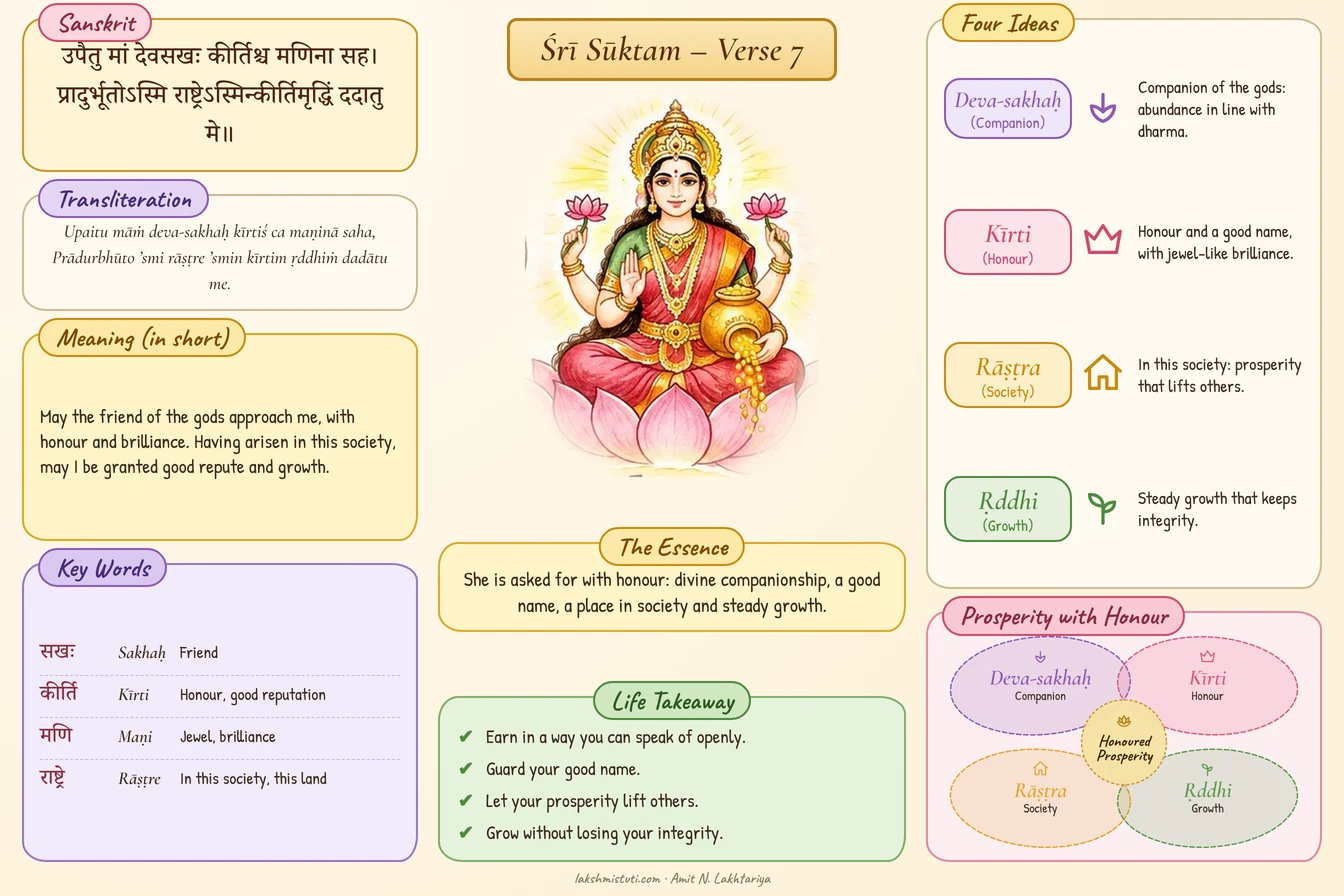
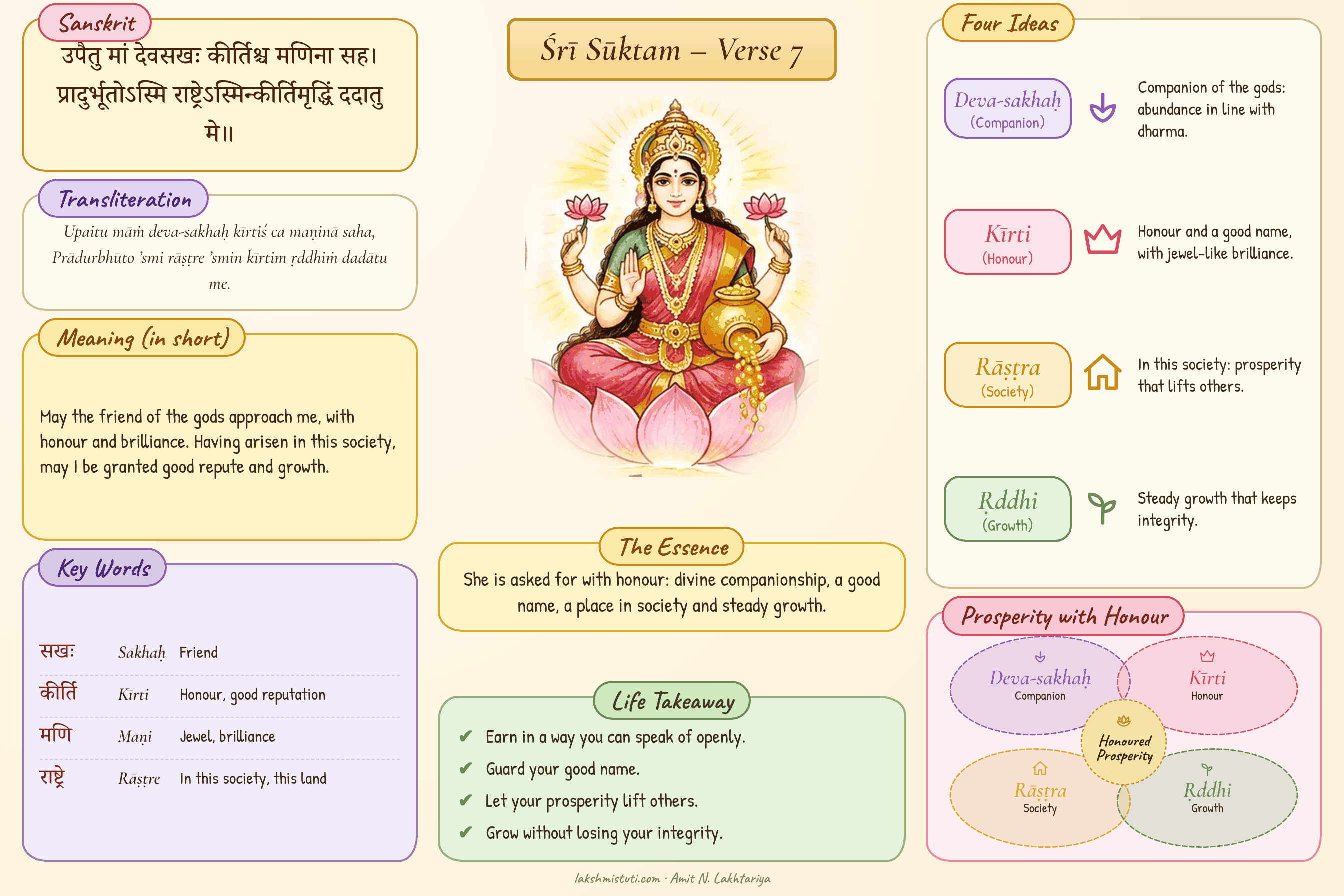
A one-page summary of the verse: Sanskrit, meaning, key ideas, key words and a takeaway. On a phone, open it full screen.
Word-by-word meaning
The literal meaning of each word.
| Sanskrit | Meaning |
|---|---|
| उपैतुUpaitu | May he (that divine force) approach me, come near me |
| मांMāṁ | Me; in my life |
| देवसखःDeva-sakhaḥ | The friend of the gods |
| कीर्तिः चKīrtiś ca | And fame, honour, good reputation |
| मणिना सहMaṇinā saha | Along with brilliance (like a jewel) |
| प्रादुर्भूतः अस्मिPrādurbhūto ’smi | I have arisen; I have become manifest |
| राष्ट्रे अस्मिन्Rāṣṭre ’smin | In this kingdom, in this land, in this society |
| कीर्तिम्Kīrtim | Honour, fame, good repute |
| ऋद्धिम्Ṛddhiṁ | Growth, prosperity, success; spiritual and material advancement |
| ददातु मेDadātu me | May it be granted to me |
Notes on each word
This is often interpreted as Kubera, the divine treasurer, one who manages wealth with righteousness and wisdom.
Some commentators also see Kīrti as the goddess of fame who comes with Kubera.
Accompanied by splendour and brilliance. Some commentators read maṇi as Maṇibhadra, the companion of Kubera.
In essence, a declaration of stepping into one’s rightful place, presence and responsibility.
It signifies prosperity and recognition not in isolation, but within the community, society or nation.
Deeper spiritual insights
Interpretation and reflection: ideas that help us read the verse, not part of the text itself.
“The friend of the gods” (Deva-sakhaḥ)
This is not just about material wealth; it is about divine companionship and guidance. True abundance does not come from selfish accumulation. It comes from aligning oneself with dharma (divine order) and being a friend to divine energies.
Honour and splendour (Kīrti and Maṇinā saha)
Prosperity without honour is hollow. The verse asks not just for wealth, but for respect, dignity and brilliance. Reflection: is my pursuit of prosperity guided by values that will earn respect in my community and family?
Living in society (Rāṣṭre ’smin)
Prosperity is not for isolation, but for uplifting the world around you. Reflection: how am I contributing to my family, my society and my country through the prosperity I am blessed with?
Good reputation (Kīrtim) and growth (Ṛddhim)
These are the two wings of true abundance: honour and steady advancement. Reflection: am I balancing growth with integrity?
Practical meditation
- Visualise yourself standing in a beautiful, radiant space, with golden light around you.
- See yourself surrounded by Kubera, the divine treasurer, Goddess Lakshmi and wise elders, all smiling at you as if blessing your actions.
- Feel honour, respect and growth radiating from you, blessing your family, your community and beyond.
- Meditate on this affirmation: “May divine companionship, honour and splendour walk beside me. In this world and community where I live and act, may I earn respect and steady, righteous prosperity.”
Reflection for today
How do I define prosperity beyond wealth? Am I building a life where people will respect me long after I have left the room? What contribution can I make to my surroundings to make my success meaningful?
This verse teaches us that prosperity is not just about gold in the vault. It is about honour in the heart, respect in the community and righteousness in action.