Home › Śrī Sūktam › Verse 5
The verse
॥ ऋचा ५ ॥
चन्द्रां प्रभासां यशसा ज्वलन्तीं श्रियं लोके देवजुष्टामुदाराम्।
तां पद्मिनीमीं शरणमहं प्रपद्येऽलक्ष्मीर्मे नश्यतां त्वां वृणे॥
॥ श्री महालक्ष्म्यै नमः ॥
Chandrāṁ prabhāsāṁ yaśasā jvalantīṁ śriyaṁ loke devajuṣṭām udārām,
Tāṁ padminīm īṁ śaraṇam ahaṁ prapadye alakṣmīr me naśyatāṁ tvāṁ vṛṇe.
Meaning in short
I surrender myself to that radiant, moon-like, luminous Goddess Lakshmi, who shines with fame, grace and generosity, adored by the gods and revered by all. I take refuge in this lotus-bearing Goddess. May all misfortune vanish from my life; O Divine Lakshmi, I choose you and your grace alone.
After praising her glory and generosity, the verse turns personal: I take refuge, let go and choose.
Key highlights
- Udārā Generous: glory that lifts others too
- Śaraṇam Refuge: do your part, then surrender the result
- Alakṣmī Let go: misfortune and the habits that feed it
- Tvāṁ vṛṇe Choose: I choose you, a conscious daily choice
Explore the four steps
Tap a card to open its meaning and a question to carry with you.
UdārāGenerous
Udārā means generous and magnanimous. The commentary reads her glory as the kind that radiates and uplifts others, so generosity is part of prosperity, not a subtraction from it.
Pause and reflect: Where could I be more open-handed this week?
ŚaraṇamRefuge
Śaraṇam ahaṁ prapadye: I take refuge in her. We do our part, the commentary says, and then surrender the outcome to grace. Effort and surrender are held together.
Pause and reflect: What can I do my best on, and then let go of?
AlakṣmīLet go
Alakṣmī is misfortune, the opposite of Śrī. The commentary reads it as scarcity thinking, bad habits, laziness and unethical actions that block abundance, and the prayer is for these to vanish.
Pause and reflect: Which one habit would I most like to let go of?
Tvāṁ vṛṇeChoose
Tvāṁ vṛṇe: I choose you. The verse ends in a conscious choice. In the commentary’s reading, prosperity and misfortune are both energies that we can invite or turn away.
Pause and reflect: What am I choosing in my thoughts, words and actions today?
Sketch note
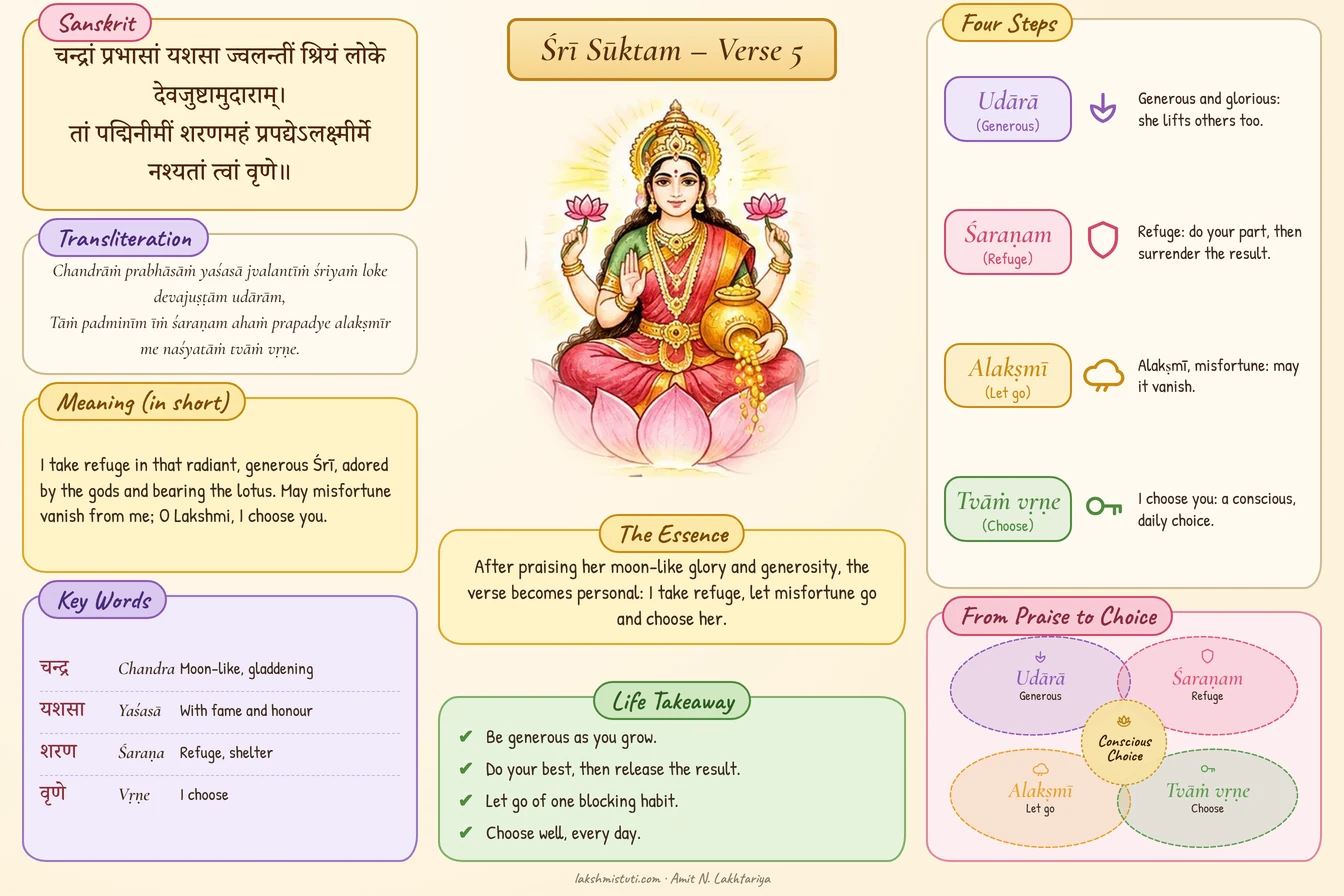
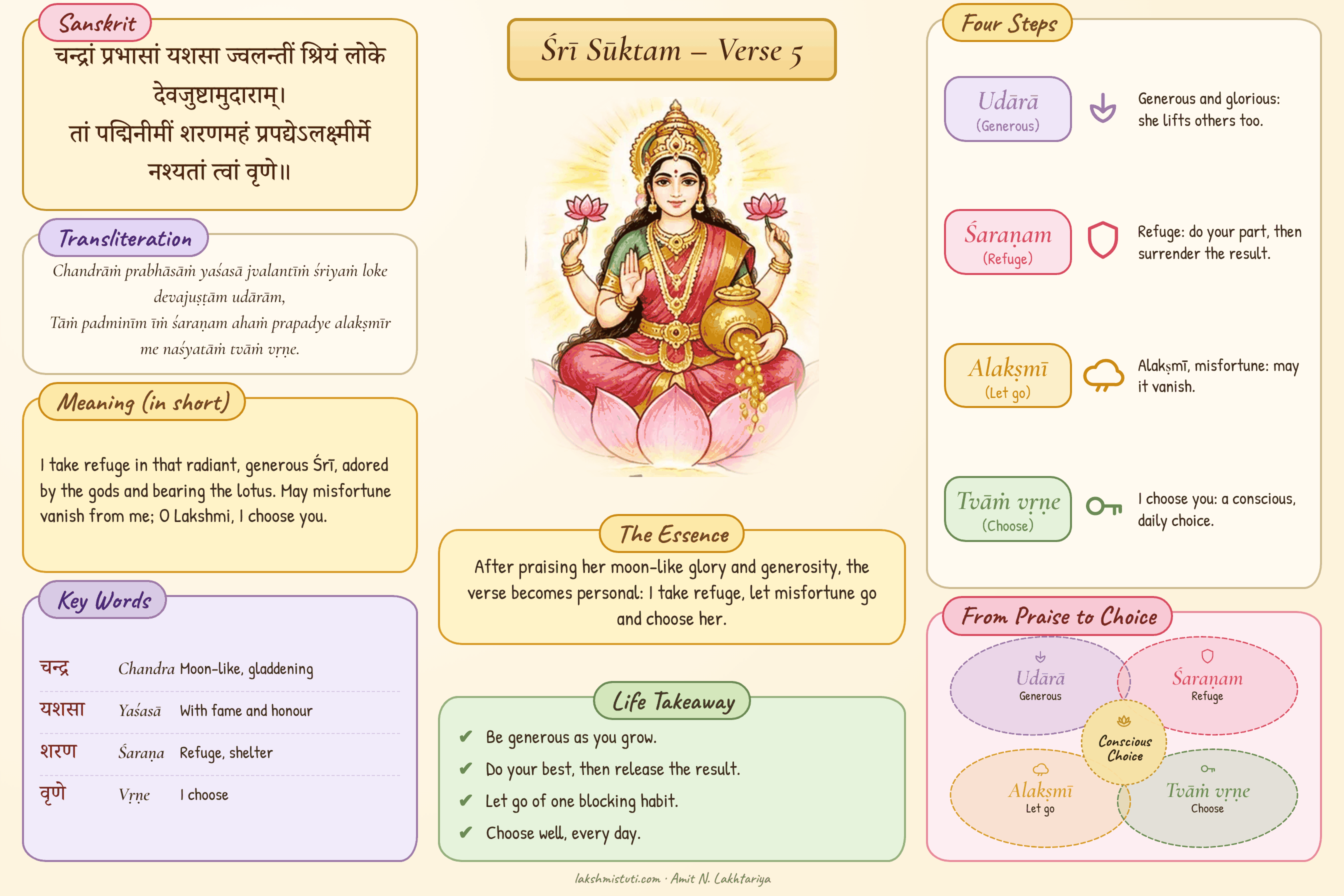
A one-page summary of the verse: Sanskrit, meaning, key ideas, key words and a takeaway. On a phone, open it full screen.
Word-by-word meaning
The literal meaning of each word.
| Sanskrit | Meaning |
|---|---|
| चन्द्राम्Chandrāṁ | Shining and gladdening, moon-like |
| प्रभासाम्Prabhāsāṁ | Full of brilliant light |
| यशसा ज्वलन्तीम्Yaśasā jvalantīm | Glowing with fame, success and honour |
| श्रियं लोके देवजुष्टाम्Śriyaṁ loke devajuṣṭām | That Śrī (Lakshmi), adored in the world and favoured by the gods themselves |
| उदाराम्Udārām | Generous, magnanimous |
| तां पद्मिनीम्Tāṁ padminīm | That lotus-bearing Goddess |
| शरणमहं प्रपद्येŚaraṇam ahaṁ prapadye | I take refuge in her; I surrender myself at her feet |
| अलक्ष्मीर्मे नश्यताम्Alakṣmīr me naśyatām | May all forms of misfortune (Alakṣmī) disappear from my life |
| त्वां वृणेTvāṁ vṛṇe | I choose you (O Lakshmi); I seek you alone |
Notes on each word
Symbolises coolness, beauty, purity, emotional calm and grace.
Refers to divine brightness, an inner spiritual glow.
True prosperity brings not just wealth, but respect and renown earned through good deeds.
True abundance is never stingy; it is generous, open-hearted and sharing.
The small word īṁ that follows is a Vedic particle of emphasis, usually left untranslated.
This is the deepest gesture of trust and humility, acknowledging that divine grace guides prosperity.
Alakṣmī is the opposite of Lakshmi: poverty, scarcity, misfortune and negativity.
A conscious choice to align with prosperity, grace and righteousness, rejecting all that is inauspicious.
Deeper spiritual insights
Interpretation and reflection: ideas that help us read the verse, not part of the text itself.
Choosing prosperity consciously (Tvāṁ vṛṇe)
The verse teaches us that prosperity and misfortune are both energies we choose to invite or reject. Reflection: am I consciously choosing prosperity in thought, word and action every day?
The removal of Alakṣmī (misfortune)
Prosperity is not just about attracting good; it is about cleansing negativity: scarcity mindsets, bad habits, laziness or unethical actions that block abundance. Reflection: what “Alakṣmī” habits or energies do I need to consciously let go of today?
Magnanimity and generosity (Udārām)
True wealth radiates and uplifts others. Generosity amplifies prosperity. Reflection: where can I be more giving and open-hearted in my life?
Surrender (Śaraṇam ahaṁ prapadye)
We do our part, but then we surrender the outcome to divine grace. Prosperity flows best when action meets surrender.
Practical meditation
- Close your eyes and visualise the radiant form of Goddess Lakshmi, soft as moonlight yet brilliantly glowing.
- See her holding a lotus, smiling with compassion and generosity.
- Whisper softly in your heart: “O Divine Mother, I surrender at your feet. May all misfortune dissolve. May I embody light, grace, generosity and abundance. I choose you and your path.”
Reflection for today
What negative patterns (Alakṣmī) am I willing to consciously let go of? Where can I express more generosity (Udārām)? How can I trust and surrender more, while still taking inspired action?
This verse is a powerful turning point. You are not just calling prosperity; you are declaring your conscious alignment with it, and rejecting scarcity, fear and negativity.